Issue 63, Fall 1975
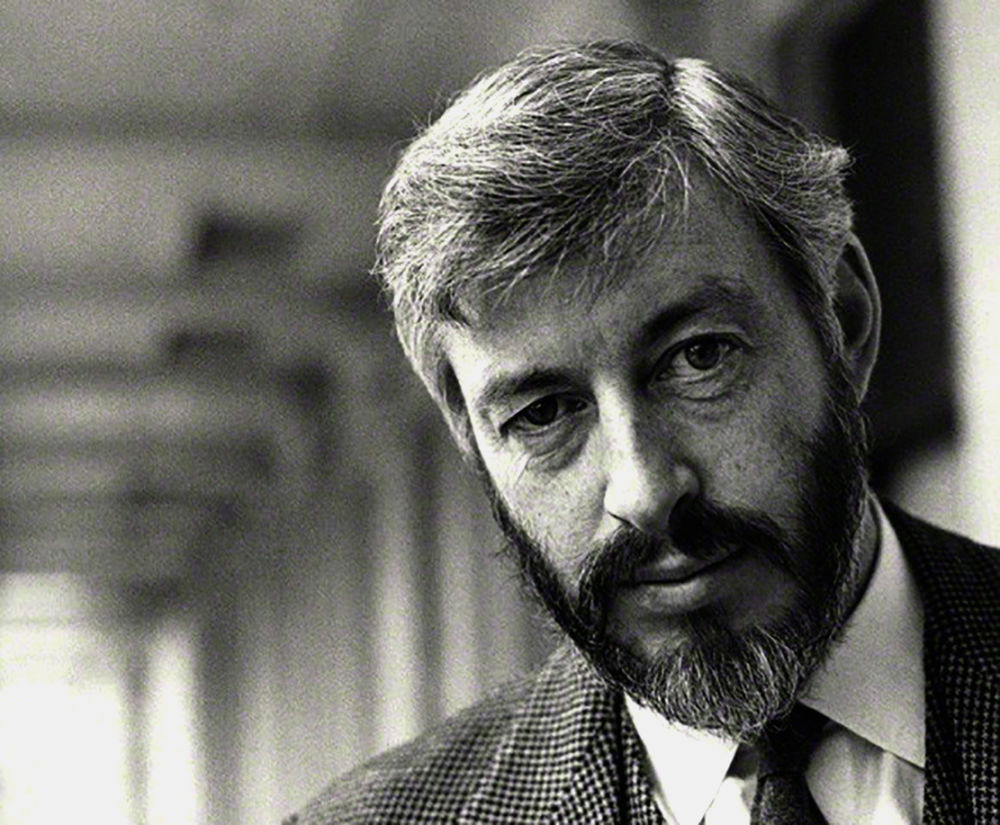 © National Portrait Gallery, London
This interview took place in March 1975 in New York City in a large apartment overlooking the East River. Mr. Donleavy was in the United States to deliver the manuscript of his latest book, The Unexpurgated Code, to his publisher, Seymour Lawrence, in Boston.
We watched from the window as he strode purposefully down the center of Seventy-second Street to the fence overlooking the river and stood there for some time before he rang the bell. He told us later that he often used to come to that place on his meanderings about the city and that it figures in his second novel, A Singular Man.
Donleavy is a slight man with a long nose and sad green eyes. He sat near the window as we talked, and the light shone through his thin gray beard, making him seem somehow fragile—a quality he does not otherwise exude. He feels that of all his characters he most resembles George Smith, of A Singular Man. Though born in Brooklyn and raised in the Bronx, he speaks with a British accent and uses British slang. During both sessions he drank orange juice continually and ate only a small portion of food. He keeps trim by daily exercise—swimming and workouts at The New York Athletic Club when he is in New York or on his own farming estate in Ireland, where he has lived since 1969.
Mr. Donleavy’s first novel, The Ginger Man, was published in June 1955. His subsequent novels have been A Singular Man (1963), The Saddest Summer of Samuel S (1966), The Beastly Beatitudes of Balthazar B (1968), The Onion Eaters (1971), and A Fairy Tale of New York (1973). His collection of short stories, Meet My Maker the Mad Molecule, was published in 1964. His plays, adapted from his novels, are The Ginger Man, Fairy Tales of New York, A Singular Man, and The Saddest Summer of Samuel S. They have all been produced in London and New York. The Unexpurgated Code: A Complete Manual of Survival and Manners, will be published this summer.
INTERVIEWER
Did you always know you would be a writer?
J. P. DONLEAVY
I wrote poetry at an early age but I didn’t get that driving desire to be a writer until I was at Trinity College in Dublin.
INTERVIEWER
How did that happen? Weren’t you a successful painter at that point?
DONLEAVY
I had had three exhibitions of my paintings in Dublin and having more or less exhausted the Irish art world, I traveled to London with some pictures and went to a gallery. One or two of the gallery’s owners were very impressed with the work, but said I wasn’t famous, and therefore, it didn’t matter that my pictures were striking and original. Not being famous, I wasn’t entitled to have anyone recognize them or me.
I realized that the only way you could ever tackle the world was to write something that no one could hold off, a book that would go everywhere, into everyone’s hands. And I decided then to write a novel that would shake the world. I shook my fist and said I would do it. “That’s what I’m going to do, and no one’s going to stop me.” I did that again and again and again. Still do it.
INTERVIEWER
So you started writing The Ginger Man while you were at Trinity?
DONLEAVY
I had just left. I’d moved to the cottage I had in Kilcoole, County Wicklow. I had built a sunporch on to it and I remember forcing myself day after day to sit at this little makeshift table on the porch. It took me seven days to get the first page and a half. I wouldn’t give up; I kept at it and at it. After about ten days, I finally managed to write about two or three pages. Then I fought and smashed and pressed on. Driving myself for several hours a day. After I’d written about thirty or forty pages, it suddenly began to ease up a lot. And then the book actually began to take on a slight personality of its own, which helped me a bit. I kept on going until I had about 140 pages.
INTERVIEWER
Did you finish the book at your cottage?
DONLEAVY
No. I wrote some on the Isle of Man and then came to America and wrote it for a year in the United States. Being out of Ireland provided a very helpful distance. My mother lives up in the Bronx and I wrote a lot of it there. I also wrote a lot of it in the West End of Boston—a little place called Poplar Street, which they’ve subsequently pulled down. It was a slum, between the back of Beacon Hill and the Charles, just to the side of the Mass. General Hospital. It’s totally gone. In those days it was a fantastic ghetto where you had the whore coming home at night, and the baker across the street. I lived there in those days for eleven dollars a week, and didn’t really want for much at all. My biggest luxury was a nickel for The New York Times. I would buy a copy and walk to the Public Gardens and read for an hour.
INTERVIEWER
How did you motivate yourself?
DONLEAVY
That was easy. It was simply money and fame. I was aware as anyone is, that in this world you can just be swept away. I’m aware of this just as much now. New York is a great place to be reminded of it. You arrive here, and Good Lord, you find out in ten seconds that nothing whatever matters, especially your own small life. So I knew I had to write a book that would be the best work in the world. It was that simple.
INTERVIEWER
What is it that makes one have that confidence? Is it just exuberance?
DONLEAVY
It could be gross stupidity.
INTERVIEWER
How did it manifest itself? Did you tell your mother?
DONLEAVY
Yes. I used to declare it openly to everybody when I was totally unpublished. The first thing anyone asks you in America is: What have you published? I’d published nothing (laughs) but I used to declare quite openly who I was, what I was. I had incredible nerve. What happens, I think, with a heavy, feverish desire is that the imagination will supply for that desire an impetus so that it can be carried out. Your imagination drives you with this burning fever. You’re looking for some one person out there somewhere who will one day hear your voice and suddenly write back. After you’re a published and accepted author, you don’t have this as an energy anymore.
INTERVIEWER
Did the success of The Ginger Man inhibit your later output?
DONLEAVY
No. I was never affected because The Ginger Man wasn’t a success. It amounted to nothing whatever! It took about eight years from its publication in 1955 to 1962 or ’63 before it ever began to make its way, to get any kind of wide recognition.
INTERVIEWER
How did you get it published, this book that was going to make you famous?
DONLEAVY
When I was still working on the manuscript in 1952, I came across John Hall Wheelock's name. He was an editor at Scribner’s, and I knew a man of this same or similar name who had taught me English at the Naval Academy Preparatory School in Maryland and who had admired my writing then and was also in publishing. I wrote a letter to Wheelock to this effect. He wasn’t in fact the same man, but he wrote me back and said, just as an editor obviously would, “If you’ve got a book, we’d love to see it.” So I took the manuscript to Scribner’s and after a few weeks Wheelock called me in. He said, “We’ve all read the manuscript here. Three of our editors think it is one of the best manuscripts ever brought to this publishing house. The fourth thinks it’s the best manuscript she’s ever come across. But I don’t think we can publish it.” This was because they had published From Here to Eternity, and it had brought them so much trouble and difficulty with its scatology that they were not eager to go through it again. And apparently the young Mr. Scribner who’d taken over the firm was less liberal than the old man. So the editors were less likely to stick their necks out to say, “You must publish this book.” Well, when I got that reaction from Scribner’s—and this was in the McCarthy era, I was aware that it was the end of the road. I realized that if I couldn’t get it published with that kind of terrific reception, then it couldn’t get published. Wheelock gave me the name of an agent who didn’t believe that Wheelock had even seen me, and when he read a sample of the book thought it was most uninteresting and “very unlikely anyone would publish it.” Random House also turned it down. Wheelock did say that I should come back if I could remove some of the objectionable parts. I did bring it back to Scribner’s later but I hadn’t removed a thing, and Wheelock sympathetically, I think, realized that obviously I wasn’t going to.
INTERVIEWER
Why wouldn’t you?
DONLEAVY
I had a sense that the book held itself together on the basis of these scatalogical parts. That its life was in these parts. And I was quite aware that cutting them would be severely damaging to it. So, to continue, that summer when I was in Boston, Little, Brown saw it. The editor called me around there on a hot, sweaty afternoon. He sat me a good distance away from his desk, and the manuscript was in a shadowy corner of the room. He leaned back in his chair very nervously and pointed at the manuscript, with his hand trembling, and said, “There’s obscene libel in that book!” So that was the end of Little, Brown.
INTERVIEWER
Did you go back to Ireland then?
DONLEAVY
Things were terrible for me. I spent a great deal of time contemplating in Woodlawn Cemetery. It is the most peaceful place in America and figures in most of my books about this country. It was also the only place I’d meet Gainor Crist, an American at Trinity also returned to the U.S> in whose wake always followed gargantuan horrors. When I left the United States I literally couldn’t speak for about ten weeks. I wrote things down on pieces of paper. I was almost dead. I could barely get on the back of a ship to get out. But things got better. I had a friend in Ireland who after reading the manuscript suggested that he would support me—he had made a lot of money writing. And there was Scribner’s good opinion, and then Brendan Behan suggested I send the book to Olympia Press, which I did, and after some delay and correspondence, they agreed to publish.
INTERVIEWER
You had met Behan during your Trinity days?
DONLEAVY
He was one of the first people I met when I went to Ireland in 1946. He had just been released from prison then. He was in the IRA and was surrounded by his cronies. I met him in Davy Byrnes. As the afternoon’s joke, the two of us were introduced to each other as writers. The Irish really cut you to ribbons. New York and London are on a different level entirely. Once you’ve survived Dublin there’s not much they can do to you anywhere else to cut through your hide.
INTERVIEWER
Had Behan written anything at that point?
DONLEAVY
Not that anybody knew of. Nor had I. But everyone knew that we were interested in writing. So it was a great joke: Ha-ha, we’ll introduce these two guys as writers. Which they did. And Behan and I were outside the pub squaring off to have a fight about five minutes later.
INTERVIEWER
Over what?
DONLEAVY
Over various insults that Behan passed to me, and I may have passed back to him. I would fight anybody. But, sensibly, as soon as we stepped outside, Behan said “We’re not going to fight,” and we didn’t.
Actually, Behan had been the first person to read the manuscript of The Ginger Man. He broke into my cottage when I was away. When I got back I found all my pots and pans and blankets and so on in disarray… and all my shoes gone! There was a small studio where I painted. I went out there looking around and found some scattered sheets of paper and I picked them up and started to read. It said, “Borstal, and so-and-so did this when the screws came.” I said, “Christ! This is Behan. Behan’s been here!” It was the manuscript of Borstal Boy! Then I picked up my own manuscript of The Ginger Man, which was lying next to it, and I saw all these funny little marks: “Leave this in” “Take this out”, and on about page eighty it had BRENDAN BEHAN written across the top of the page. So Behan was the first one to read The Ginger Man and, as a consequence, had sat down to do editorial work on it. This was in about 1949 or ‘50.