Issue 57, Spring 1974
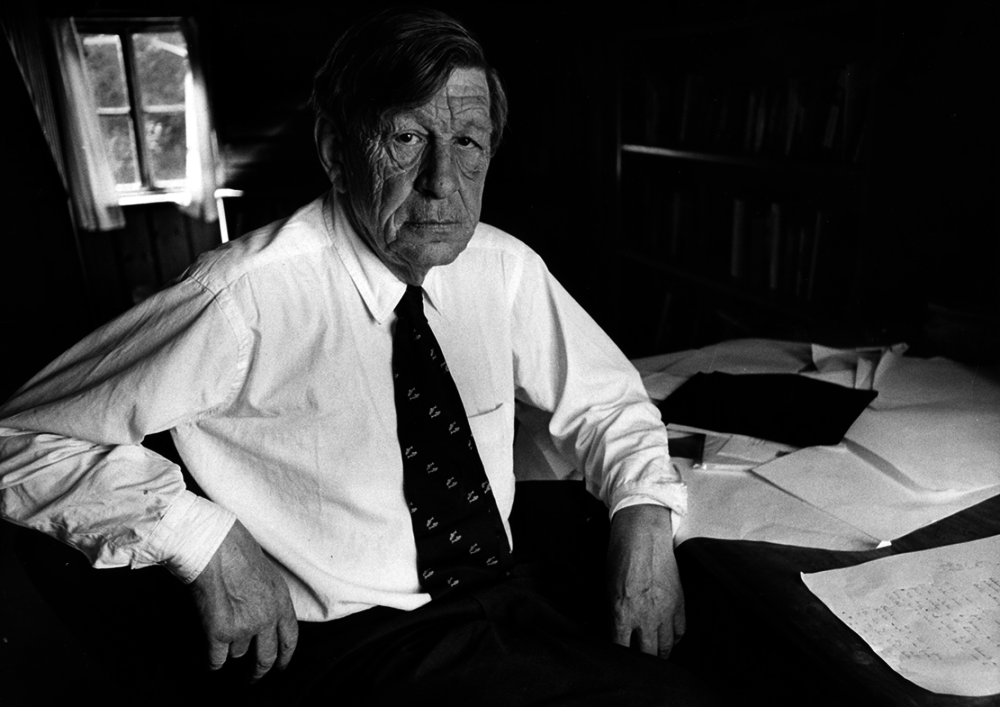
AUDEN
What’s that again?
INTERVIEWER
I wondered which living writer you would say has served as the prime protector of the integrity of our English tongue… ?
AUDEN
Why, me, of course!
—Conversation, Autumn 1972
He was sitting beneath two direct white lights of a plywood portico, drinking a large cup of strong breakfast coffee, chain-smoking cigarettes, and doing the crossword puzzle that appears on the daily book review page of The New York Times—which, as it happened, this day contained, along with his photo, a review of his most recent volume of poetry.
When he had completed the puzzle, he unfolded the paper, glanced at the obits, and went to make toast.
Asked if he had read the review, Auden replied: “Of course not. Obviously these things are not meant for me…”
His singular perspectives, priorities, and tastes were strongly manifest in the décor of his New York apartment, which he used in the winter. Its three large, high-ceilinged main rooms were painted dark gray, pale green, and purple. On the wall hung drawings of friends—Elizabeth Bishop, E. M. Forster, Paul Valéry, Chester Kallman—framed simply in gold. There was also an original Blake watercolor, The Act of Creation, in the dining room, as well as several line drawings of male nudes. On the floor of his bedroom, a portrait of himself, unframed, faced the wall.
The cavernous front living room, piled high with books, was left dark except during his brief excursions into its many boxes of manuscripts or for consultations with the Oxford English Dictionary.
Auden’s kitchen was long and narrow, with many pots and pans hanging on the wall. He preferred such delicacies as tongue, tripe, brains, and Polish sausage, ascribing the eating of beefsteak to the lower orders (“it’s madly non-U!”). He drank Smirnoff martinis, red wine, and cognac, shunned pot, and confessed to having, under a doctor’s supervision, tried LSD: “Nothing much happened, but I did get the distinct impression that some birds were trying to communicate with me.”
His conversation was droll, intelligent, and courtly, a sort of humanistic global gossip, disinterested in the machinations of ambition, less interested in concrete poetry, absolutely exclusive of electronic influence.
As he once put it: “I just got back from Canada, where I had a run-in with McLuhan. I won.”
INTERVIEWER
You’ve insisted we do this conversation without a tape recorder. Why?
W. H. AUDEN
Because I think if there’s anything worth retaining, the reporter ought to be able to remember it. Truman Capote tells the story of the reporter whose machine broke down halfway into an interview. Truman waited while the man tried in vain to fix it and finally asked if he could continue. The reporter said not to bother—he wasn’t used to listening to what his subjects said!
INTERVIEWER
I thought your objection might have been to the instrument itself. You have written a new poem condemning the camera as an infernal machine.
AUDEN
Yes, it creates sorrow. Normally, when one passes someone on the street who is in pain, one either tries to help him, or one simply looks the other way. With a photo there’s no human decision; you’re not there; you can’t turn away; you simply gape. It’s a form of voyeurism. And I think close-ups are rude.
INTERVIEWER
Was there anything that you were particularly afraid of as a child? The dark, spiders, and so forth.
AUDEN
No, I wasn’t very scared. Spiders, certainly—but that’s different, a personal phobia which persists through life. Spiders and octopi. I was certainly never afraid of the dark.
INTERVIEWER
Were you a talkative child? I remember your describing somewhere the autistic quality of your private world.
AUDEN
Yes, I was talkative. Of course there were things in my private world that I couldn’t share with others. But I always had a few good friends.
INTERVIEWER
When did you start writing poetry?
AUDEN
I think my own case may be rather odd. I was going to be a mining engineer or a geologist. Between the ages of six and twelve, I spent many hours of my time constructing a highly elaborate private world of my own based on, first of all, a landscape, the limestone moors of the Pennines; and second, an industry—lead mining. Now I found in doing this, I had to make certain rules for myself. I could choose between two machines necessary to do a job, but they had to be real ones I could find in catalogues. I could decide between two ways of draining a mine, but I wasn’t allowed to use magical means. Then there came a day which later on, looking back, seems very important. I was planning my idea of the concentrating mill—you know, the platonic idea of what it should be. There were two kinds of machinery for separating the slime, one I thought more beautiful than the other, but the other one I knew to be more efficient. I felt myself faced with what I can only call a moral choice—it was my duty to take the second and more efficient one. Later, I realized, in constructing this world which was only inhabited by me, I was already beginning to learn how poetry is written. Then, my final decision, which seemed to be fairly fortuitous at the time, took place in 1922, in March when I was walking across a field with a friend of mine from school who later became a painter. He asked me, “Do you ever write poetry?” and I said, “No”—I’d never thought of doing so. He said: “Why don’t you?”—and at that point I decided that’s what I would do. Looking back, I conceived how the ground had been prepared.
INTERVIEWER
Do you think of your reading as being an influence in your decision?
AUDEN
Well, up until then the only poetry I had read, as a child, were certain books of sick jokes—Belloc’s Cautionary Tales, Struwwelpeter by Hoffmann, and Harry Graham’s Ruthless Rhymes for Heartless Homes. I had a favorite, which went like this:
Into the drinking well
The plumber built her
Aunt Maria fell;
We must buy a filter.
Of course I read a good deal about geology and lead mining. Sopwith’s A Visit to Alston Moor was one, Underground Life was another. I can’t remember who wrote it. I read all the books of Beatrix Potter and also Lewis Carroll. Andersen’s “The Snow Queen” I loved, and also Haggard’s King Solomon’s Mines. And I got my start reading detective stories with Sherlock Holmes.
INTERVIEWER
Did you read much of Housman?
AUDEN
Yes, and later I knew him quite well. He told me a very funny story about Clarence Darrow. It seems that Darrow had written him a very laudatory letter, claiming to have saved several clients from the chair with quotes from Housman’s poetry. Shortly afterwards, Housman had a chance to meet Darrow. They had a very nice meeting, and Darrow produced the trial transcripts he had alluded to. “Sure enough,” Housman told me, “there were two of my poems—both misquoted!” These are the minor headaches a writer must live with. My pet peeve is people who send for autographs but omit putting in stamps.
INTERVIEWER
Did you meet Christopher Isherwood at school?
AUDEN
Yes, I’ve known him since I was eight and he was ten, because we were both in boarding school together at St. Edmund’s School, Hindhead, Surrey. We’ve known each other ever since. I always remember the first time I ever heard a remark which I decided was witty. I was walking with Mr. Isherwood on a Sunday walk—this was in Surrey—and Christopher said, “I think God must have been tired when He made this country.” That’s the first time I heard a remark that I thought was witty.
INTERVIEWER
Did you have good teachers?
AUDEN
Except in mathematics, I had the good luck to have excellent teachers, especially in science. When I went up for my viva, Julian Huxley showed me a bone and asked me to tell him what it was. “The pelvis of a bird,” I said, which happened to be the right answer. He said: “Some people have said it was the skull of an extinct reptile.”
INTERVIEWER
Have you ever taught writing?
AUDEN
No, I never have. If I had to “teach poetry,” which, thank God, I don’t, I would concentrate on prosody, rhetoric, philology, and learning poems by heart. I may be quite wrong, but I don’t see what can be learned except purely technical things—what a sonnet is, something about prosody. If you did have a poetic academy, the subjects should be quite different—natural history, history, theology, all kinds of other things. When I’ve been at colleges, I’ve always insisted on giving ordinary academic courses—on the eighteenth century, or Romanticism. True, it’s wonderful what the colleges have done as patrons of the artists. But the artists should agree not to have anything to do with contemporary literature. If they take academic positions, they should do academic work, and the further they get away from the kind of thing that directly affects what they’re writing, the better. They should teach the eighteenth century or something that won’t interfere with their work and yet earn them a living. To teach creative writing—I think that’s dangerous. The only possibility I can conceive of is an apprentice system like those they had in the Renaissance—where a poet who was very busy got students to finish his poems for him. Then you’d really be teaching, and you’d be responsible, of course, since the results would go out under the poet’s name.
INTERVIEWER
I noticed that in your early works, there seems to be a fierceness toward England. There’s a sense of being at war with where you are—and that this is lacking in poems you’ve written here in the United States, that you seem more at home.
AUDEN
Yes, quite. I’m sure it’s partly a matter of age. You know, everybody changes. It’s frightfully important for a writer to be his age, not to be younger or older than he is. One might ask, “What should I write at the age of sixty-four,” but never, “What should I write in 1940.” It’s always a problem, I think.
INTERVIEWER
Is there a certain age when a writer is at the height of his powers?
AUDEN
Some poets, like Wordsworth, peter out fairly early. Some, like Yeats, have done their best work late in life. Nothing is calculable. Aging has its problems, but they must be accepted without fuss.
INTERVIEWER
What made you choose the U.S. as a home?
AUDEN
Well, the difficulty about England is the cultural life—it was certainly dim, and I suspect it still is. In a sense it’s the same difficulty one faces with some kinds of family life. I love my family very dearly, but I don’t want to live with them.
INTERVIEWER
Do you see any demarcation between the language you have used since you came to America, and the language you used in England?
AUDEN
No, not really. Obviously you see little things, particularly when writing prose: very minor things. There are certain rhymes which could not be accepted in England. You would rhyme “clerk” and “work” here, which you can’t in England. But these are minor—saying “twenty of” instead of “twenty to” or “aside from” instead of “apart from.”
INTERVIEWER
How long have you lived here, and where in America were you before taking this apartment?
AUDEN
I’ve been here since ’52. I came to America in ’39. I lived first in Brooklyn Heights, then taught for a while in Ann Arbor, then at Swarthmore. I did a stint in the army, with the U.S. Strategic Bombing Survey. The army didn’t like our report at all because we proved that, in spite of all of our bombing of Germany, their weapons production didn’t go down until after they had lost the war. It’s the same in North Vietnam—the bombing does no good. But you know how army people are. They don’t like to hear things that run contrary to what they’ve thought.
INTERVIEWER
Have you had much contact with men in politics and government?
AUDEN
I have had very little contact with such men. I knew some undergraduates, of course, while I was at Oxford, who eventually made it—Hugh Gaitskell, Crossman, and so forth. I think we should do very well without politicians. Our leaders should be elected by lot. The people could vote their conscience, and the computers could take care of the rest.
INTERVIEWER
How about writers as leaders? Yeats, for instance, held office.
AUDEN
And he was terrible! Writers seldom make good leaders. They’re self-employed, for one thing, and they have very little contact with their customers. It’s very easy for a writer to be unrealistic. I have not lost my interest in politics, but I have come to realize that, in cases of social or political injustice, only two things are effective: political action and straight journalistic reportage of the facts. The arts can do nothing. The social and political history of Europe would be what it has been if Dante, Shakespeare, Michelangelo, Mozart, et al., had never lived. A poet, qua poet, has only one political duty, namely, in his own writing to set an example of the correct use of his mother tongue which is always being corrupted. When words lose their meaning, physical force takes over. By all means, let a poet, if he wants to, write what is now called an “engagé” poem, so long as he realizes that it is mainly himself who will benefit from it. It will enhance his literary reputation among those who feel the same as he does.
INTERVIEWER
Does this current deterioration and corruption of language, imprecision of thought, and so forth scare you—or is it just a decadent phase?
AUDEN
It terrifies me. I try by my personal example to fight it; as I say, it’s a poet’s role to maintain the sacredness of language.
INTERVIEWER
Do you think the present condition of our civilization will be seen by the future, if there is one, as a prewar decadence?
AUDEN
No, I don’t think it has anything to do with the fact of another war. But in the old days people knew what the words meant, whatever the range of their vocabulary. Now people hear and repeat a radio and TV vocabulary thirty percent larger than they know the meaning of. The most outrageous use of words I’ve ever experienced was once when I was a guest on the David Susskind TV program. During a break he had to do a plug for some sort of investment firm, and he announced that these people were “integrity-ridden”! I could not believe my ears!
INTERVIEWER
You have said bad art is bad in a very contemporary way.
AUDEN
Yes. Of course one can be wrong about what is good or bad. Taste and judgment can differ. But one has to be loyal to oneself and trust one’s own taste. I can, for instance, enjoy a good tear-jerking movie, where, oh, an old mother is put away in a home—even though I know it’s terrible, the tears will run down my cheeks. I don’t think good work ever makes one cry. Housman said he got a curious physical sensation with good poetry—I never got any. If one sees King Lear, one doesn’t cry. One doesn’t have to.
INTERVIEWER
You have said that the story of your patron saint, Wystan, was rather Hamlet-like. Are you a Hamlet poet?
AUDEN
No, I couldn’t be less. For myself I find that Shakespeare’s greatest influence has been his use of a large vocabulary. One thing that makes English so marvelous for poetry is its great range and the fact that it is an uninflected language. One can turn verbs into nouns and vice versa, as Shakespeare did. One cannot do this with inflected languages such as German, French, Italian.
INTERVIEWER
In the early thirties, did you write for an audience that you wanted to jolt into awareness?
AUDEN
No, I just try to put the thing out and hope somebody will read it. Someone says: “Whom do you write for?” I reply: “Do you read me?” If they say, “Yes,” I say, “Do you like it?” If they say, “No,” then I say, “I don’t write for you.”
INTERVIEWER
Well, then, do you think of a particular audience when writing certain poems?
AUDEN
Well, you know it’s impossible to tell. If you have someone in mind… well, most of them are probably dead. You wonder whether they’ll approve or not, and then you hope—that somebody will even read you after you’re dead yourself.
INTERVIEWER
You have always been a formalist. Today’s poets seem to prefer free verse. Do you think that’s an aversion to discipline?
AUDEN
Unfortunately that’s too often the case. But I can’t understand—strictly from a hedonistic point of view—how one can enjoy writing with no form at all. If one plays a game, one needs rules, otherwise there is no fun. The wildest poem has to have a firm basis in common sense, and this, I think, is the advantage of formal verse. Aside from the obvious corrective advantages, formal verse frees one from the fetters of one’s ego. Here I like to quote Valéry, who said a person is a poet if his imagination is stimulated by the difficulties inherent in his art and not if his imagination is dulled by them. I think very few people can manage free verse—you need an infallible ear, like D. H. Lawrence, to determine where the lines should end.
INTERVIEWER
Are there any poets you’ve read who have seemed to you to be kindred spirits? I’m thinking of Campion here, with whom you share a great fascination with metrics.
AUDEN
Yes, I do have several pets, and Campion is certainly among them. Also George Herbert and William Barnes, and yes, all shared a certain interest in metrics. These are the poets I should have liked to have had as friends. As great a poet as Dante might have been, I wouldn’t have had the slightest wish to have known him personally. He was a terrible prima donna.
INTERVIEWER
Can you say something about the genesis of a poem? What comes first?
AUDEN
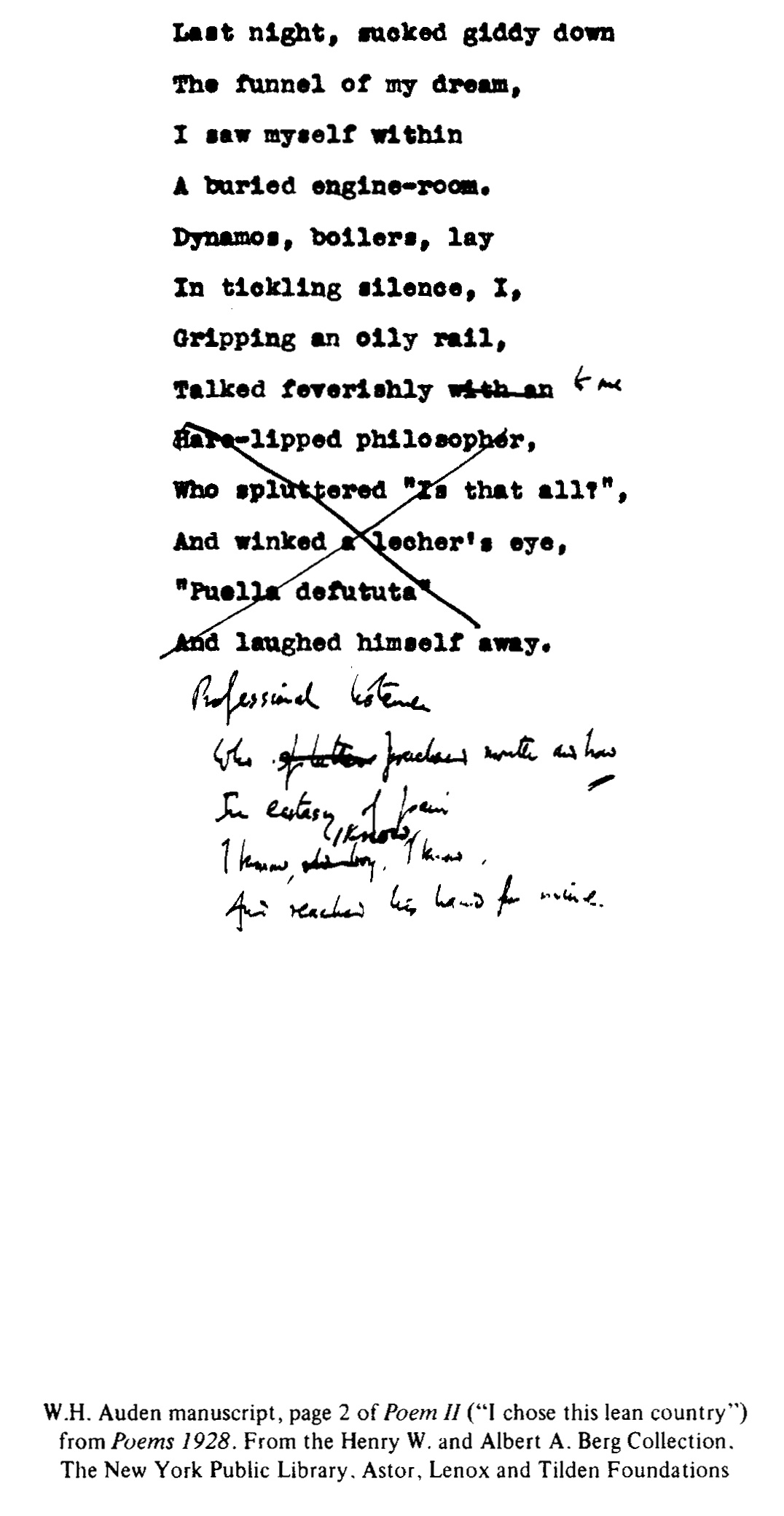
At any given time, I have two things on my mind: a theme that interests me and a problem of verbal form, meter, diction, etc. The theme looks for the right form; the form looks for the right theme. When the two come together, I am able to start writing.
INTERVIEWER
Do you start your poems at the beginning?
AUDEN
Usually, of course, one starts at the beginning and works through to the end. Sometimes, though, one starts with a certain line in mind, perhaps a last line. One starts, I think, with a certain idea of thematic organization, but this usually alters during the process of writing.