Issue 57, Spring 1974
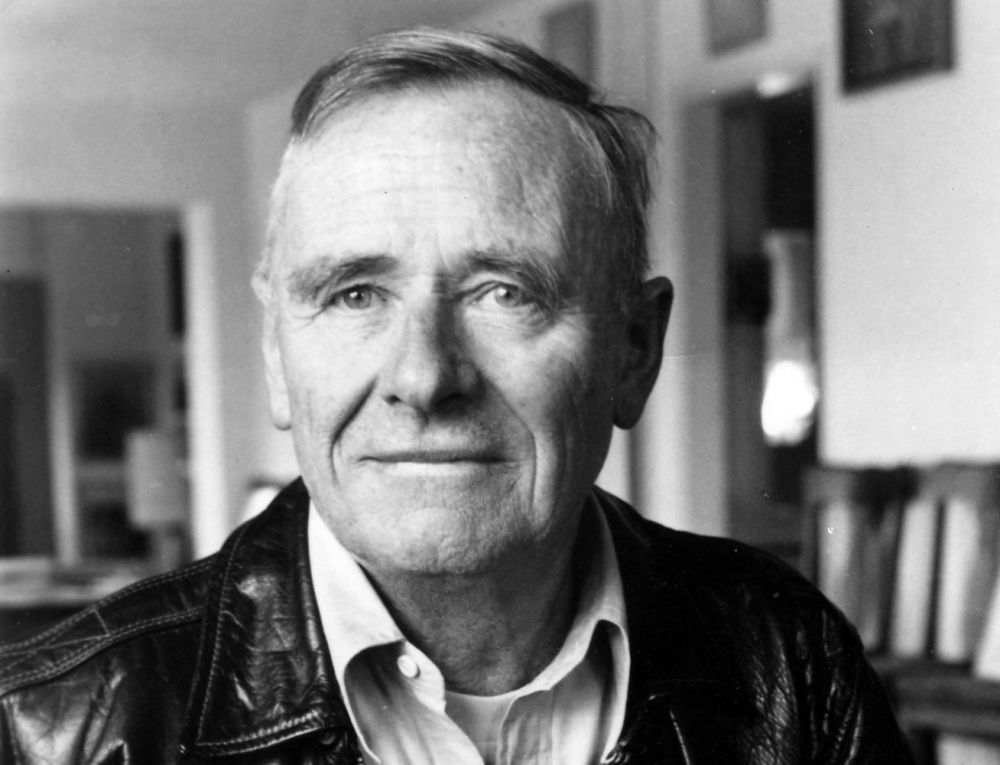 Christopher Isherwood.
Christopher Isherwood’s home is in “the canyon” on the edge of Santa Monica, California—a quiet bohemian district of stucco houses inhabited mostly by people involved in the arts. It preserves much of the character it must have had thirty years ago when it first became a haven for refugees from the vast sprawl of Los Angeles. But Demon Change is just around the corner. In 1973 Santa Monica is being Miamified. Pallid apartment blocks with factitious names (Highland Glen, Sunset Towers) are rising all around, and the coastline is dominated by fat piles of concrete.
Still, the developers have not yet hit the Canyon (though they are widening the road amid clouds of dust above Isherwood’s house), and you can see the ocean in the distance, a silvery blue, dotted with wet-suited surfers riding the swell like seals. The house is built into the steep side of the canyon, and you must slither down a driveway, past a garage containing two Volkswagens, side by side, to the door. Isherwood himself opens it and leads the visitor into the living room. He is dressed with great neatness: navy-blue jacket, open shirt, gray, well-pressed pants. He is neatly constructed, too: short, spry (“jockeylike,” said Virginia Woolf), with a lean, suntanned face. His most striking features are the bony, Celtic-looking nose and the pellucid blue eyes, which focus on you in oddly hypnotic fashion, as if observing neither dress, nor mannerisms, but Something Deeper. We agree to drink tea. “Do look around,” he says, “while I make it.”
The living room is high, white, a bit ascetic, but cool despite the hot July afternoon. Nearly all the paintings are modern, including several graphics of the kind that show cubes and cones suspended in space. There are many books, little furniture, and no clutter. A terrace has been added (“We eat breakfast here usually”), and vines cover it. The little houses descend below and climb the far side of the valley. This is the neighborhood lovingly described in A Single Man, by general agreement the finest of Isherwood’s ten novels. There is even a gay bar, which fits exactly a favorite haunt of that book’s protagonist, “down on the corner of the ocean highway, across from the beach, its round green porthole lights shining to welcome you.” But it is called The Friend Ship, not The Starboard Side.
Isherwood looks almost startled when you ask why he lives in California: “Why, it’s my home. I’ve spent almost half my life here.” Originally, he was drawn by the presence of Aldous Huxley and Gerald Heard, with whom he wanted to discuss pacifism and the impending war. There were trips to New York, lectures at universities, a journey across country by bus, and, during the war, after he had registered as a conscientious objector, a spell in Haverford working for a Quaker refugee hostel: “But apart from that I suppose I don’t know this country awfully well. I’ve been an American citizen for—what, nearly thirty years; yet I still seem very British, even to myself. I’ve lived in eleven places in America, and all of them are within sight of this window.”
Isherwood is now 69, although he scarcely seems it. His career as a novelist began in 1928 with the publication of All the Conspirators, and over four decades his literary appeal has remained remarkably constant. his most famous book, Goodbye to Berlin, has enjoyed recently a third life as the movie Cabaret (its second was the play I Am A Camera). Now the “religious comedy” which he and Don Bachardy—the artist with whom he has lived for almost 20 years— have extracted from A Meeting by the River has been staged in New York and at Los Angeles’ Mark Taper Forum. It was a great success.
In recent years, in common with many other writers and artists, Isherwood has become outspoken about the problems and advantages of being homosexual. He has discussed the subject in print and on television (the Cavett show). He says, “For me as a writer, it’s never been a question of ‘homosexuality,’ but of otherness, of seeing things from an oblique angle. If homosexuality were the norm, it wouldn’t be of interest to me as a writer.”
Isherwood works every morning and then usually walks to the ocean to swim. The substance of this interview was therefore recorded in a series of late-afternoon sessions—teatime. Possibly the conversation reflects something of the hour.
INTERVIEWER
You don’t mind if I record this? I have a terrible memory.
CHRISTOPHER ISHERWOOD
Of course not. So do I.
INTERVIEWER
I wanted to ask first how you came to write A Meeting by the River. It seems so different from your earlier novels.
ISHERWOOD
You know of course that I’ve been involved with a Hindu monk, Swami Prabhavananda, for almost the entire length of my life in America—more than thirty years now. A few years ago, there was a centenary of the birth of Vivekananda, who is the chief disciple of Ramakrishna and a great inspirer of Gandhi—he had all kinds of ideas about the future of India. So there was a great national celebration, especially in Bengal, that year, and they decided to have one of those congresses that they so dearly love with speakers from foreign lands; and Swami said would I come along. So I did. At the same time, two monks from the Vedanta monastery here were coming out to India to take their final vows, sannyas, and I was in close contact with their feelings and the whole predicament of being about to take sannyas. For a long time I’d wanted to write a confrontation story where the representative of something meets the representative of something else, and quite suddenly it came to me that this was the way to do it. I talked a great deal with the monks afterward while I was writing it and checked up immensely on the details. I had been to the monastery once before with Don [Bachardy] in 1957, but that was only briefly… It was infinitely more comfortable than the hotel in Calcutta! Perfectly clean, with nice simple little rooms and a place where you washed down with a bucket of water.
INTERVIEWER
Has your involvement with Vedanta changed your life?
ISHERWOOD
It’s made a very great difference, but I couldn’t exactly describe to you what the difference is. I could say what, so to speak, I’ve got out of it. I simply became convinced, after a long period of knowing Swami Prabhavananda, that there is such a thing as mystic union or the knowledge—we get into terrible semantics here—that there is such a thing as mystical experience. That was what seemed to me extraordinary—the thing I had completely dismissed.
INTERVIEWER
There’s a passage in one of your books in which you and Auden are on a train, and you’re savagely attacking religion, and he says: “Be careful, my dear, if you carry on like that, one day you’ll have such a conversion.” Do you think of it in those terms, as a conversion?
ISHERWOOD
Yes. I rather think so. I went through all sorts of attitudes to it. There was a period when I thought I might become a monk myself.
INTERVIEWER
What would that have meant, in practice?
ISHERWOOD
It would have meant living at the Vedanta Center in Los Angeles; I’d probably have spent a great deal of my time helping to translate Hindu classics and increasing my knowledge about Vedanta philosophy; and perhaps giving lectures when I got to be a swami, which I should have been by this time if I’d stayed with it—it’s about twelve years before you take the final vows. Not long after I met Swami Prabhavananda, the war began, and I went to work with the Quakers at a hostel for refugees in Philadelphia, and after 1940 and Pearl Harbor I volunteered to join a Quaker ambulance corps going to China; but they only wanted qualified doctors or automobile mechanics—it was essential to be able to repair the ambulance. Then I would have registered as a conscientious objector and gone to a forestry camp for firefighting—like the one in Paul—but suddenly in the midst of the war they lowered the age limit, and I wasn’t liable for service. I was completely at a loose end, I’d untied all ties; and then Prabhavananda said, “Why don’t you come up to the center and help me translate the Gita,” which we did. There was a general feeling that I might become a monk, but then I decided, rightly or wrongly, that I didn’t have a vocation. But I’ve always remained in touch with Swami Prabhavananda; in fact, I see him every week.
INTERVIEWER
I’ve never been quite sure what people mean when they talk of a vocation.
ISHERWOOD
Well, would you say there is such a thing as having a literary vocation? Let me put it like this: You know the sort of person who goes around thinking I Wish I Were A Writer, and perhaps he does write a bit; and in the end his friends say, well, the trouble was he had no talent. Really, talent is vocation: there is such a thing as having a natural aptitude for a way of life; not everybody can become a monk.
INTERVIEWER
It’s the overwhelming desire to do that thing, then.
ISHERWOOD
Yes, the desire to do that rather than anything else. In the end it would have meant giving up a whole area of my writing.
INTERVIEWER
And you would have to be celibate.
ISHERWOOD
Yes, they make a great point out of that.
INTERVIEWER
All religions do, don’t they?
ISHERWOOD
One has to look at it from two angles, to hear the Hindus explain it. One is that by being celibate, you store up energy; and since there is only one life force, one kind of energy, that is what you are using, in one way or another. Even that Hindu attitude was a tremendous revelation to me. I’d been brought up in this puritanical way to think of flesh and spirit, the low and the high, the forces of lust and the forces of… something else. But they think it is the same thing on different levels: The Hindus have this image of what they call a serpent power, that rises through different centers—like an elevator that calls at the lust department on the bottom floor and rises to other levels. That’s one aspect of it—really little more than athletes are told: to lay off while they’re in training. From the other side there is the aspect of being devoted to this search, of avoiding human entanglements and devoting oneself to the love of God. And yet, of course, the Hindus are the first to agree that all love is related, and that one can go a very long way through genuine devotion to another human being. One always talks as if loving someone was simple and easy, but in fact it can be very hard work.
INTERVIEWER
The play of A Meeting by the River had a big success here in Los Angeles.
ISHERWOOD
I’m awfully glad. One of the most gratifying of all expressions on one’s friends’ faces is when they are genuinely surprised that you had it in you. It is far more realized than the book: It plays out the undecided duel between the two brothers more intensely, and so the nature of the comedy comes out more clearly.
INTERVIEWER
What made you choose that book to dramatize? You once described A Meeting as “rather a secret little book”; and the letter form seems prohibitive.
ISHERWOOD
Well, I would never have thought we could dramatize it. It was largely James Bridges, who’s an old friend, who insisted that we could. Then we asked ourselves: Is it possible? Then it became a challenge; and then we saw that the very fact that the characters were all elsewhere—except for the two principals—imposed a technique which was fun: The people are there, and yet they’re not there, just as they are in life.
INTERVIEWER
My one reservation about A Meeting by the River was that it seemed rather withdrawn about the ecstatic side of religious experience—a bit veiled: There were no Dostoyevskian agonies and ecstasies. Do you think religious experience of this kind can be transmitted in writing?
ISHERWOOD
I think it’s awfully difficult to do, but possible: Dostoevsky does it better than almost anybody. One day somebody gave Prabhavananda The Brothers Karamazov. Now, although he has read all kinds of books, he certainly doesn’t restrict himself, he had read no novels. And he said, “But this is absolutely marvelous!” He was astounded; he adored the character of Father Zossima. He really thought that all novels must be like this. I’m afraid he was badly let down. But I think the experience of many people who take to contemplative religion is that when you first stir the thing up you get extraordinary moments of joy, a sense of excitement which tends later to disappear and only come back when you’re much further on. There’s no question that Prabhavananda has such moments, and then he’s quite something. In A Meeting by the River, though, Oliver is rather dour: his temperament is such that it’s rather difficult for him to feel that kind of joy. He has something of that kind of experience when he sits on the stone bench in the monastery, and he feels that Swami has been sitting beside him. This is one thing we rewrote in the play and tried to bring out more strongly, making it more like a series of ejaculations: “Yes! Yes, I saw him! He was actually there!”—that kind of thing. It’s written now in a way that makes it easier for the actor to project that kind of ecstatic joy. It’s really a terrific sense of relief: that after all the whole thing is true! You’ve been telling yourself that it is, but you didn’t absolutely believe it, and it’s only after you’ve had such an experience that you realize it really is: There’s always a further dimension of belief which you don’t think you have reached. I agree that it’s rather missing from the book; I hope it isn’t from the play.
INTERVIEWER
Perhaps it’s a Western Christian attitude to expect these agonies: I guess what I’m saying is that the Hindu religion may be more joyous. I missed the suffering.
ISHERWOOD
No, the Hindus are not so impressed by suffering: They don’t think it’s something marvelous in quite the same way. It’s true that Ramakrishna said that people shed buckets of tears over their families and their bank accounts, but they won’t shed one tear for God… The Bengalis, anyway, are so absolutely non-Nordic, very lively and bright and mercurial, and if they weep, it’s not for long; much more like the Italians.
INTERVIEWER
Edward Upward once said that you became a pacifist after your journey to the war in China. Was that in fact a turning point for you?
ISHERWOOD
Well, I’ve always hated explanations that sound so rational. I’m quite sure that I’ve had a strong leaning toward pacifism throughout my life. But it was very convenient to say that, and it’s not exactly a lie. It did bring things home to see what people look like after they’ve been killed in an air raid, to see the effects of gas gangrene on boy soldiers, to see millions of innocent civilians dragged into a war they neither wanted nor understood.
INTERVIEWER
Here’s a quotation that interested me from Down There on A Visit. The narrator is going through a crisis of sorts about his pacifism at the start of World War II, and he says: “Suppose I have in my power an army of five million men. I can destroy it instantly by pressing an electric button. The five millionth man is Waldemar. Will I press that button? No, of course not, even if the four million, nine hundred and ninety-nine thousand, nine hundred and ninety-nine others are world-destroying fiends.” Is this your basic, personal reason for being a pacifist?
ISHERWOOD
Oh yes—because once you have refused to press the button on account of Waldemar, you can never press it. Because Waldemar might be absolutely anybody! And since then, I’ve had occasion to say this, tentatively thinking it might be regarded as a self-regarding, capricious argument—but to my surprise people said that it had convinced them more than some high-sounding reasons for being a pacifist. They thought it sensible. But really I was just trying to describe what, when you’re driven into a corner, makes you react that way.
INTERVIEWER
What does Vedanta teach?
ISHERWOOD
It’s quite ambivalent on the subject. The Hindus believe in one’s dharma, one’s duty, one’s nature; they say the great need is to discover one’s dharma, which, of course, is an intense mystery nowadays; in classical India you had your caste; your caste had its own duties. If you belonged to the second caste, the warriors, you either fought or became a monk… rather like the Middle Ages.
INTERVIEWER
I suppose the Christian position in justifying war is that the wicked simply profit from meekness and go on to worse evil.
ISHERWOOD
But then that’s a political argument, really. It’s not an argument that cuts any ice in reference to what we’re talking about… Above all, and this is really what made the greatest impression on me when I was young, I got into my head how loathsome older people were when they preached war, when they were well past the age when they could be sent out to die. And I always said to myself, I won’t be like that when I get old. And yet you know, one of the best and noblest men I’ve known, Bertie Russell, got into exactly that situation. We talked about it, and he was marvelous—he said how it embarrassed him, but yet that he did believe this war—the Second World War—was different. As you know, he fearlessly opposed World War I. I said, Well, I didn’t think you could only oppose some wars. Just as later I’ve sometimes got into arguments with people who specifically resist just Vietnam, for instance. Except that on a political level one’s absolutely entitled to do that.
INTERVIEWER
Do you follow a routine when you’re writing a novel? A certain number of hours a day, that sort of thing?
ISHERWOOD
I don’t have any special routine. The great thing is to get after it every day, and that to my mind applies to everything one does; even the tiniest act of the will toward a thing is better than not doing it at all.
INTERVIEWER
Do you type?
ISHERWOOD
Yes. For many years I’ve written on a typewriter.
INTERVIEWER
How long does it take you to write a book?
ISHERWOOD
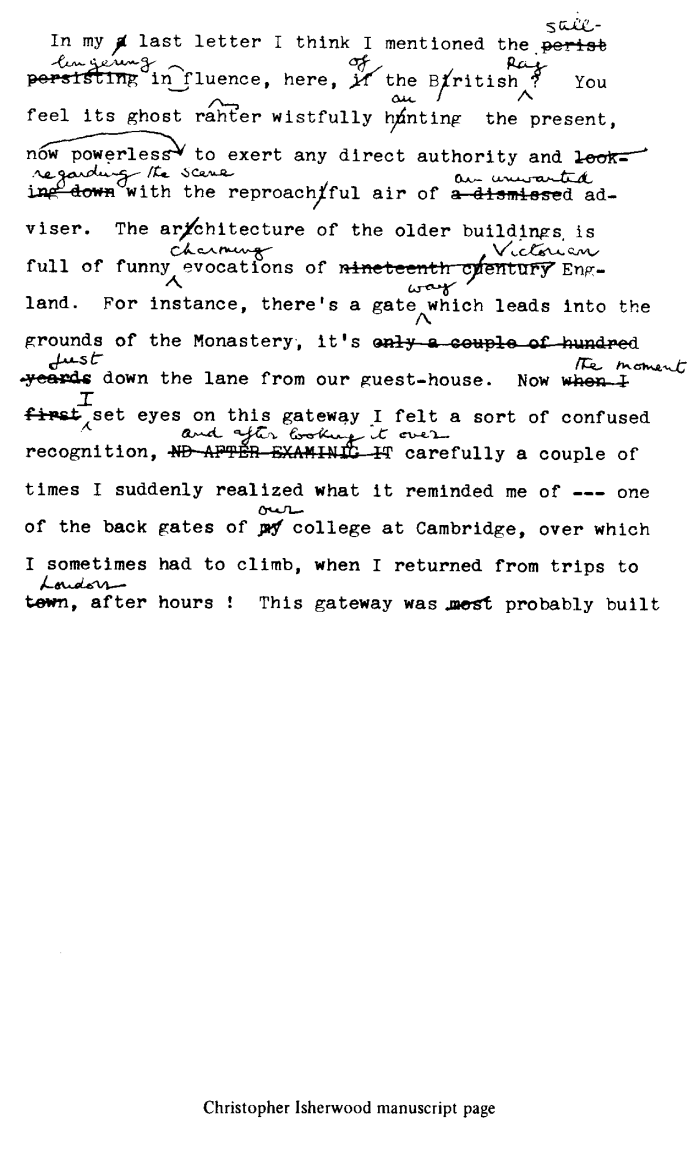
Hard to say. Eighteen months, two years for A Single Man. I wrote three drafts in that time. When I was young, I used to proceed like a rock climber: I had to get to a certain point, and then I considered that everything below me was conquered. But now I don’t do that at all. I go through the first time in a very slapdash way, and if I get into some nonsense or digressions, I write it through to the end and come out on the other side. I’m not at all perfectionist at first. I do all the polishing in the last draft. When I was young, I was absolutely fanatical. I wrote in longhand, and I couldn’t bear for there to be any erasures on the paper, and since this was before all these wonderful breakthroughs with Liquid Paper, etc., I used to scratch words out with a razor and then polish the paper with my thumbnail and write it in again. It was terrible! I wasted so much energy fussing!
INTERVIEWER
Have your books been widely translated? What countries like them?
ISHERWOOD
Everything has been done in French and Italian; a certain amount in German, Swedish, Danish, Dutch. One little thing, a story called The Nowaks, in Russian. A couple of Czech and Spanish translations. But I don’t think they’re really popular in translations. It may be a question of nuance. The French really liked the books; they’ve been more sympathetic than anybody. The Germans, who you might think would be interested, were not all that much. The Berlin Stories, to some extent; the play of I Am a Camera was performed in Germany. There are things that are very difficult to translate: half puns and concealed quotations and little things like that.
INTERVIEWER
Is there any particular aspect of your work that you dislike?
ISHERWOOD
Well, my attitude’s rather like Pontius Pilate: What I have written I have written, you know; and I can’t imagine—as some writers have—going through a book and producing a rewritten version. There are some gross mistakes which I should change if I could ever remember to. Wrong words in German… silly things like that.
INTERVIEWER
Do you rewrite much?
ISHERWOOD
Yes, a great deal. What I tend to do is not so much pick at a thing but sit down and rewrite it completely. Both for A Single Man and A Meeting by the River I wrote three entire drafts. After making notes on one draft I’d sit down and rewrite it again from the beginning. I’ve found that’s much better than patching and amputating things. One has to rethink the thing completely.
INTERVIEWER
I noticed a remarkable number of changes in the version of “Mr. Lancaster” that originally appeared in the London Magazine and the final version of the book.
ISHERWOOD
You’re really a student! But you’re quite right. I just changed my whole attitude in certain parts of that.
INTERVIEWER
Do you work fast?
ISHERWOOD
I don’t know; it seems to take me quite a time to finish a book… They say D. H. Lawrence used to write second drafts and never look at the first.
INTERVIEWER
Why did you cut what seemed to me a climactic scene from “Paul” about hashish smoking?
ISHERWOOD
Simply because it didn’t relate to Paul, the character. It related to me. I thought we were getting too far away from Paul.
INTERVIEWER
When I read it later in Exhumations, I wished you’d left it in.
ISHERWOOD
Well, we did have it in even when the book was in proof. I only cut it at the last moment. Perhaps I was wrong to do so.
INTERVIEWER
One thing that surprised me about Ambrose, from the same book (Down There on A Visit), was a distinct lack of enthusiasm for things Greek; you absolutely didn’t partake of that special British literary worship of that part of the world.
ISHERWOOD
Well, it wasn’t the best way of seeing Greece; here we were, holed up on this island, and we got rather used to it. But I remember certain things about Greece that moved me tremendously.
INTERVIEWER
Yet this Hellenic syndrome, the fetish for Greece, never shows in your writing. I’m thinking of… Durrell… lots of them from Byron onwards. Greece means to them what Italy did to Forster.
ISHERWOOD
Well, I was very prejudiced in my youth against the values of the academic world; and since then I’ve become prejudiced in another way because I think that Hindu philosophy is so much broader in its scope than that of, say, Plato. That’s a temperamental thing, perhaps, but I’m not really knocked over by the Greeks. I can’t feel that “everything started in Greece,” or “had they not been there, there would be nothing.” I daresay this is my ignorance, but it’s how I feel. One aspect of Italy turned me on far more. I had the atypical experience of never seeing Italy when I was young. I went first in 1955 with Don; we went like two innocents, and we were duly stunned. I was, what, fifty-one? And I was seeing all this for the first time. It was late in the year, with few people about, and the most marvelous Indian summer. We drove through Tuscany, and in Milan we met an old friend, King Vidor, who was making War and Peace, and took absurd home movies of that. All his best takes were ruined because the Italian extras were having such a terrific time falling off bridges and roaring with laughter. And it all culminated in a rather banal—I suppose—experience, which was also the greatest part of the trip. We went to Venice and arrived in a thick fog and occupied a vast suite in some grand hotel where the prices had been slashed to a tenth because of the season. And in the morning I went to the window and there was this wonderful Guardi sunlight, and the lagoon, and Santa Maria della Salute. It simply hit me over the head, and I burst into tears. I’ve never felt like that to the same extent, except perhaps when I saw Yosemite, which was rather different.