Issue 64, Winter 1975
Hailed as an Angry Young Man on the publication of his rollicking and irreverent first novel, Lucky Jim (1954), Kingsley Amis continued to be regarded as primarily a comic novelist for several years afterwards, although the grave side of his purpose was already apparent in Take a Girl Like You (1956). But it was not until The Anti-Death League (1965), which he described as “a protest against death and an attack on the Christin God,” that Amis served public notice of his wish to be taken seriously.
In recent years Amis has demonstrated remarkable versatility. As well as poetry and belles-lettres, he has published three straight novels, I Want It Now (1968), Girl, 20 (1971) and Ending Up (1974), and an assortment of genre fiction: (as Robert Markham) Colonel Sun (1968), a spy thriller featuring a resurrected James Bond, The Green Man (1969), a ghost story, and The Riverside Villas murder, a classic mystery story.
His academic career has been almost as varied. From 1949 until 1961 he lectured in English at University College, Swansea, and from 1961 until 1963 was a Fellow of Peterhouse College, Cambridge. He also spent a year as Visiting Fellow in Creative Writing at Princeton, 1958-9, and was Visiting Proffessor at Vanderbilt University, Nashville, in 1967.
At present he lives in High Barnet, an outer suburb north of London, in a large, early nineteenth century house beside a wooded common. To reach it, one makes a similar journey to that described by the narrator of Girl, 20 when he visits Sir Roy Vandervane: first by tube to the end of the Northern Line at Barnet, then, following a phone call from the station to say where one is, on foot up a stiff slope; and then down a suburban road. But instead of being picked up en route by Sir Roy’s black chum, Gilbert, I was intercepted by Amis’s tall and imposing blonde wife, the novelist Elizabeth Jane Howard.
Amis’s study was a picture of bohemian disorder. Scattered across the floor were several teetering piles of poetry books and a mass of old 78 r.p.m. jazz records, while the big Adler typewriter on his desk was almost hidden behind a screen of empty bottles of sparkling wine which he’d recently sampled in his capacity as drink correspondent of Penthouse. A more sober note was struck by some shelves containing a complete Encyclopaedia Britannica, a thirteen-volume OED, and various other authoritative tomes, but this was quickly dispelled by the sight of a small sherry cask in one corner, full, I was told, of whiskey.
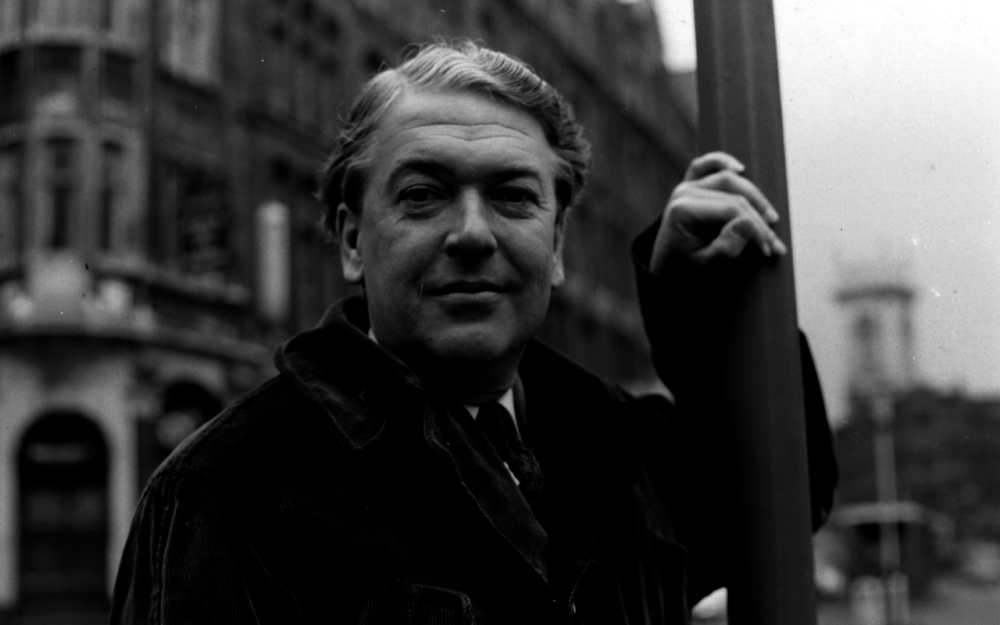
For someone whose only regular exercise is strolling to and from the local pub, Amis at fifty-three is well preserved, with just a modest paunch hinted at beneath the light blue pullover and brown slacks he was wearing when we met. Early photos show him with thick, wavy hair; it’s grey now, but there’s still plenty of it, conventionally styled, and only a little longer at the back and sides than twenty years ago. He has a mobile face that lends itself to the impersonations for which he is famous (and of which I caught a tantalizingly brief glimpse), and an educated but far from affected voice that reminds one at times of the actor, Kenneth More's. The interview did not take place in his study, but in a pleasant, book-lined sitting room with a prospect of the back lawn through lofty French windows. We talked for about two hours, from eleven-fifteen until one-fifteen, Amis perched on the edge of a sofa rather than sitting back in it so as not to provoke a troublesome recording. He chose his words carefully, sometimes pausing to think things out, but rarely needing to rephrase an answer. At about midday he had a Scotch, which was replenished shortly before the interview closed.
INTERVIEWER
You’ve said that “until the age of twenty-four, I was in all departments of writing abnormally unpromising.” This suggests that you were trying to write before this.
KINGSLEY AMIS
Oh, indeed yes. I’ve been trying to write for as long as I can remember. But those first fifteen years didn’t produce much of great interest. I mean, it embarrasses me very much to look back on my early poems—very few lines of any merit at all and lots of affectation. But there were quite a lot of them. That’s a point in one’s favor, I think, to work these poisons out of one’s system on paper: bad influences, like Dylan Thomas and Yeats—I’m not saying they’re bad poets, but I do think they’re bad influences, especially on a young writer. As regards prose, that was even worse. My first novel, which will never see the light of day, was really affectation from beginning to end—well, it did have a few jokes which I lifted for later stuff, and some bits of background from the town I was living in at the time, Berkhamsted, that were usable in Take a Girl Like You many years later.
INTERVIEWER
Have you always had the capacity for making people laugh?
AMIS
I was the, or a, school wit at twelve years old. Well, not wit exactly—someone who could imitate the masters. I’ve always been a fair mimic; one of my party pieces is FDR as heard by the British over shortwave radio in 1940. This perhaps has something to do with writing fiction; a novelist is a sort of mimic by definition.
INTERVIEWER
Did the fact that you were an only child have any bearing on your development as a writer? Either the amount of reading you did, or the fact that you had to use your imagination more?
AMIS
I think it’s… well, writing for me is to a large extent self-entertainment, and the only child is driven to do that. For example, I’m an expert whistler—I won’t give you a sample—but that takes hours of practice, the sort of thing one hasn’t got time for if one’s part of a large family, I imagine. And as for reading, well, of course I got a lot done. Again, totally heterogeneous material—what we would now call very bad literature: the boys’ comics of those days—which were, of course, compared with today’s comics, positively Flaubertian in their style and Dickensian in their character portrayal—all the way up through hardbound books of adventure stories and such, and taking in real writers like Dickens himself, Shakespeare, and so on, in much the same sort of spirit. I think it’s very important to read widely and in a wide spectrum of merit and ambition on the part of the writer. And ever since, I’ve always been interested in these less respectable forms of writing—the adventure story, the thriller, science fiction, and so on—and this is why I’ve produced one or two examples myself. I read somewhere recently somebody saying, “When I want to read a book, I write one.” I think that’s very good. It puts its finger on it, because there are never enough books of the kind one likes: one adds to the stock for one’s own entertainment.
INTERVIEWER
Did you draw on your childhood memories for The Riverside Villas Murder?
AMIS
To some extent. None of the events: I wasn’t lucky enough to be seduced by the pretty next-door neighbor, nor did I find a corpse in the sitting room. But the feeling and the adolescent attitudes were as close as I could remember to my own. The attitude to sex, to girls, to parents and school—that was all out of my emotional experience.
INTERVIEWER
You served in the Royal Signals in the war. Did My Enemy’s Enemy owe anything to this?
AMIS
Well, as you know, there were three stories of army life. And the shortest one, “Court of Enquiry,” was based on an experience of my own. I was the unfortunate Lieutenant Archer who was given a bad time by his Company Commander. But the other two stories were total fiction.