
“ ‘Artificial Intelligence will take part on stage,’ the website informed us, ‘not as a character, but as an image-generating force.’ ”

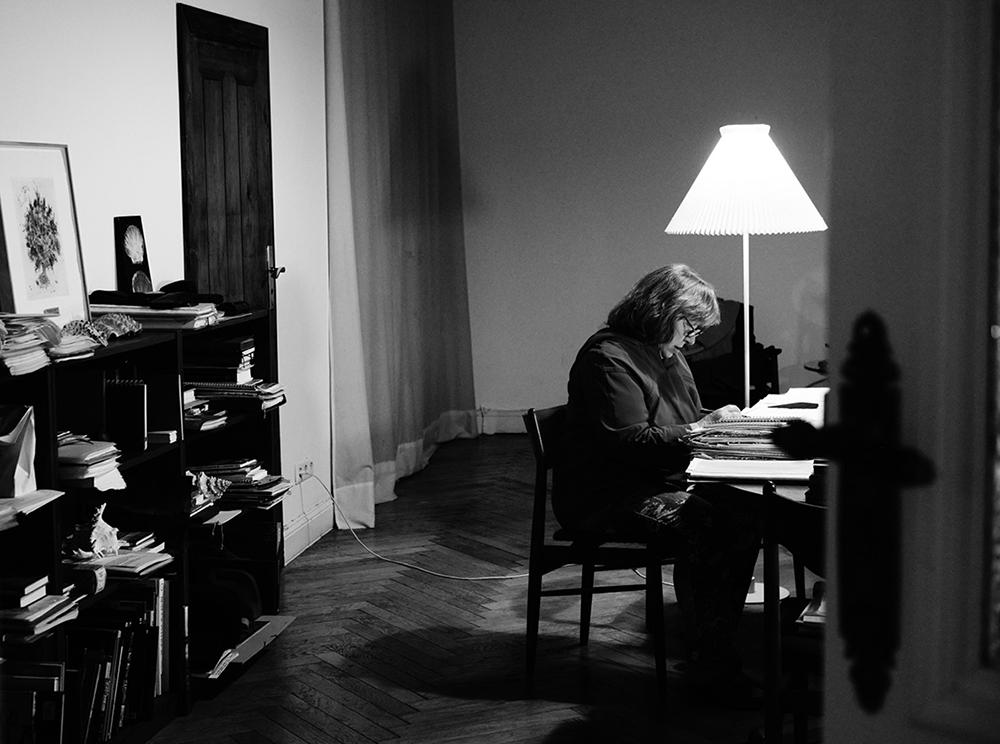
In her apartment in Berlin, 2026. © Lena Kashirsky.
Svetlana Alexievich asked me as many questions as I asked her. At intervals, she would propose that we pause so she could record me; in one of our final sessions, when a photographer, Lena Kashirsky, came to take her picture, Alexievich insisted that she stay to talk. She wanted to know what books we were reading, whether a revolution could be bloodless, what music teenagers were listening to these days in Moscow, whether I thought Putin was a happy person. She also asked about love—what it is, and why we believed it appears or disappears. She stopped using a handheld recorder years ago; the app on her iPhone works fine.
Alexievich was sixty-seven when she received the Nobel Prize in Literature in 2015, “for her polyphonic writings, a monument to suffering and courage in our time.” By then, she had been working on the project she calls Voices of Utopia for almost forty years. Drawn from thousands of recorded testimonies, the pentalogy depicts historical moments as they took place within and around her subjects’ lives: World War II, from the perspectives of Soviet women who’d served, in War’s Unwomanly Face or The Unwomanly Face of War (1985; translations 1988, 2017), and of people who had been children at the time, in Last Witnesses (1985; 2019); the Soviet war in Afghanistan, in Zinky Boys or Boys in Zinc (1989; 1992, 2017); the 1986 explosion at the nuclear power plant in Chernobyl, in Voices from Chernobyl or Chernobyl Prayer (1997; 1999, 2005, 2016); and the fall of the Soviet Union, in Secondhand Time (2013; 2016).
I first came across Alexievich when I was in eighth grade and looking through my mother’s old copies of Semia i shkola (Family and school), a Soviet magazine for schoolteachers. A spread in one of the issues was devoted to letters from readers of Boys in Zinc, which takes its name from the zinc-plated coffins in which the bodies of Soviet soldiers were sent home from Afghanistan. In these letters, Alexievich was by turns a liar, the only writer who told the truth, a raving hysteric, a great woman, a traitor, an amoral monster. Naturally, I went to the library to check out the book that had caused so much uproar. It wasn’t like anything I’d ever read about war; far from heroic, these stories told of people who felt lost and bewildered, who struggled to live with themselves after what they had been through and done. Alexievich was subsequently sued by four people she’d interviewed for the book, veterans and mothers of soldiers who’d been killed in the war, who claimed that she’d distorted or fabricated their words. Three of these cases were thrown out or dismissed. One was upheld; Alexievich was unable to substantiate two passages that the court considered defamatory. She told me she hadn’t been able to locate the tape in time for the court hearing.
Alexievich was born on May 31, 1948, in the city of Ivano-Frankivsk in western Ukraine, where the Ukrainian Insurgent Army was still resisting the Soviet Union, and spent her childhood between villages in the more Soviet-aligned regions of Vinnytsia, in central Ukraine, and the Homyel region of Belarus. She told me that, when she was a child, a teacher had rebuked her when she claimed not to understand the notion of the “hero nation”: “She said, ‘Our nation is powerful’—things of that nature. But even then I refused to see things that way.” When she thought of the men and women she knew from the villages, Alexievich said, “I couldn’t help but see each person as an individual. I remember the women’s faces, their tears … Referring to them as ‘the nation’ was something I could not abide.” This aversion has been clear to her readers since The Unwomanly Face of War, which presents details that are radically at odds with the sanctioned Soviet iconography of World War II.
Voices from Chernobyl took eleven years to complete. While writing it, Alexievich became a mother to Natalia, the daughter of Alexievich’s younger sister, Tamara, who was diagnosed with cancer before the explosion at the nuclear power plant and who died soon after, when Natalya was four—an indirect result, Alexievich still believes, of the explosion, the effects of which, she told me, killed the most vulnerable first. In 2020, Alexievich was forced to flee Minsk, leaving behind friends, family, and the transcripts of her interviews for a new book on the nature of love. Secondhand Time was supposed to be the final installment in her five-part cycle, but, as Alexievich explained to me, “the Red Man kept shooting.” She settled in Berlin, where she has been at work on her latest book, an attempt to understand the nature of hatred and violence through the “trampled” Belarusian revolution of 2020 and the Russia-Ukraine War.
The Berlin apartment where she has lived for several years has a temporary feel. It is clean and spartanly furnished, with books piled on the floor and on armchairs. The most lived-in room is the one with a long dining table and six mismatched chairs. This is where she works. Transcripts of interviews, printouts of articles, books—everything has its place. Flat stones sit between the papers—Alexievich uses them as coasters for her tea and coffee. She keeps her pens in a wooden cup covered in birch bark. In the middle of the table is a stack of blank paper next to a pile of handwritten pages, the lines spaced widely for ease of revision. Alexievich writes her books by hand.
We met several times between July and October of 2025. Before each session, Alexievich would lay out a dish of meat patties, slice some cheese, and make me coffee. I saw this as something like a village custom: feeding the guest before turning to serious conversation. The patties were made by Liuba, one of her assistants; Alexievich confessed that she herself has never learned how to cook. When I presented Alexievich with the final draft of the interview in person this past July, she marked it up with a great many edits. She reverted most of them after I read her the original passages followed by her revisions. “I have a much better ear for other people,” she said. “Thank you for not letting me deface my own voice.”
SVETLANA ALEXIEVICH
You can smoke if you like—there are some cigarettes over there.
INTERVIEWER
Would you like one?
ALEXIEVICH
Me, no. I’m cold just sitting here. It’s not so bad out, but this wind is no good for me. I used to be a very healthy person, and then I got this trigeminal neuralgia.
INTERVIEWER
Was that after Chernobyl?
ALEXIEVICH
Nobody knows. It could be from Chernobyl, or maybe it’s just from my life. But I don’t want to talk about my personal affairs, it opens the door to all sorts of undesirable attention. People will start talking about who Alexievich is sleeping with instead of what she’s doing.

Subscribe for free: Apple Podcasts | Spotify | Amazon Music