Issue 76, Fall 1979
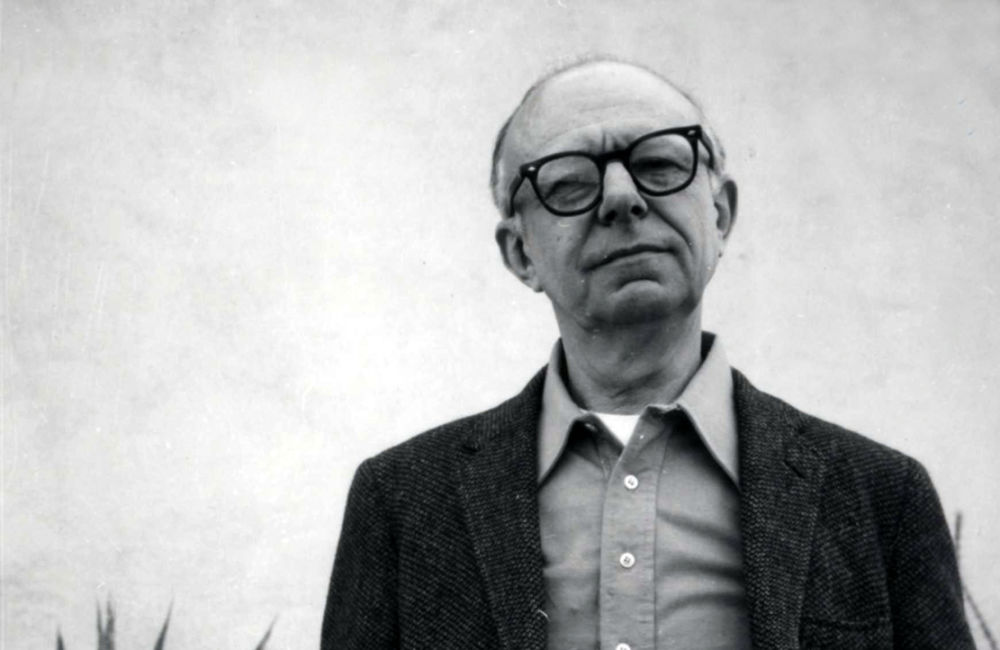 Photograph by LaVerne Harrell Clark 02/17/1971
David Ignatow keeps an apartment in Queens close to York College where he teaches—four small rooms with bare walls. The windows of the living-room look out on a quaint cemetery dating back to the late 1700s. On its far side runs the BMT Jamaica subway line, one of the few remaining elevated trains; every so often one hears the sound of the train approaching the 168th Street station. The sparseness of the apartment does not suggest poverty, but nor are there indications of an aesthetically enriched life: Ignatow has no study. He maintains a modest library, two or three filing cabinets, and a typewriter, all in the bedroom.
Mr. Ignatow, who is now in his early sixties, has grown a prominent silver-white moustache over the past few years which has served to tone down what was a rather severe demeanor. His voice is somewhat high-pitched and hoarse, with little of the accent one would assume from a Brooklyn upbringing.
The poet is a singular instance of a man rising to eminence late in life. He tried for years to be a businessman, a career for which he was not suited. He wrote poems during this time, and much that he observed with a photographer’s eye of everyday life in the business world is incorporated in his writing. At first, his career as a poet was no more successful than his business practice. A study of his Notebooks indicates the struggle against academic jealousies and prejudice, and the neglect and hostility of his contemporaries, especially in the ’40s. Now it appears his time has come. He has written and published, never with great success, but with an increasing reputation (his last two books are Facing the Tree, 1975, and Tread the Dark, 1978) that has brought him honors including a Guggenheim Fellowship, the Bollinger Prize, and an award from the National Institute of Arts and Letters “for a lifetime of creative achievement.”
INTERVIEWER
Do you consider yourself vulnerable?
DAVID IGNATOW
Vulnerable, damn right. But the fear of being vulnerable prompts me into bringing myself forward. It’s like being on the battlefield. As you engage in battle, you begin to feel fear; but as you make contact with the enemy, he’s almost your friend because he’s reducing the fear to excitement and participation. In Facing the Tree there’s a poem about Croatian guerrillas who are being executed, and they keep identifying with the executioner. It’s strange. It’s terribly ironical.
INTERVIEWER
In your poems where you show your anger do you feel a danger in having your vulnerability misunderstood?
IGNATOW
I couldn’t care less. This is what I have to feel, this is what I have to write. This is the life, this is the life. I’m living it.
INTERVIEWER
Do you feel “visceral” is an accurate description of your poetry?
IGNATOW
Very much so. My poetry is a gut reaction. I’ve lived a gut life for so many years, and I guess I still do. When we talk of the gut, I mean literally sometimes being worried where I’m going to get the money for the next rent. Always living on the fucking edge.
INTERVIEWER
Anthony Burgess said, “The scientific approach to life is not really appropriate to states of visceral anguish…”
IGNATOW
That’s very good. Visceral anguish is really survivor’s experience, he who fights his way back from the edge of a cliff or burrows his way out of a locked cage, out of the coal mine… a perpetual struggle.
INTERVIEWER
What is the worst thing that could happen to you?
IGNATOW
Well… losing my job, being out of money. Problems of love, problems of human relationships are secondary. Emotional problems have a way of resolving themselves.
INTERVIEWER
You write in the Notebooks that pain is your favorite subject. Do you still believe that?
IGNATOW
I have probably passed that point in my life. Things have changed. I don’t intend to go on living a life of pain and celebrating pain. I have experienced a tremendous joy in the last three years. I’ve been fantastically happy in long spurts. This is something I haven’t had for many years.
INTERVIEWER
Over the years, you seem to have become more preoccupied with prose poems. Does this visual change in your work correspond to the way you’ve changed your life? Have you become impatient, or more patient with yourself?
IGNATOW
Well, the lyric has limitations. I’ve found myself impatient with the lyric form. And that’s the reason I changed my style, a rebellion against the traditional, contemporary, lyric form of, say, William Carlos Williams. I had had it that way. I found my language was responding to the form rather than to my sensibilities. I was getting a little too self-conscious about it. So I decided: Cut loose and give emphasis to the imagination rather than to the line. By “imagination” I mean also the intelligence within the imagination, giving the intelligence its opportunity to explore the imagination as far as it will go. Of course it has a form, but it’s a form that constantly renews itself because the intelligence is restless. Emotions tend to repeat themselves over and over again, whereas the intelligence is constantly renewing itself, recreating itself. Therefore, I feel in the prose poems the emphasis is on the intelligence with an undercurrent of emotion. In the lyric form the emphasis was on the emotion and the intellect was the undercurrent. I’m also following Pound’s rule, that poetry should be as good as good prose. That it’s a vernacular, colloquial thing. And vernacular, the colloquial, doesn’t sing. It talks. If you want to sing, then you write an elevated line, an elevated language. Occasionally, I’ll do that. There are moments. But, on the whole, the contemporary tradition is talking. And if that’s the case, then why not come out and use the prose line?
INTERVIEWER
When you started to write, who were your chief influences?
IGNATOW
At first I was very pleased to model myself on Hart Crane. But then I knew I wasn’t a Crane temperament; I felt much more closely aligned with Whitman, so I began to model myself on him. Then I found that I couldn’t quite grasp the Whitman thing because he was just a little too euphoric for me. So I went away from him and I went to Williams. Williams repelled me at first. He repelled me because he was so… I felt he was so literal, so prosy. Where is the poetry in all this? I kept thinking. And then all the praise he was getting from people had me hanging on the ropes. I said, “I’ve got to come back and read him again.” So I kept going back and reading him. And I was finding myself in experiences which were shockingly similar to the experiences he was recounting in his work. And when I started to write these experiences, I saw that I was using his techniques. There was no choice. But then, my life diverged from his in many respects. First of all, he was a physician. And my lifestyle went in the opposite direction. So I began to reshape the technique according to my lifestyle. Then I met César Vallejo on the page and, boy, he flipped me out! Then, I said, “I’m going to let loose.”
INTERVIEWER
Who have been some of your other influences?
IGNATOW
I learned the surrealist technique from Russell Edson. Before I read him I had made a jab at surrealist poetry and I dropped it very quickly, because my life became much too complicated and in need of direct confrontation to keep it simple. But later on I was reminded of my past attempts when I read Edson. I said, “Gee, I must try it again.” Then, as I said, Vallejo was very important to me, the intellectualization of states of being that I think characterizes his work. The extraordinary combination of the guts and the mind… how they get together and inform one another. He’s a metaphysical poet. By metaphysical, I mean he’s a man who’s constantly seeking values. Neruda, too… the whole Spanish school of poetry gave me much to think about. They drew me away from the Whitman tradition and I thought myself freer… freed of the Whitman tradition.
INTERVIEWER
And yet you’re often characterized as the son of Whitman and Williams…
IGNATOW
I know, but I don’t believe it altogether. I have a lot of bizarre, surrealistic, macabre images at work in my head. The ill curse of contemporary life. I think if Williams were alive today, he would’ve gone in that direction. As for Whitman, if you take him seriously you have to swallow the whole bit about man’s divine origins and all men being equal. I reject that. I don’t see it in practice, therefore it doesn’t exist for me.
INTERVIEWER
So, you don’t use Whitmanesque techniques anymore.
IGNATOW
I still use some of his repetition, parallel structures, chanting, incantatory style… but it's more evident in my earlier work. It grows much tighter and more intellectual, more imagistic with the years because of my study of men like Neruda, Vallejo, Machado, and the French poets.
INTERVIEWER
When you came upon the surrealist poets, did you feel that the Whitman tradition had limitations for you that forced you to move on to the surrealist poets?
IGNATOW
The limitation in the Whitman tradition was its openness to everything at a time when it seemed wrong to be open to everything. That is, to accept evil, the kind of evil that was going on, to believe that it could be transcended or transformed or used. I didn’t think that any of this could happen. The pivot really is my turning toward the existentialist movement… I felt man ought to judge himself… there was no one else to appeal to, contrary to Whitman’s work, that there is a final arbiter in life. I don’t think so. An arbiter beyond the personal, beyond the individual… I don’t believe it. But Whitman tried to straddle two concepts: the individual as a unique person with a strength of his own and the concept that beyond the individual, since he was of a divine source, was still a greater force towards which he was progressing to perfect himself. I had to throw all that out; I was left with the individual. That was it, which unraveled the whole Whitman tradition for me. Therefore I had to turn to other sources and other sensibilities. And these were men like Rimbaud and Baudelaire and Williams and the Spanish poets who dealt with pain—from suffering, from severe deprivation: mental, physical, social, universal. And yet they sought to expand their world. They sought to include the entire world in their pain and suffering and their anguish towards a freer life. The kind that Whitman sought for… the kind that Whitman thought he had, but, in other words, they were going through the door of life, whereas Whitman thought he had opened the front door.
INTERVIEWER
A Mexican writer, José Gaos, was quoted in Octavio Paz’s beautiful book The Bow and the Lyre as saying: “As soon as a man enters life he is already old enough to die.”
IGNATOW
That’s good. When you assume that knowledge, you begin to live a very vital life, because everything you do is in the background of immortality. The background is the immortality of death. That’s when you can say you are a man in the full sense of the word. You’ve become an existentialist. That’s what it’s all about.
INTERVIEWER
How old were you when you first began writing?
IGNATOW
About sixteen when I realized that I had some kind of gift.
INTERVIEWER
Were you excited because all of a sudden you realized that you were dealing with a secret language?
IGNATOW
No. I was able to make things vivid on the page. I could recreate, I could bring life to a page. That’s what I was thinking about. To see my visions on paper almost exactly as I had visualized them, being read and viewed with pleasure the way I viewed them myself. That’s what amazed me. I didn’t will myself to become a writer. It was just a natural outgrowth of the pleasure readers got from my work. I wanted to give pleasure and give myself pleasure. It wasn’t a dry fuck, in other words.
INTERVIEWER
Does it help you as a writer to go for long periods without sex?
IGNATOW
Sexuality, in itself, is quite a distraction. It’s an art in itself. It requires a very intense concentration, delicacy and nuance, and that takes a lot of practice… knowing the other person. If your time is limited, that really can cut into your writing. It’s really a common problem. Our profession requires almost a total concentration of personality and the moment you start to divert yourself, you begin to lose your grip… and you drift, and you become quite irritable about it, too.
INTERVIEWER
In the Notebooks you say: “Being a poet is to know you do not exist by poetry.” What does that mean?
IGNATOW
I guess, at some point… you have to think you exist for poetry. But if you remove love from your life or you remove, say, the financial security from your life, then you know that poetry plays a very minor role. This is the Age of Survival. That’s the point. If life wasn’t so dangerous, and we had a stable form of society, then I suppose poetry would play a more prominent role. When did I say that, by the way?
INTERVIEWER
1964.
IGNATOW
Well, I was going through some real shit problems then. Very heavy financial burdens. My business had collapsed. Not “my” business, the family business. I had sold it in 1962. After my father’s death, I left myself out on a limb. I sold it for nothing! All I wanted was to get free of the whole entanglement.
INTERVIEWER
You seem profoundly energetic as a teacher of other poets, and also prolific as a poet in your own right. What is the relation between these activities?
IGNATOW
Teaching poetry has stimulated me to no end. At the beginning it was virtually an explosive experience! Because, as I had to get up there and discuss poetry, I was really, finally, articulating ideas that had remained unsaid in my mind. The whole thing illuminated my past and my present, and I found myself taking tremendous leaps forward as a writer.
INTERVIEWER
How do you feel when someone imitates you?
IGNATOW
I’m uneasy.
INTERVIEWER
When you started writing poetry, were you interested in something like what John Wieners calls “the fellowship of poets”? Were you eager to meet a lot of poets?
IGNATOW
Very much so. I thought poets would be the ideal candidates for a community of spirits. I still had the Whitman thing in me. But the more I became familiar with poets, the more I recognized that they were limited human beings, like myself. I was extremely excited to see how different they were from me, which accounted for the difference in their poetry, too. So, I’m still interested in meeting poets. I like to talk with them. I like to feel them out. I like to read their work. But I’m not searching for myself in their work; I’m searching for something that affirms differences—creative differences—between us.
INTERVIEWER
Do you ever feel lonely?
IGNATOW
Oh, sure. I’m lonely most of the time. I’m always after company. I guess when I’m writing I feel I’ve suddenly made company with myself. You become your own guest.
INTERVIEWER
Or your own audience.
IGNATOW
Yes. And that’s fine. That’s very nice. Out of a day, that represents three or four hours at the most. There are times when I can find myself in a book, too, for two or three hours. But afterward I have such an urge to go out and reach for other people. Very often they’re not around. There’s also a metaphysical loneliness. We all feel it. The burden of living one’s own life is experiencing sensations that no one else can share. You take a step in a house, you start moving around the house, no one else moves with you. You’re walking by yourself.