Issue 188, Spring 2009
"It isn’t easy to get here,” Annie Proulx e-mailed from Bird Cloud, her six-hundred-forty-acre Wyoming ranch. In case that was too subtle a warning, she added, “I loathe interviews and getting me to sit still for a whole day is unprecedented.” Even after Proulx agreed to the procedure, she advised that “the directions to this place baffle most people.” She sent a map showing the turnoff to Bird Cloud, just west of the Medicine Bow range in southern Wyoming, but she decided it would be best if she picked me up on the first day in Saratoga, the nearest town. On the drive to the ranch, we passed a fox, a golden eagle, and a coyote darting through the sagebrush. On the drive the next day, there was another coyote, this one shot dead and recently mounted on a fencepost, its matted, fly-covered fur a rancher’s promise to the rest of its kind.
Proulx’s house is newly built: its roof is lined with solar panels and a well-stocked greenhouse sits to one side. It was late summer and the kitchen counter was covered with just-picked tomatoes that the author planned to make into a winter’s worth of sauce. Past the kitchen, a dining-room table and sitting area give way to a large room with a writing desk and hundreds of books arranged on metal shelves. Proulx takes great pride in her library, and the books are separated by category, providing a quick summary of Proulx’s particular interests: water, fire, fur trade, maritime, river travel, gates, textiles, rodeo, livestock, death, outdoors, indian wars. A section devoted to her own work is labeled oeuvre.
Proulx was in her fifties when she published her first short-story collection, Heart Songs(1988), but since then she has worked steadily, publishing four novels and three more story collections. She often takes as her subject the dissolution of North American rural life: farmers, laborers, and ranchers whose livelihood is destroyed both by changes in society and their own purblind stubbornness. Proulx tackles these bleak themes with a sharp sense of humor and a master stylist’s sense of language—the pill is never wholly bitter. Her first novel, Postcards (1992), like Heart Songs, begins in Vermont, but it eventually comes to cover the entire country, following its central character, Loyal Blood, through a lifetime of odd jobs after he flees his family’s dairy farm. The novel won the PEN/Faulkner award. She won both the Pulitzer Prize and the National Book Award for her next novel, The Shipping News (1993), an offbeat look at Newfoundland and the men and women cast adrift by the collapse of the fishing industry there. Accordion Crimes (1996) is something of an anomaly among her novels: it has several sections set in urban areas and it jumps from character to character, from a Sicilian just off the boat in New Orleans to third-generation Norwegian-Americans in Minnesota. Her most recent novel, That Old Ace in the Hole (2002), returns to a single protagonist with Bob Dollar, a scout for a hog-farming corporation, as he navigates the dying ranches of the Texas panhandle.
Proulx considers her short stories to be a greater accomplishment than her novels, particularly her three volumes of Wyoming stories—Close Range (1999), Bad Dirt (2004), and Fine Just the Way It Is (2008)—which cover broad swaths of Wyoming history, from the earliest trappers and settlers to the ranchers and game wardens and oil men who populate the state today. Her long story “Brokeback Mountain,” from Close Range, was named an O. Henry Prize Story and won a National Magazine Award, and pieces from all three collections have been anthologized. “The Wamsutter Wolf,” which appeared in the Fall 2004 issue of The Paris Review, received the magazine’s Aga Khan Prize for fiction and was collected in Bad Dirt. Both The Shipping News and “Brokeback Mountain” were made into movies.
Since 1975, when she left a Ph.D. program in history at Concordia University, Proulx has been writing full time, which has allowed her to move frequently—she rarely lives in the same place for more than a few years. She has been married, she says, “too many times,” and has four grown children. Proulx now spends her winters in New Mexico and the rest of the year in Wyoming, where she lives alone and enjoys a constant stream of visitors: just after I left she was hosting a team of archaeologists who were investigating a series of pre-Columbian fire pits on her property. She keeps a pair of binoculars at the ready in the kitchen, and when a number of magpies flew right up to the living-room windows and peered in, she explained, “They probably notice that you’re not a familiar face. They’re just checking you out.” When our interview was complete, Proulx drove me up to the top of the sandstone bluff that looms over her house and the North Platte River to get a closer look at the golden eagles that make the cliffside their home. The skeletal remains of a raccoon’s hand slid from side to side on her dash while we navigated the bumpy roads. We passed only one other truck on the drive, and as we did Proulx remarked, “Heavy traffic today.”
INTERVIEWER
Your characters have memorable names—Wavey Prowse, Leetil Bewd, Flyby Amendinger, Beaufield Nutbeem. Where do these names comes from? Do you have them in mind when you start a story?
ANNIE PROULX
Sometimes they come halfway along, sometimes names get changed six or seven times. I keep a book full of names and keep adding to it. At one point the singer Jim White, who had an album I like called Wrong-Eyed Jesus, made me a list from the newspaper and there were some fascinating names there. But I don’t think I’ve used any of them. They were a little over-the-top whereas mine are quite common and modest.
INTERVIEWER
Ribeye Cluke is a common name?
PROULX
Well, it depends on where you hang. You’ve been going around with the wrong people. I wouldn’t be a bit surprised if there were four or five Ribeye Clukes from your state.
INTERVIEWER
Do you ever feel like you should go the opposite way and have a few John Smiths in there?
PROULX
No, the reason I put out-of-the-ordinary names on characters is because the John Smiths of the literary world make me sick—Bob and Bill and Joe and Nancy and Sandy and Fanny and so forth. I started using distinctive names as a mnemonic device for readers.
INTERVIEWER
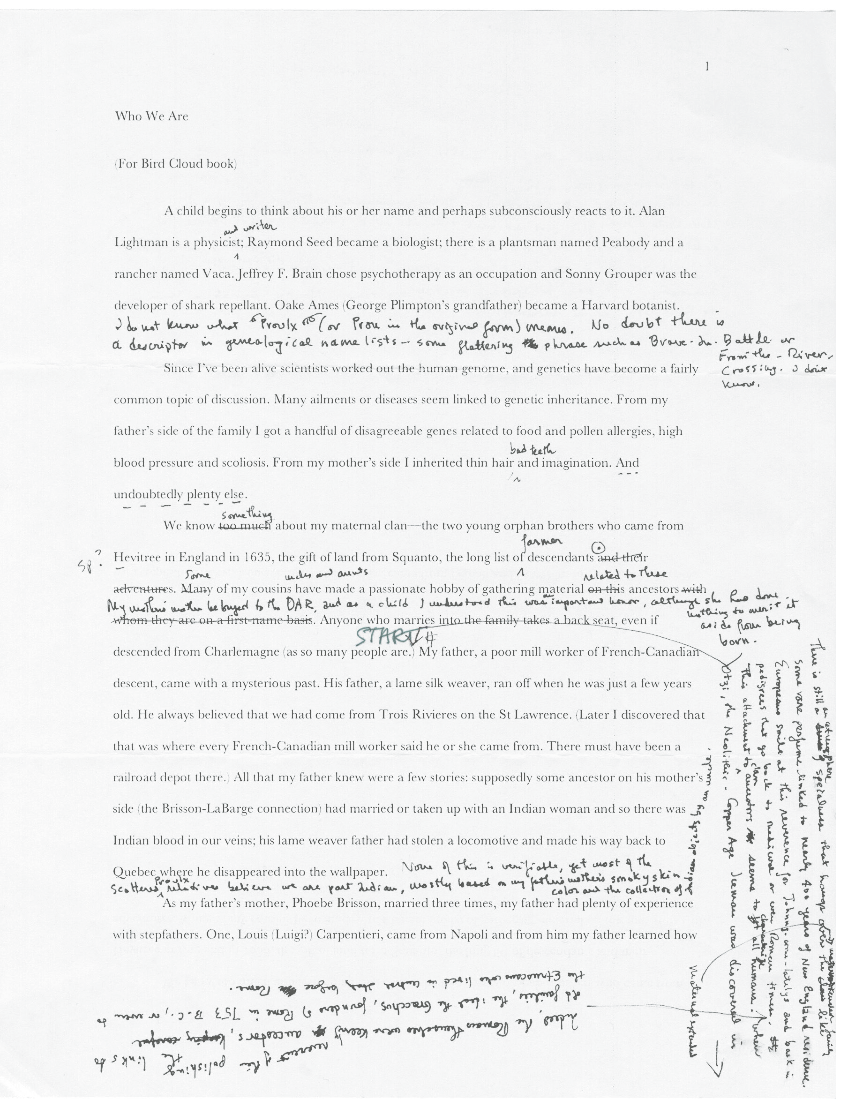
You’ve had several names yourself. Your first stories are credited to E. A. Proulx, but now it’s just Annie Proulx. Why did your name change?
PROULX
When I first started writing stories and trying to place them in the outdoor magazines, they insisted that it be E. A. Proulx so the guys who read these magazines wouldn’t think it was a woman writing them. Sexist editors. The ones who suggested it were from a small Vermont publication, and I got back this awful letter, full of bad spelling and clumsy syntax, suggesting that I should change my name to initials. Very tiresome. I went along with it, and then it became E. Annie, and then finally I got sick of writing E so it just got dropped.
INTERVIEWER
The earliest of the Vermont stories that ended up in your first collection, Heart Songs, appeared in Gray’s Sporting Journal. How did you start writing for them?
PROULX
Well, in those days I was an ardent fisherperson and bird hunter. And any stories to do with blood sports or the outdoors—hook-and-bullet stories—went in men’s magazines. Stories like, “I Was Attacked by Eighteen Lynxes,” or whatever. So when Gray’s came along everybody who was even faintly literate and involved in outdoor stuff was thrilled. It was beautifully produced, the illustrations were top-notch, and there was good writing in it. After the magazine first appeared I bought an issue or two and finally subscribed to it. One of the writers that I knew suggested that this was something I could do. I wrote something, sent it to them, and they published it.
For the late eighties they paid magnificent sums of money. They paid a thousand dollars for a short story, which was big bucks then. But there was a group of us who wrote for them and hardly ever got paid because they kept running out of money. I swapped a story for a canoe at one point. It was a three-way deal where Gray’s ran an ad for Mad River Canoes, I got a canoe, and they erased the cost of one story. It worked out pretty well—I think the canoe was eleven hundred dollars. I named it Stone City after one of the stories Gray’s published.
INTERVIEWER
You seem to have spent a great deal of time outdoors.
PROULX
All my life I’ve lived in rural places. My mother was a painter and very much involved with outdoor walks and sketching and so forth. But it was only when I was an adult that the outdoor world became intensely important to me.
INTERVIEWER
What did your father do?
PROULX
My father, of French-Canadian lineage, left school at fourteen to work as a bobbin boy in the cotton mills of Rhode Island and Connecticut. He was ambitious, worked his way up the ladder to become a vice president of a textile mill.
I had four sisters and all of us ended up liking the outdoors. We went on a big vacation every year, camping in Maine, usually along the beach at Reid State Park in Georgetown. What I remember is a vast expanse of water, and when we were kids we always used to go early in the spring, just as early as possible. It would always be freezing cold—March on the seashore, and of course you had to go in the water, even though it was like the Arctic.
My family is all from the East. I don’t see them much now, but I did go to a big family reunion this summer in Litchfield, Connecticut, and saw people I haven’t seen in decades. My family has had property in Connecticut since 1635. They are so wedded to that past, and it’s so important to them in a way that it’s not important to me. This whole question of memory and history and the tangle of one into the other.