David Ignatow keeps an apartment in Queens close to York College where he teaches—four small rooms with bare walls. The windows of the living-room look out on a quaint cemetery dating back to the late 1700s. On its far side runs the BMT Jamaica subway line, one of the few remaining elevated trains; every so often one hears the sound of the train approaching the 168th Street station. The sparseness of the apartment does not suggest poverty, but nor are there indications of an aesthetically enriched life: Ignatow has no study. He maintains a modest library, two or three filing cabinets, and a typewriter, all in the bedroom.
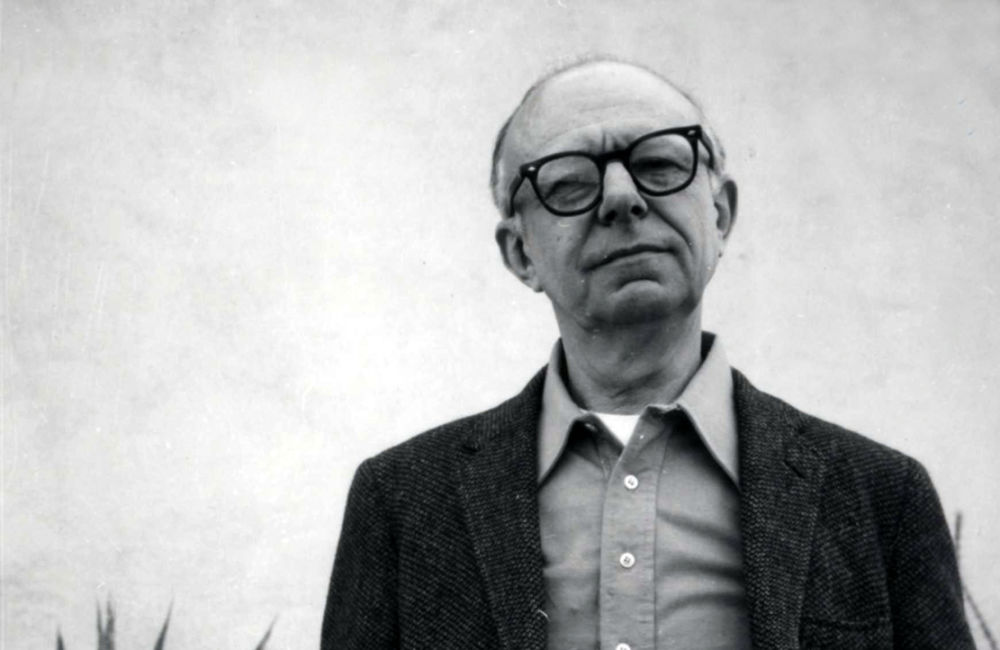
Mr. Ignatow, who is now in his early sixties, has grown a prominent silver-white moustache over the past few years which has served to tone down what was a rather severe demeanor. His voice is somewhat high-pitched and hoarse, with little of the accent one would assume from a Brooklyn upbringing.
The poet is a singular instance of a man rising to eminence late in life. He tried for years to be a businessman, a career for which he was not suited. He wrote poems during this time, and much that he observed with a photographer's eye of everyday life in the business world is incorporated in his writing. At first, his career as a poet was no more successful than his business practice. A study of his Notebooks indicates the struggle against academic jealousies and prejudice, and the neglect and hostility of his contemporaries, especially in the forties. Now it appears his time has come. He has written and published, never with great success, but with an increasing reputation (his last two books are Facing the Tree, 1975, and Tread the Dark, 1978) that has brought him honors including a Guggenheim Fellowship, the Bollinger Prize, and an award from the National Institute of Arts and Letters “for a lifetime of creative achievement.”
INTERVIEWER
Do you consider yourself vulnerable?
DAVID IGNATOW
Vulnerable, damn right. But the fear of being vulnerable prompts me into bringing myself forward. It's like being on the battlefield. As you engage in battle, you begin to feel fear; but as you make contact with the enemy, he's almost your friend because he's reducing the fear to excitement and participation. In Facing the Tree there's a poem about Croatian guerrillas who are being executed, and they keep identifying with the executioner. It's strange. It's terribly ironical.
INTERVIEWER
In your poems where you show your anger do you feel a danger in having your vulnerability misunderstood?
IGNATOW
I couldn't care less. This is what I have to feel, this is what I have to write. This is the life, this is the life. I'm living it.
INTERVIEWER
Do you feel “visceral” is an accurate description of your poetry?
IGNATOW
Very much so. My poetry is a gut reaction. I've lived a gut life for so many years, and I guess I still do. When we talk of the gut, I mean literally sometimes being worried where I'm going to get the money for the next rent. Always living on the fucking edge.
INTERVIEWER
Anthony Burgess said, “The scientific approach to life is not really appropriate to states of visceral anguish . . . ”
IGNATOW
That's very good. Visceral anguish is really survivor's experience, he who fights his way back from the edge of a cliff or burrows his way out of a locked cage, out of the coal mine . . . a perpetual struggle.
INTERVIEWER
What is the worst thing that could happen to you?
IGNATOW
Well . . . losing my job, being out of money. Problems of love, problems of human relationships are secondary. Emotional problems have a way of resolving themselves.
INTERVIEWER
You write in the Notebooks that pain is your favorite subject. Do you still believe that?
IGNATOW
I have probably passed that point in my life. Things have changed. I don't intend to go on living a life of pain and celebrating pain. I have experienced a tremendous joy in the last three years. I've been fantastically happy in long spurts. This is something I haven't had for many years.
INTERVIEWER
Over the years, you seem to have become more preoccupied with prose poems. Does this visual change in your work correspond to the way you've changed your life? Have you become impatient, or more patient with yourself?
IGNATOW
Well, the lyric has limitations. I've found myself impatient with the lyric form. And that's the reason I changed my style, a rebellion against the traditional, contemporary, lyric form of, say, William Carlos Williams. I had had it that way. I found my language was responding to the form rather than to my sensibilities. I was getting a little too self-conscious about it. So I decided: Cut loose and give emphasis to the imagination rather than to the line. By “imagination” I mean also the intelligence within the imagination, giving the intelligence its opportunity to explore the imagination as far as it will go. Of course it has a form, but it's a form that constantly renews itself because the intelligence is restless. Emotions tend to repeat themselves over and over again, whereas the intelligence is constantly renewing itself, recreating itself. Therefore, I feel in the prose poems the emphasis is on the intelligence with an undercurrent of emotion. In the lyric form the emphasis was on the emotion and the intellect was the undercurrent. I'm also following Pound's rule, that poetry should be as good as good prose. That it's a vernacular, colloquial thing. And vernacular, the colloquial, doesn't sing. It talks. If you want to sing, then you write an elevated line, an elevated language. Occasionally, I'll do that. There are moments. But, on the whole, the contemporary tradition is talking. And if that's the case, then why not come out and use the prose line?
INTERVIEWER
When you started to write, who were your chief influences?
IGNATOW
At first I was very pleased to model myself on Hart Crane. But then I knew I wasn't a Crane temperament; I felt much more closely aligned with Whitman, so I began to model myself on him. Then I found that I couldn't quite grasp the Whitman thing because he was just a little too euphoric for me. So I went away from him and I went to Williams. Williams repelled me at first. He repelled me because he was so . . . I felt he was so literal, so prosy. Where is the poetry in all this? I kept thinking. And then all the praise he was getting from people had me hanging on the ropes. I said, I've got to come back and read him again. So I kept going back and reading him. And I was finding myself in experiences which were shockingly similar to the experiences he was recounting in his work. And when I started to write these experiences, I saw that I was using his techniques. There was no choice. But then, my life diverged from his in many respects. First of all, he was a physician. And my lifestyle went in the opposite direction. So I began to reshape the technique according to my lifestyle. Then I met César Vallejo on the page and, boy, he flipped me out! Then, I said, I'm going to let loose.

INTERVIEWER
Who have been some of your other influences?
IGNATOW
I learned the surrealist technique from Russell Edson. Before I read him I had made a jab at surrealist poetry and I dropped it very quickly, because my life became much too complicated and in need of direct confrontation to keep it simple. But later on I was reminded of my past attempts when I read Edson. I said, Gee, I must try it again. Then, as I said, Vallejo was very important to me, the intellectualization of states of being that I think characterizes his work. The extraordinary combination of the guts and the mind . . . how they get together and inform one another. He's a metaphysical poet. By metaphysical, I mean he's a man who's constantly seeking values. Neruda, too . . . the whole Spanish school of poetry gave me much to think about. They drew me away from the Whitman tradition and I thought myself freer . . . freed of the Whitman tradition.
INTERVIEWER
And yet you're often characterized as the son of Whitman and Williams . . .
IGNATOW
I know, but I don't believe it altogether. I have a lot of bizarre, surrealistic, macabre images at work in my head. The ill curse of contemporary life. I think if Williams were alive today, he would've gone in that direction. As for Whitman, if you take him seriously you have to swallow the whole bit about man's divine origins and all men being equal. I reject that. I don't see it in practice, therefore it doesn't exist for me.
INTERVIEWER
So, you don't use Whitmanesque techniques anymore.
IGNATOW
I still use some of his repetition, parallel structures, chanting, incantatory style . . . but it's more evident in my earlier work. It grows much tighter and more intellectual, more imagistic with the years because of my study of men like Neruda, Vallejo, Machado, and the French poets.
INTERVIEWER
When you came upon the surrealist poets, did you feel that the Whitman tradition had limitations for you that forced you to move on to the surrealist poets?
IGNATOW
The limitation in the Whitman tradition was its openness to everything at a time when it seemed wrong to be open to everything. That is, to accept evil, the kind of evil that was going on, to believe that it could be transcended or transformed or used. I didn't think that any of this could happen. The pivot really is my turning toward the existentialist movement . . . I felt man ought to judge himself . . . there was no one else to appeal to, contrary to Whitman's work, that there is a final arbiter in life. I don't think so. An arbiter beyond the personal, beyond the individual . . . I don't believe it. But Whitman tried to straddle two concepts: the individual as a unique person with a strength of his own and the concept that beyond the individual, since he was of a divine source, was still a greater force towards which he was progressing to perfect himself. I had to throw all that out; I was left with the individual. That was it, which unraveled the whole Whitman tradition for me. Therefore I had to turn to other sources and other sensibilities. And these were men like Rimbaud and Baudelaire and Williams and the Spanish poets who dealt with pain—from suffering, from severe deprivation: mental, physical, social, universal. And yet they sought to expand their world. They sought to include the entire world in their pain and suffering and their anguish towards a freer life. The kind that Whitman sought for . . . the kind that Whitman thought he had, but, in other words, they were going through the door of life, whereas Whitman thought he had opened the front door.
INTERVIEWER
A Mexican writer, José Gaos, was quoted in Octavio Paz's beautiful book The Bow and the Lyre as saying: “As soon as a man enters life he is already old enough to die.”
IGNATOW
That's good. When you assume that knowledge, you begin to live a very vital life, because everything you do is in the background of immortality. The background is the immortality of death. That's when you can say you are a man in the full sense of the word. You've become an existentialist. That's what it's all about.
INTERVIEWER
How old were you when you first began writing?
IGNATOW
About sixteen when I realized that I had some kind of gift.
INTERVIEWER
Were you excited because all of a sudden you realized that you were dealing with a secret language?
IGNATOW
No. I was able to make things vivid on the page. I could recreate, I could bring life to a page. That's what I was thinking about. To see my visions on paper almost exactly as I had visualized them, being read and viewed with pleasure the way I viewed them myself. That's what amazed me. I didn't will myself to become a writer. It was just a natural outgrowth of the pleasure readers got from my work. I wanted to give pleasure and give myself pleasure. It wasn't a dry fuck, in other words.
INTERVIEWER
Does it help you as a writer to go for long periods without sex?
IGNATOW
Sexuality, in itself, is quite a distraction. It's an art in itself. It requires a very intense concentration, delicacy and nuance, and that takes a lot of practice . . . knowing the other person. If your time is limited, that really can cut into your writing. It's really a common problem. Our profession requires almost a total concentration of personality and the moment you start to divert yourself, you begin to lose your grip . . . and you drift, and you become quite irritable about it, too.
INTERVIEWER
In the Notebooks you say: “Being a poet is to know you do not exist by poetry.” What does that mean?
IGNATOW
I guess, at some point . . . you have to think you exist for poetry. But if you remove love from your life or you remove, say, the financial security from your life, then you know that poetry plays a very minor role. This is the Age of Survival. That's the point. If life wasn't so dangerous, and we had a stable form of society, then I suppose poetry would play a more prominent role. When did I say that, by the way?
INTERVIEWER
1964.
IGNATOW
Well, I was going through some real shit problems then. Very heavy financial burdens. My business had collapsed. Not “my” business, the family business. I had sold it in 1962. After my father's death, I left myself out on a limb. I sold it for nothing! All I wanted was to get free of the whole entanglement.
INTERVIEWER
You seem profoundly energetic as a teacher of other poets, and also prolific as a poet in your own right. What is the relation between these activities?
IGNATOW
Teaching poetry has stimulated me no end. At the beginning it was virtually an explosive experience! Because, as I had to get up there and discuss poetry, I was really, finally, articulating ideas that had remained unsaid in my mind. The whole thing illuminated my past and my present, and I found myself taking tremendous leaps forward as a writer.
INTERVIEWER
How do you feel when someone imitates you?
IGNATOW
I'm uneasy.
INTERVIEWER
When you started writing poetry, were you interested in something like what John Wieners calls “the fellowship of poets”? Were you eager to meet a lot of poets?
IGNATOW
Very much so. I thought poets would be the ideal candidates for a community of spirits. I still had the Whitman thing in me. But the more I became familiar with poets, the more I recognized that they were limited human beings, like myself. I was extremely excited to see how different they were from me, which accounted for the difference in their poetry, too. So, I'm still interested in meeting poets. I like to talk with them. I like to feel them out. I like to read their work. But I'm not searching for myself in their work; I'm searching for something that affirms differences—creative differences—between us.
INTERVIEWER
Do you ever feel lonely?
IGNATOW
Oh, sure. I'm lonely most of the time. I'm always after company. I guess when I'm writing I feel I've suddenly made company with myself. You become your own guest.
INTERVIEWER
Or your own audience.
IGNATOW
Yes. And that's fine. That's very nice. Out of a day, that represents three or four hours at the most. There are times when I can find myself in a book, too, for two or three hours. But afterward I have such an urge to go out and reach for other people. Very often they're not around. There's also a metaphysical loneliness. We all feel it. The burden of living one's own life is experiencing sensations that no one else can share. You take a step in a house, you start moving around the house, no one else moves with you. You're walking by yourself.
INTERVIEWER
You're living alone? Do you prefer living alone, or would you rather have someone living with you?
IGNATOW
I'd like to have someone living with me. My family is out in East Hampton. We're separated for practical reasons. I have my work here; my office, my schoolwork. I travel out there on weekends. But when I'm there I get very restless because it's a totally isolated area. I've lived long enough in the country; I've done some nice things on the life lived among trees and rabbits and fox and geese . . .but now I want to come back and hear the gunfire and watch the drunks vomiting in the street and hear the buses roaring on the avenue. Actually I'm getting to the point, living here by myself, of getting used to it. I'm used to living in a domestic environment, with a family . . . all my life. Brought up . . . surrounded by family. So this is the first time I ever pitched myself into this sort of thing. When I left my parents' home I got myself a small apartment in New York in the Village and I started housekeeping. Then I went out hunting for women . . .you know, someone to share my life with me. Now it's all settled . . . I'm not looking.
INTERVIEWER
Back to the Notebooks, again, you speak quite a bit about isolation. Do you feel more or less isolated now than at the beginning of your career as a poet?
IGNATOW
Much less isolated now. I know there are people out in the world who have read my work and who know what I'm doing.
INTERVIEWER
In the past you were isolated, culturally from your contemporaries. How do you account for this?
IGNATOW
The New Criticism was in ascendance in the forties; also I was isolated from the proletarian school of the thirties, because it was so totally ideological . . . the Communist Party, the war poets. I didn't go to war. Being married, I was deferred for quite some time. When the war was coming to a conclusion I was called up, but I had some kind of heart murmur. The Japanese attack, the Nazi horror, the Italian fiasco . . . none of this really affected me. I was so deeply involved with my personal domestic relationships even in those years. Since I did feel myself to be a very private man, it explains why I have an antipathy toward the school of proletarian poetry in the thirties, and why, in turn, I had antipathy toward the whole school of New Criticism. The sort of poetry they were writing was metaphysical in the most tenuous sense; they were philosophically oriented and in their work they began with a principle or a hypothesis and then tried to create the poem from either one. Whereas I was deriving my poetry directly from life experience. In that sense I was anticipating the poetry of the sixties and the seventies. So, I was isolated for a good many years, because I was such a personal guy. And it was only in the early sixties that poets began to flourish within themselves as the so-called confessional poets. But I wasn't a confessional poet either.
INTERVIEWER
In a sense you were, but not in a pretentious sense.
IGNATOW
No, I wasn't flagellating myself or exposing my weaknesses just to show how weak a person I was as Randall Jarrell and Robert Lowell and Sylvia Plath were.
INTERVIEWER
Your situation is very unique. Is there another poet that is similar to you?
IGNATOW
Of my generation? No.
INTERVIEWER
Were poets like Meredith and William Jay Smith and Jarrell and Eberhart aware of your presence?
IGNATOW
Jarrell wrote a favorable, very short review of my work. He called me a street Sophocles or something like that because I would take the theme of Hamlet or the theme of Oedipus and put it in the language of the living room, the language of ordinary conversation. And to him that was remarkable. Otherwise, I was a total nonentity.
INTERVIEWER
You went your own way, you were your own man, your own poet.
IGNATOW
Right. Really, I'd been formed much earlier in my life by the experiences in my parents' home. What I saw there left its mark upon me ever since. I saw how important it was to maintain personal initiative, to remain an individual. Because with my parents I was always in the precarious position of being submerged in their interests and subjected to their manipulations. And I had to fight it and discover myself. Discover myself through this conflict. I extricated myself from their demands on me. And that is the traumatic experience I think I brought into my poetry that was so different from everyone else. I found it very difficult to be accepted by magazines in those years. The styles were formed in schools, you see, and poems had to be recognizably from one of these.
INTERVIEWER
And the WPA was obviously one particular school.
IGNATOW
It was a school in itself. Strangely enough, I wrote very little about my WPA experiences. Almost nothing. I had some remarkable experiences on the WPA, and on relief, and I never got to writing about it because I felt to do so would violate my individual integrity. I must have been terribly neurotic about it.
INTERVIEWER
There were instances—moments or topics—in the Notebooks where I wished you would have elaborated more, such as the passage where you say: “What is it about my life I don't like? It is the lack of more fame, the uses of oneself that come from it, the sense of belonging.”
IGNATOW
What an awfully self-involved person that is!
INTERVIEWER
Was it because you were not recognized or famous that you felt isolated?
IGNATOW
Well, in order to be famous, you have to write a poetry that's accepted by people whose opinions you respect. And in the early periods I was trying to do that. But after I had written the kind of poetry I thought deserved the respect and attention of people whose opinions I respected, I discovered to my dismay that I was writing a kind of poetry that really did not relate to the taste or interests of my generation in any way!
INTERVIEWER
Are you interested in fame or in being famous?
IGNATOW
No, I just want to be useful. To me, fame means contributing. Giving the community something helpful.
INTERVIEWER
A nourishment.
IGNATOW
That's all, and being nourished back in return. Giving it love and getting love in return. To stand apart on some platform and people wave their little white handkerchiefs at you? That's horseshit. That's movie idolatry.
INTERVIEWER
In your opinion, who were the prominent poets of your generation?
IGNATOW
Lowell, Jarrell, and Berryman. And I was divided from all of them because my experiences were not their experiences. My style and my lifestyle are altogether different from what theirs were. The war psychology those guys brought home was such a strong social bind on them; they couldn't get away from it. A guy like Jarrell made a deliberate effort after returning from the war to be personal in his world and it just wasn't convincing on that level. He couldn't get into the adult stage of his life. Berryman made a very slight attempt to reach out to me . . . we met at a party . . . a reception for, I think Edwin Honig and his wife. That was more or less at the beginning of Berryman's career. I think he had just completed Homage to Mistress Bradstreet. At the party he called me over and we talked briefly, less than one minute, and I just sort of clammed up. I wasn't interested. Because that poem didn't interest me. It was highly artificial to me, tremendously willed artifice, and I was turned off by it. That explains a lot of my isolation, you know. Generally, generations stick together and they take to each other and they help promote each other. I didn't experience that, though the others promoted each other a great deal. The generation that followed them began to take notice of me. The younger generation. The generation of Harvey Shapiro.
INTERVIEWER
Well, has your current fame altered your sense of vocation?
IGNATOW
No, I'm still struggling to be the guy I dreamt I was going to be when I was a child. That dream. I don't think I am anywhere near it, to be the exponent of the national sensibility, whatever that is. No, the vocation of writing poetry means remaining a private poet. When I write my political poetry it's as a private citizen. Fame hasn't changed much, except that I have a wider and heavier correspondence than I ever had before. And I may have to get an answering service. And the fact that I have helped edit an important magazine like the American Poetry Review is something I'm rather grateful for.
INTERVIEWER
Why did Williams mean so much to you?
IGNATOW
Well, he was a poet of national reputation who came out in the New York Times with a review of my first book to call it a potential national best-seller, strangely enough. I felt I was confirmed as a poet. And from then on I could feed on that in a dry season, and fed on it for many years. It watered my desert, my loneliness, for a long time.
INTERVIEWER
In what way was he useful to you that was different from other poets?
IGNATOW
He was useful in his being present, on the scene—in this country as a person. Without him, American poetry was impoverished for me.
INTERVIEWER
But he was also getting a lot of negative feedback . . .
IGNATOW
That's right. This is what astonished me, finally! When I began to recognize that he, too, was almost as isolated as I. Nevertheless, he was somebody. He was respected, endemic to American poetry. He represented the American grain. He made life important.
INTERVIEWER
Did you feel that certain poets refused to acknowledge you as a poet because of your allegiance to Williams?
IGNATOW
I think that happened. Oscar Williams tried to cultivate my friendship at one point. I was witness to a confrontation that he had with Williams one day and Oscar Williams was so nasty and insulting to William Carlos Williams. And Williams was sitting there very patiently smiling at this guy, not letting himself lose his temper. But Oscar was like a buzzing fly diving in on him. And I developed an intense dislike for Oscar Williams after that. That immediately disenfranchised me from the other poets he was publishing and left me out of his anthologies forever.
INTERVIEWER
So, you felt even more isolated for supporting Williams?
IGNATOW
I think there was an intensification of my isolation as a result of my allegiance to Williams, yes. Of course, it was happening anyway. I couldn't publish in Poetry or Accent. The stuff was automatically sent back. That was the school of New Criticism. I wanted to be part of the establishment. I thought the establishment could have some variety within itself. In the Whitman spirit. But, of course, I should have known better. Ransom was a gentleman and not a Whitmanite. A gentleman that preferred . . .
INTERVIEWER
Tea and biscuits. So, the critics had a headlock on the scene?
IGNATOW
Total censorship.
INTERVIEWER
How would you evaluate Lowell's influence?
IGNATOW
When Lowell came along, he—his style—completely cornered the market in magazines like Partisan Review, the Nation, the New Republic, the Atlantic Monthly and Harper's. Most of us were under the shadow of his fame. And those of us who couldn't conform to that kind of writing were shuttled off into the little out-of-the-way magazines.
INTERVIEWER
But he was a breath of fresh air . . .
IGNATOW
Oh, yes. His early work is exceptionally good. So he was a double-barreled power, a genuine poet whose influence blanketed the entire northern sector.
INTERVIEWER
And he also helped to carry certain poets, like Delmore Schwartz . . .
IGNATOW
He nurtured them. But that's past now. Passed into the shadows. The whole school has just evaporated.
INTERVIEWER
How did Lowell's influence affect Williams's influence?
IGNATOW
At the time, Lowell's prominence in the northern sector was tremendously damaging to Williams's literary influence. Now, to Lowell's credit, he was able to see into the work of Williams. Lowell became a very good friend of his. And Williams learned to tolerate him and became quite affectionate. So, when Lowell published Life Studies, the influence of Williams was marked.
INTERVIEWER
Getting back to you . . . to what do you attribute your survival during this long, lonely, struggling period of isolation?
IGNATOW
Well, I had a friend here and a friend there and my wife was very strongly in my favor, which was great. She worked with me closely on my poems.
INTERVIEWER
Is it possible for you to specify some of the things Williams enabled you to guard against?
IGNATOW
Against a romantic view of life. Against elevated language. Against trying to make a leap into something that didn't exist. He taught me to guard against being dogmatic, didactic, opinionated . . . He taught me to stay within the circumference of the experience. If you know your limitations and cultivate these limitations to their limits, that will extend you into the very next area, which you may not be able to get into thoroughly, but at least you'll be anticipating something that goes beyond your limitations.
INTERVIEWER
In the Notebooks, you say that you met with resistance from your father about your poetry . . .
IGNATOW
Yes, very strong resistance. It was harrowing, to say the least. I began working for him about six months after I graduated from high school; I was about eighteen and a half, with no job and no prospect of a job. This was deep in the Depression, 1932 going on 1933. Well, I had no choice. I tried staying home for a while and writing. I had the illusion that if I wrote the great short story, I would make my whole family rich. I was aiming at the Saturday Evening Post, and I wrote a story about a couple that meets on a trans-Atlantic liner, they fall in love and get married. She was rich. That whole number. He was a writer. Writing in big, romantic slashes. Well, it got turned down, of course. So, I realized that I wasn't going to make the family fortune as a writer. And that sort of collapsed my resistance toward my parents. They were trying to be very patient with me. They were in very desperate financial straits at that time. The old man was living on a quarter a day! You could have a bowl of soup for ten cents, and you could have a roll and butter for a nickel, and I suppose the other ten cents went for goodies of some kind. Well, when he came home he was desperately tired. And I could see his whole appearance changing under the circumstances; he became quite gaunt. But I absolutely had to be a writer. My old man had a little insight into these things. He came from Russia and loved Russian literature. He had books at home. But that was during his period as a worker. He was quite a man, quite an affable guy; very sociable and very loving. But somehow he was influenced by his brother, who was rather wealthy, to become an enterprising businessman and he changed. But when he was younger he told me stories by Dostoyevsky and others, which I found fascinating. He had such a great love for these writers that I said: “I must emulate them because I want that kind of love from my father!”
INTERVIEWER
In the long run, it was a reaction that worked against you?
IGNATOW
Right. He humored me for a while, for six months; but I had no skill at that kind of Saturday Evening Post crap. Well, bite the bullet: I had to go to work. That's when the real tension started between us. We fought like cat and dog. Many a time I thought I was going to kill him; many a time I thought he was going to kill me. It was awful. Very often I'd leave the shop when everyone else would be working overtime. I'd try to eat and rest and get my strength together to write. He'd come home at eight o'clock and say, “Where is that bastard?! Where's that son of a bitch!?” It really broke my heart . . .because I knew how much he loved me.
INTERVIEWER
What did your job consist of?
IGNATOW
The business was a pamphlet bindery. Machine work. Or I had to push carts through the streets downtown, just above Canal Street. That's how I became acquainted with the Village: loading the pushcarts and hauling them over to the printer. I was in the business on and off. I'd run away. I tried to join the army; the army turned me down. Then one day I said, “I'm finished, I'm never coming back again.” And I had exactly ten cents in my pocket. So, I took the train to Borough Hall in Brooklyn; I had heard that boys would gather around the fountain there and form groups. Then they'd go out through the country, looking for jobs or taking freight trains. Anything to get away . . . So I decided I was going to do that. I could see they were a tough bunch of bastards: very hardened, cruel, cynical guys. They'd been through much worse than I had. They had no good clothes on. And I was fairly well-dressed. They scared me. “Christ, if I get in with these guys, I'm going to be really finished! Where's my career as a writer?” I had spent five cents for fare and I'd spent five cents for peanuts. I had no money. So I walked over the Brooklyn Bridge back to the shop. I walked in. The old man turned around and saw me. There was a big grin on his face. He went to the telephone, called my mother and said, “He's here. Your little boy is here.” So that fixed me for about a year. I ground it out from eight in the morning until five, five-thirty, working and trying to write at night. It was awful. But I wrote.
INTERVIEWER
What characteristics have you inherited from your parents?
IGNATOW
My mother's stubborn pride and my father's highly mercurial temperament. Within a half an hour he could show you seven different sides of himself: very excited, or very warm, or very angry, or very jovial. He had a creative temperament. My mother had a staunch capacity to stick with something . . . stay with it and endure it. I have that very much, too. She was very stoic, a very strong woman. The post in the house . . . you know, the anchor. She kept the whole thing together. From her I learned how to handle domestic problems, money and emotions. I always remind myself of her steadfast plodding manner in the house to compose myself under stress in my own domestic relationships.
INTERVIEWER
How did you finally get out of that job?
IGNATOW
I think it was in 1932 or 1933. I'd published a short story that was named on the honor list in the Best Short Stories of the Year anthology. And out of the blue I got this letter! The WPA was looking for writers to fill its Writers Project. A godsend!
INTERVIEWER
Could you settle down and work any place in the States other than New York?
IGNATOW
I don't think so. I've turned down teaching jobs in Berkeley, Michigan, Kansas . . . I would not have kept my voice there as a poet.
INTERVIEWER
You're quoted as saying that the writing of a poem is a celebration to you, “ . . . the experience of one's everyday life that readers can relate to.” Have you found a joy in despair? How can a poem of pain also be a poem of celebration?
IGNATOW
Well, there's no suffering without life, there's no life without suffering. Put on the coat of life, and it has two sides to it: It has suffering and joy. It all depends what the weather is. If the weather is joyful, you turn the coat on to the joyful side; if it's full of suffering, you turn it to the suffering side.
INTERVIEWER
When did you begin to recognize this element of celebration in your poetry?
IGNATOW
If there was a turning point, it was when my son's breakdown happened. I was ready to give up. But what was I going to give up? I mean, I've seen the worst already, what worse could there be? He needed me to at least survive his own ordeal, and I had to stay well. And I had to stay well for my wife's sake, too. You can't go on despairing . . . it'll drown you.
INTERVIEWER
There was one very vivid passage in the Notebooks where you run into your son on the street carrying your diaries . . .
IGNATOW
My notebooks.
INTERVIEWER
. . . to oblivion.
IGNATOW
And I didn't stop him. Amazing. I didn't stop him, because I felt so sick, so sick of everything already . . . He dumped them in the Hudson River. I just shrugged . . . And I said, “Oh, he's got the notebooks on him . . .” He even said to me, “I've got your notebooks in here.” He threw away a couple of years of notebooks. I just shrugged and went upstairs. He went and dumped them into the Hudson River.
INTERVIEWER
What's he like, your son?
IGNATOW
In a rather crippled way, he's a survivor. It's interesting. I tend to agree with Laing that the emotionally disturbed child is simply not bound to the culture and would like to free himself of the culture, and this is the only means he has with which to express his independence. We immediately term these people insane, but they're not . . . They have created a different order of existence for themselves, which doesn't have a base in reality. They can't organize a society around themselves; they don't have the means with which to do it. They're powerless, absolutely powerless. They have to be put in a special category, a special place. My son continues to have hallucinations . . . different people, voices. But he's very practical minded. He knows that he's getting enough money on supplemental security income to cover his expenses; whereas, if he were to go out for a job, he couldn't make any more than that. And he might be in danger of rebelling again and once more become really incapable of handling a job. So, he thought all this out; he decided that this is it, this is what he has to do; he has to stay where he is until he can really recover himself, and integrate with society the way he sees me integrating. I can understand it. I'm quite sure that if he were to drop from SSI and be forced to take a job he'd crack up again. Because, to him, society in that sense is worthless, doesn't mean a thing.
INTERVIEWER
How old is he now?
IGNATOW
In his thirties.
INTERVIEWER
Has the relationship now improved between you and your son?
IGNATOW
Well, I spent thousands and thousands and thousands of dollars on him at one period. I broke myself. He'd come out, go to a psychiatrist. He came out three times. And back three times. So I had no more money. There was nothing left I could do for him. I was trying to be very close to him during that period, but I couldn't penetrate. Couldn't get beyond his hallucinatory states. Or, when he would have that more or less under control with the aid of a doctor and some medicine, he would be quite a tense young man. It would be very hard to take him into my confidence, or he to take me into his confidence. He was just too tense and he'd be very hard in the house. The whole atmosphere of the house would be so charged with his emotion . . . which couldn't be articulated. He was already nineteen when my daughter was to be born, and he became violent and we had to get him out of the house again. So that was the extent of our relationship. And today he'll drop up to see me occasionally, but there isn't much that we can say to each other. He's lost contact with his old friends and just maintains relationships with the guys around him who are also from the hospital. They talk about baseball, they ride around in a car occasionally, go see this, go see that, and they talk about their meals . . . but it's very low level stuff. No intellectual content in his life at all. He avoids it like the plague. So we sit there and we have nothing to say to each other. He has no interest in my work. I don't know, I could talk to him about baseball all the time. Baseball or good food. That's the relationship.
INTERVIEWER
How do you feel about money?
IGNATOW
Well, I'm not a Buddha in the sense of I can sit under a tree for a thousand years. Who can? The climate doesn't allow for it, anyway. So we need money. We need money for houses and for comforts. To relax.
INTERVIEWER
Are you an impulsive writer, or do you set aside a certain number of hours to write?
IGNATOW
I've alternated between being impulsive and scheduled. When I was living out in East Hampton, during the three grants that I was lucky to get, I organized myself on a morning schedule, and, whether I had anything to say or not, I would sit down at the typewriter and slip in a piece of paper there, and I would tell myself there was nothing to write until something finally emerged, and I'd just keep at it for three or four hours. Those were the years when I didn't have to teach; I didn't have any other schedule to keep except my writing schedule, and so a lot of work got produced. Now, trying to keep a schedule these days while teaching . . . it's impossible! I write when I can.
INTERVIEWER
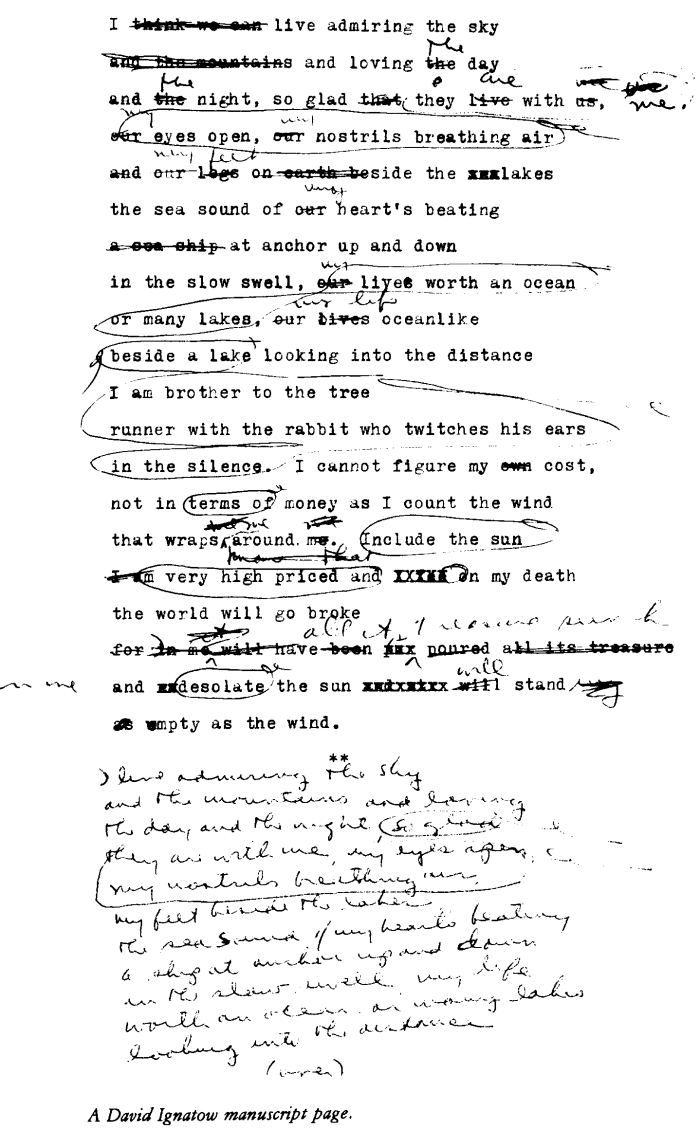
Do you work from drafts?
IGNATOW
Sure. I get the first idea down as fast as possible. Sometimes, it's largely, successfully realized, with just a few little things needed here and there. But I'd say just as often, I have to fool around with it afterwards. Often I want it to grow cold on me so I can go back and become the critic of it. And then, seeing it cold, I see what really emerges and what doesn't, and I can almost instantly supply the needed lines or stanza. In this way I may have three or four poems going at one time.
INTERVIEWER
Do you write a poem straight to its end, or do you write a poem in sections and then proceed to fit the sections together?
IGNATOW
Well, the shorter poems I complete. I can go to forty or fifty lines, and then come back to it and see what I could use. But there were poems like those in “The Ritual,” which were written in steps and stages. Each one had to be written over a period of several weeks; had to rethink it over and over again. I'll often take a lot of short poems, which might have been written over a period of four or five years, and put them in a sequence. I come back to my subjects, come back to my themes over and over again, and look at them differently as time goes by. There's always a new emphasis.
INTERVIEWER
Do your working habits vary with the nature of the poem?
IGNATOW
Oh, yes. Sometimes I can take it quite casually, where I could knock off, say, ten or twelve lines, and just let it rest for a while. At other times, I feel I must go on. I often get an impulse. If I get started on a poem, I feel I must go to the very end of it. And I exhaust myself. Say, if it's a thirty or forty line poem I just have to do it! Nothing can stand in the way; but then, often enough, I find that I've gone too far.
INTERVIEWER
How long does it generally take you to finish a poem?
IGNATOW
Anywhere from ten minutes to ten hours.
INTERVIEWER
How do you know when a poem's finished; how do you know when to stop writing?
IGNATOW
If I feel I'm no longer getting an image, or a metaphor, of what has to be said, or if I feel that the cadences are petering out, or that I'm beginning to editorialize, then I know I've got to stop. If I'm beginning to comment on the poem itself I just drop it. At other times I feel that I may be writing tongue-in-cheek . . .
INTERVIEWER
Does the writing of a poem present answers for you, or merely more questions?
IGNATOW
I think answers, a good many answers. My poems don't raise any questions; all they do is state the facts, or state the situation as is, and I take that as the reality, the solution itself. But, of course, I may go back in time to write about a subject, but it'll be from another angle . . . totally different because the situation is changed for me, as for example, a new context has developed around the whole issue of death, and that for me creates a whole new need for new insights. Poetry, for me, is insight.
INTERVIEWER
Do you make notes for future use?
IGNATOW
I have done it in the past, but I don't need to make notes anymore. A poem emerges from a whole stock of mental impressions I've had from long ago.
INTERVIEWER
Are you very self-critical, or critical of others?
IGNATOW
I'm both. I think I'm critical of myself as a poet. But it remains for the critics to tell me if I'm critical enough. I'm always willing to listen. I think I've done a pretty good job of keeping myself in line as a poet.
INTERVIEWER
Do you find that your work makes relationships with people more difficult?
IGNATOW
It depends. With poets, I don't have any problem. But with the average person, for example . . . here in this apartment house, I'm unable to reach out and invite them to my apartment for coffee and talk; I can't do that. That is the result of being a poet and writing poetry. They, I can see, are people who might be accountants or bookkeepers or garage mechanics or chauffeurs or workers in dress shops. I'll be in the elevator with them. I'll say sometimes, “How are you? Nice day. How's the weather?” and I can see they're anxious to say more, they want to say more. But they don't know how. And I don't encourage it. How could you explain to them what it means to be a poet?! How could you really open up to these people? How could you tell them the most important thought you've had for the day on the subject of emotion, imagination, love or life itself? They'll tell you things. They may want to tell you that they also have a deep emotional life, but they don't have the tools with which to express themselves. They can listen to you. But, they become alienated from you because they're unable to meet you in verbal terms. And so you find yourself talking to impassive faces. And this isn't to say that they don't have those feelings. They do! But they are amazed and possibly resent your articulate abilities; you're opening up areas that they have decided they can't ever reach because it's too difficult. Maybe they even think it's too dangerous to get into that area. It might interrupt their lives. It might affect their work. It might affect their marriages. But here you are articulating. That creates a problem for them, and this is where poetry closes you off from people.
INTERVIEWER
And that separates you. Poetry is the most powerful of the arts and because of this it has the power to make people feel stupid.
IGNATOW
That's the great tragedy.
INTERVIEWER
When you write a poem, do things occur to you that were not at all in your mind when you first started the poem?
IGNATOW
Oh, yes! That's the great joy of writing a poem. Coming to a whole mine of unexplored stuff, and you just dive into it without a helmet and you just hope you survive all that richness that you find. It's a marvelous feeling, digging out a few shovelfuls of that stuff. That's what I look for in a poem, a new adventure, a new depth.
INTERVIEWER
Have you ever described a situation of which you have no personal experience other than a belief in the poem itself?
IGNATOW
Oh, yes. All three ritual poems I've never actually experienced. It's an art to make a poem as convincing as reality.
INTERVIEWER
Do you ever go through periods where you don't work at all? When you find you can't write?
IGNATOW
That's happened. I've stopped writing because I haven't been able to resolve my personal life, where I couldn't face certain events in my life and didn't want to write about them falsely.
INTERVIEWER
What do you do then?
IGNATOW
I keep in touch with people by correspondence. I do a lot of editing. I make phone calls. I worry about money. I see people. I go to the theater. I keep in touch with friends. I keep busy. I wash the floors. I do my laundry. Work on school work . . .
INTERVIEWER
Have you ever written about not being able to write?
IGNATOW
That's what I'm doing in my journals.
INTERVIEWER
How real to you are your poems after the poems are finished?
IGNATOW
Oddly enough, it takes quite a few years to recognize their reality. For example, the poems I wrote in the fifties, when I was writing them, they weren't the reality; the reality was the living itself. At the time I thought that this was just filling in a couple of hours with release . . . relief from torture, or relief from life. But now I see they are the life.
INTERVIEWER
Can you think of any one of your poems in your experience that in its reading has led you to a mood of despair?
IGNATOW
Yes, some of the poems about my son. I sometimes break down when I read them.
INTERVIEWER
Which poem are you most proud of?
IGNATOW
“Rescue the Dead.”
INTERVIEWER
Do you have a stance in either confronting your own poetry as you write it or looking at somebody else's?
IGNATOW
For myself, I try to take the most truthful position toward the poem in relation to the experience. In relation to other poets, I try to remain as catholic in my view as I can. I really will work very hard, where the poem is difficult, to become involved with it and see it from the inside.
INTERVIEWER
Do you have a sense of limitation?
IGNATOW
But definitely. I don't think I could live without a sense of limitation. Sometimes you feel that you're unlimited, but it's very scary. When you're writing a poem that's very exciting. It's so intense you think you're leaving yourself. That's important to experience. In fact it's invaluable. Then you know how close you get to death. What's limitless is death; life is limited. And it's good to get back to life . . . after you've written a poem.
INTERVIEWER
I sometimes get the impression that you find writing poems a burden. That you become restless, that this sense of restlessness can be felt in the poem.
IGNATOW
Sometimes writing a poem is a burden. It doesn't always answer the problems. When you aren't particularly interested in writing, but you have no other choice but to write. That's happened often. It's like being imprisoned, and you have no choice but to do what's limited to the life of the prison. And the writing is hard to do. Very hard.
INTERVIEWER
Are there any poems of a kind that you haven't written before that you visualize yourself writing?
IGNATOW
Sure! I'd like to write great poetic drama! A tremendous epic! I'd like to write great epics. I'd like to write the last poem of the world.
INTERVIEWER
That's an interesting concept!
IGNATOW
I tried that in one little poem. Shall I read it to you? This poem has no title to it, and I thought of it as the last poem of the world.
I am dreaming of the funeral of the world watching it go by carried in an urn reduced to ashes and followed by a horde of mourners a million abreast across the broadest land and all chanting together: We are dead, we have killed ourselves. We are beyond rescue. What you see is not us but your thoughts of us. And I, who am observing in terror of it being true hope not to have to wake up so as to let myself discount it as a dream.
INTERVIEWER
It works on two levels at once: It works on the level of the waking world and on the level of the sleeping world.
IGNATOW
Well, I hope it's not the last poem in the world.
INTERVIEWER
Cocteau said, “Know what you can do well and don't do it.” Would you say that the kind of poem you write or perhaps the prose poem is something you do well, and, with this in mind, have you ever considered changing to another kind of writing?
IGNATOW
I have . . . I have to do something that I can't define for myself now. Maybe it's a return to the direct, very personal lyric. I've been writing a lot of love poems. They are very personal, very direct and open . . . explicit. I'm more comfortable with that right now. The emotion dominates the poem rather than the concept.
INTERVIEWER
Your sensibilities have changed?
IGNATOW
I'm wandering . . . I'm going in circles.
INTERVIEWER
You are read so widely now, among poets and students alike, and studied, in fact, on many campuses, that one rarely meets anybody interested in contemporary American poetry who doesn't at least know your name. In fact, you've eclipsed a great many poets you had to deal with back in the forties. How do you account for this?
IGNATOW
Well, I guess my style anticipated the style and sensibility that today is prevalent among the young and maybe among college teachers. I started out with a sense of doom and frustration . . . my personal sense of tragedy has become the metaphor for the sense of tragedy we feel nationally.
INTERVIEWER
Do you account for becoming generally known among a younger generation of poets because they did not try to write like the generation to which you properly belong by age . . . the generation of, say, Lowell, Berryman, Schwartz?
IGNATOW
Seeing it from the point of view of the students, well, then, the answer would be yes. They wouldn't want to write like Lowell or Berryman. Neither of them took their lives seriously enough or saw their lives in its tragic context. There's a sense of distaste in Lowell's work, a kind of disdain for his life . . . a weariness with it. And Berryman has a kind of contempt, too. For himself.
INTERVIEWER
They're kind of snobby.
IGNATOW
They found themselves in this menial society. They of superior craft, of superior mentality and education and social status, had to deal with these problems of everyday living, which, according to their education and background, should have been of very little consequence to them. They couldn't escape it. So they have a contempt for their material. I had a struggle with my demons, and I took them very seriously and that was the difference.
INTERVIEWER
What is the recurring metaphor of walking that you employ in your work? What does it mean to you?
IGNATOW
Well, walking to me is thinking . . . going from one object to another, a way of working things out.
INTERVIEWER
What do dreams mean to you and how do you apply them to your writing? I'm thinking of such poems as “The Errand Boy” or the poem entitled “The Dream,” which is in Say Pardon.
IGNATOW
They're flashes of insight that penetrate the banalities and clichés of everyday life. I know that something is going on beneath the surface that's really the life we're living, not that surface cliché. So I discovered a good mode of expression is through bizarre arrangements of images we call dreams.
INTERVIEWER
Do you write the dream out as it actually happened, sequence by sequence?
IGNATOW
I invent the dream.
INTERVIEWER
Do you record dreams?
IGNATOW
Actually I don't. Virtually every poem in the book Facing the Tree . . . every dream poem is an invented dream. But these are metaphors for states of mind that are below the surface of my everyday conversation. I invent them in order to have access to the insights below the surface. This is how I state these insights. I can't find any other way . . . I have to imagine.
INTERVIEWER
What is important to you?
IGNATOW
The most important thing is peace of mind . . . growing out of an assurance about one's relationships with others. Relationships that you can count on that won't backfire . . . on which you can turn your back and not fear some sort of a reprisal or betrayal. It's a dependence thing. You have a relationship that becomes a metaphor for your relationship with the rest of the world. And if it's a secure and loving relationship on which you can count for your needs, physical, mental, and emotional to be filled, then you have what most people lack. You have going for yourself a balanced energizing situation. Then you can turn around and put your energy into a lot of different things because you can take this other thing for granted. A person loves you. You know that this love will not fail you under virtually any circumstance. This love is for you and you alone. Something for you that is for no one else. That's important. When you have that I think you have a treasure.
INTERVIEWER
What are you working on at the moment aside from the love poems?
IGNATOW
Well, I'm thinking about how everything is related to everything else. It's a world of oneness, really, which has been hidden from us by the world of specialization into which we are plunged. The world of technocracy makes too prominent and too important such utilities as the refrigerator, or the car, and a special kind of a car, to separate it from all other cars. You can say this all comes from the earth. Everything is from the earth. We're from the earth. We're all intimately involved with one another and with each other. We're intimately related. You can only distinguish yourself by maybe your name, because you might find a mirror image of yourself in some other person and it would amaze you, but it happens. I'm not saying that that mirror image would be writing the same kind of poetry you write. That's not it. But you see responses that are strikingly similar to yours in situations. It raises a lot of questions. The body is attracted to other bodies. All bodies are attracted to one another, really. What then is love? We all love one another. Beneath the surface of race, conflict, social conflict, money conflict, nation conflict, we're all very much alike and we could love one another, at least in the abstract. We know this . . . we've seen it happen. An American soldier falls in love with a Vietnamese girl because bodies are all informed with the same need to have other bodies. So when we see all is one then why do we take one for all? Interesting question. Why do we take one for all? Well, could it be that we will it so? Is this a cultural phenomenon? These are questions I ask myself. If all is one, why do we choose one for all? I ask myself is this necessary? You know this whole concept of romanticizing a relationship. The whole concept of love. Not every society believes in it. They really encourage it in this society and it causes terrible trouble. An awful mess. And I'm the worst offender of all. The Chinese are perfectly realistic. They marry their children to one another before the child is even aware. They recognize that the whole idea of love is an illusion, because it's love for everyone. You have to love everyone. Anyone and everyone.
INTERVIEWER
If you had to describe how you're feeling now in your life and work in a few words, how would you do it?
IGNATOW
Well, I'm drifting, ecstatic at times, sad at times . . . drifting, I seem to be caught in some kind of rapids and I don't know where it's taking me. I'm terribly excited about it, because I willed it.
INTERVIEWER
Do you see yourself in some way being or becoming a major influence on American poetry? Have poets come around to your way of thinking?
IGNATOW
I think most poets have caught up with me now. So I think what I really am is in a kind of a tradition . . . carrying out a tradition, rather than hacking out a new wilderness. From that point of view, it's rather unfortunate if I find poets copying me in any way. I feel that they're falling behind.
INTERVIEWER
What do you think of Allen Ginsberg?
IGNATOW
Ginsberg's influence was tremendously overpowering for a while. I think he is suffering from a decline of his influence . . . if it's of any importance to him. His influence no longer shows itself. By that I mean, the poets who felt him strongly aren't around to give his work that kind of an ambience, that radiance, that intensity it once had. Instead, they've taken his surface changes, his surface appearances. His best work remains very powerful. But, believe it or not—believe this or not!—the young poets I'm in touch with now think that he's almost totally irrelevant for the seventies. They can see that “Kaddish” is a nice poem, a moving poem, but it doesn't affect them. “Howl” doesn't even apply to them. They're not in that kind of a groove. That applies to my work, too. I don't feel myself any longer unaccepted, left out, exiled. And that does something. Except with certain critics, like Harold Bloom, or poets and critics like Richard Howard who have pretensions to the genteel tradition on a plane of abstraction within Transcendentalism, or A. R. Ammons elected to carry on this tradition within Transcendentalism. If that became the dominant sensibility in this country again I would have a fight on my hands again. My own sensibility would once more become radicalized in confrontation with genteelism. But that has become peripheral to contemporary poetry. Writers like Harold Bloom and Richard Howard are peripheral to American poetry. But they never were at the center either, except Ammons who still could be, but, apparently under the influence of Harold Bloom, he has spread himself very thin. I'm one of a group that is at the center, the living center of contemporary poetry today. And that doesn't make me stand out any longer as a major influence. There isn't any poet standing head and shoulders above others today, in that sense. Maybe we're all trying to find a way to emerge from the web in which we are living. Where is the new frontier? For me, it only can be very personal. Whether it has a significance eventually in poetry, I couldn't estimate at this time. But I know that I personally am confronting new frontiers, and it's scaring the shit out of me. It's like being in space. It's tremendously exhilarating, too. I'm going to have to make certain sacrifices. But that's all personal. That's of no significance at the moment in poetry.
INTERVIEWER
You've stated in the Boundary 2 interview that “more than ever I'm convinced that political poetry is here to stay.” What is your own sense of the poet as political writer?
IGNATOW
Politics, to me, means how to run a government. Since we have a social structure that needs someone to govern it there are values involved. To me political poetry is not a matter of getting on a platform . . . And yet the technique by which we can avoid writing a kind of political poem that sounds like agit prop is to do it through the person. The poet should do it through his own sensibility and not through a whole series of ideological statements . . . which to me is ridiculous. I saw that sort of thing being done by the Communist Party in the thirties and I rejected it immediately. Not only was it impersonal, but it was dehumanizing . . . the sort of thing they were asking poets to do. So I decided I had to give up that method, but I couldn't give up the principle of arguing the large issues. The large issues of life and death as related to the conduct of a state, how to conduct a social system. The individual poet must respond to political issues from his own experiences and from reading and from a general sense of what is right and wrong. It can never be ideological.
INTERVIEWER
In light of what we've been discussing in regard to poetry and criticism, Robert Bly stated in one of his columns in American Poetry Review that “we can let the academic imagination regain the control over American poetry that it had during the time of the New Critics or we can fight.” Do you think that this regaining of control Bly talks about now that Williams and Olson are dead, their sphere of influence on younger poets is no longer a threat to academically oriented poets and critics, that one way that we can overcome their regaining control is to follow Lincoln's example of the warrior energy by forcing the issue to band together, to fight them in print where it hurts? I remember reading somewhere Lincoln says,* “To sin by silence when they should protest makes cowards of men.”
IGNATOW
I think that would be a somewhat perverse statement made by Bly, perhaps meant to be ironical. It doesn't sound like Bly, you know. But I think Bly was simply stating the alternatives, otherwise it sounds like what the Communists used to say at the time before Hitler came into power, We got to let Hitler come into power so we can have something to fight for. It's idiotic because the catastrophe was enormous. No, I hardly believe Bly meant that. No. In fact, I think that our view of the influence of Williams and Olson as declining today is not quite correct. The influence is still very great . . . still remains at its crest, as far as I can see from the poems I'm getting for APR and other places. The use of the free form remaining paramount among all poets that I know of, established poets and learning poets. So, I don't see what the issue is here.
INTERVIEWER
Has a new kind of academic arisen lately?
IGNATOW
Yes. Men like Bloom, for example, and John Hollander who writes in free form, but whose poetic sensibility is overly refined and recherché. You don't get the harsh impact that Williams searched for and which Olson also presented. What I mean when I say harsh impact, is the kind of life both of them had to live, which was the only kind of life they had. They had no choices, you see. Neither of them was an academic and neither thought of making his living in college or by writing in such a way as to appeal to a genteel audience. That wasn't what interested them. They had their backs to the genteel tradition and their faces toward the life they were participating in. But what's happened is that the powerful influence of men like Williams and Olson has gone very deeply into the writings of the genteel tradition, so that the academics have had to absorb their techniques and with these techniques are once more reasserting a kind of quietism, an intellectualism that both Williams and Olson would have totally rejected.
INTERVIEWER
Because it wasn't enough . . .
IGNATOW
It's not rounded enough.
INTERVIEWER
Or not enough of a commitment.
IGNATOW
That's right. I'm thinking of John Ashbery, for example, though he reaches passages of acute evocatory insights.
INTERVIEWER
Do you still sense a critical resistance to your work? And where is it coming from?
IGNATOW
I think it comes from the genteel tradition. They certainly sense that I'm opposed to contemplative poetry in the sense of withdrawal from life. I'm very pleased that there are a number of critics who side with me and work towards making my poems better known. But there is still a very strong resistance from men like Bloom and Hollander and Richard Howard. They have a strong resistance because I threaten their basic assumption about poetry, which is that language takes precedence over content. They think through language you learn of life. I say you learn of life through sensibility, which then has to be translated into language. Their tradition is a bastard romanticism. If you look carefully at the romantic tradition you'll see that it began with sensibility. Resistance to the intellectualization of poetry in the eighteenth century. Wordsworth resisting it by personalizing his poetry with the language he was born into and raised with. So the fight is still there. It's a kind of seesaw fight. Right now I would say that the prestigious prizes on the whole are going to those favored by the genteel tradition.
INTERVIEWER
Did you find yourself, after Williams's death, suddenly alone again?
IGNATOW
No, I didn't. I have some marvelous friendships among poets: Jim Wright, Robert Bly, Stanley Kunitz, William Meredith, Harvey Shapiro, Armand Schwerner, Jerome Mazzaro, Ralph J. Mills, Jr. They've been very good to me.
INTERVIEWER
But at the time of Williams's death did you go through the struggle or lack of optimism of some kind of support?
IGNATOW
Well, I felt that it meant the beginning of the kind of regression we've been talking about: the reassertion of the genteel tradition. It had more or less gone into the background. His influence had gained enormously just before his death. The young were flocking to him, learning from him in every way. Well, with his death I felt we had lost a powerful, exciting force in the midst of the enemy, the elite.
INTERVIEWER
It's as if he had handed you the torch.
IGNATOW
That was the feeling I had. Not only me, but he gave it to a few of us.
INTERVIEWER
But I think the others were well on their way already. Olson already had his school of poetry behind him . . . was plunging on.
IGNATOW
Well, I still felt myself alone in the sense that I didn't actually have followers, not that I wanted any; but, you know, it inevitably happens when a poet publishes a large body of work he draws the attention of other poets who are beginners who will tend to model themselves on his work. And I find that makes me very uncomfortable. Your own work returns to you through the psyche of another poet and he or she is not doing it quite the way you would want it to be done. And it's not right. I get poems dedicated to me from poets and some of them really send me up the wall. With the years I came to realize that I had a lot of friends all the while and they stepped forward or I reached out to them, too.
INTERVIEWER
I like what you just said about reaching out to them because you bring across a certain kind of generosity from a part of your personality that comes across in your work as well as in other areas.
IGNATOW
I always seem to find where the water is coming from.
* This quote, widely attributed to Lincoln, is actually from a poem by Ella Wheeler Wilcox.
Author photograph by Gerard Malanga
Andre de Mandiargues, The Bath of Madame Mauriac
David Evanier, The One Star Jew
Norman Lock, The Love of Stanley Marvel and Claire Moon
David Ignatow, The Art of Poetry No. 23
Peter Levi, The Art of Poetry No. 24
Jean Rhys, The Art of Fiction No. 64
Jean Follain, Eleven Poems
Kenneth King, Word Raid
Peter Klappert, Matthew's Other Love Song
Pier Paolo Pasolini, The Ashes of Gramsci
Louis Simpson, Sway
John Wynne, Two Struggling Actresses
David Plante, Jean Rhys: A Remembrance
Michael Hurson, Pencil Drawings
Robert Kushner, Aïda
Richard Thompson, Honest Work