Issue 241, Fall 2022
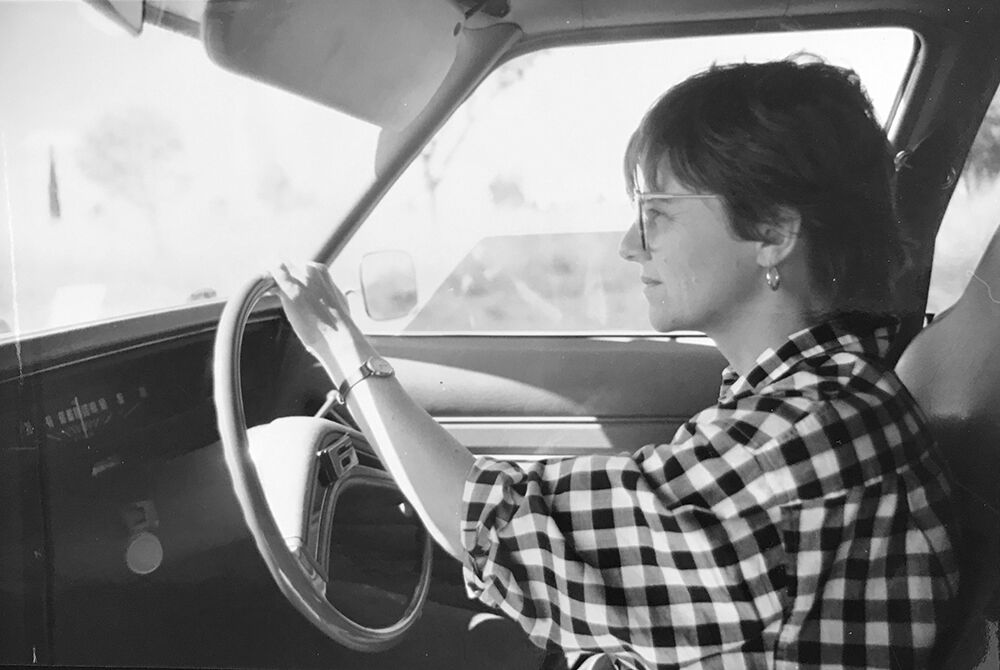 Driving across the Nullarbor Plain, 1984. Courtesy of Helen Garner.
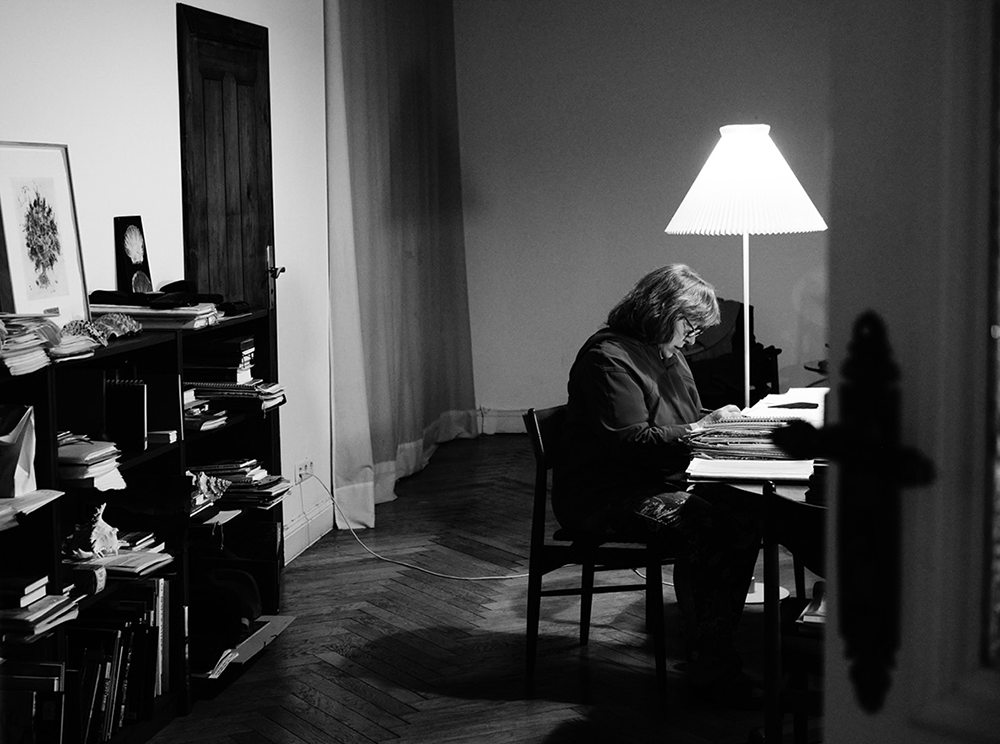
Helen Garner lives in the Melbourne suburb of Flemington, in an Edwardian-style house with a picket fence. A corridor from the guest bedroom connects to the house next door, where Garner’s daughter, Alice, lives with her family. Most evenings, the two households have dinner together. My first meeting with Garner took place on a summer morning at her kitchen table, which looks out onto a brick patio, a vegetable garden, and a wire enclosure accommodating three ISA Brown chickens—or chooks, as Garner calls them.
Garner was born Helen Ford in 1942, the eldest of six children, in the coastal city of Geelong, Victoria. In 1968, she married the actor and writer Bill Garner, a fellow graduate of the University of Melbourne; they separated in 1971, when Alice was two. Garner’s debut novel, Monkey Grip, published in 1977, describes a love affair between a divorced single mother living in a Melbourne share house and a heroin addict. “Helen Garner has published her private journal rather than written a novel,” one reviewer complained, apparently unaccustomed to the peculiar laws of what would today be called autofiction. Garner is up-front about the fact that she makes liberal use of material from her diaries in her fiction. Her second novel, The Children’s Bach (1984) was a technically precise yet lyrical account, told from shifting perspectives, of an upending of family life. Cosmo Cosmolino (1992), her third novel—three linked stories of a hospital visit, a cremation, and a Garner-like figure experiencing a spiritual crisis in a former share house—was written after Garner’s divorce from her second husband, the French journalist and translator Jean-Jacques Portail; her fourth and most recent, The Spare Room (2008), describes, with blistering honesty, the frustrations of caring for a dying friend.
In 1995, Garner, already an accomplished journalist, published The First Stone, a book-length investigation into a campus sexual assault scandal, which stirred controversy by challenging contemporary feminist thinking about sex and power. It sold more than fifty thousand copies in its first year. Garner’s reputation as a nonfiction author was cemented by the publication of two propulsive, devastating books about murder cases: Joe Cinque’s Consolation (2004), an account of the trial of a young woman who killed her boyfriend, and This House of Grief (2014), about the conviction of a father who drove himself and his three children into a dam. Four years ago, Garner began editing her diaries for publication in three volumes. Together they offer an intimate portrait of a writer with a gift for self-scrutiny, an astute reader of everyone from Patrick White to Goethe to her psychoanalytic therapist. In one of our exchanges, Garner rightly likened the third volume, How to End a Story (2021)—which details the disintegration of her third marriage, to “V,” the writer Murray Bail—to a novel.
“I never planned for there to be a nicely balanced tripod,” Garner told me, but her ease and brilliance across fiction—including many short stories and, in 1986, the screenplay for Jane Campion’s film Two Friends—nonfiction, and diary writing challenged this magazine’s classification system for interviews. These days, she considers herself primarily a nonfiction writer, but in every form she retains the same voice and capacious emotional intelligence that distinguishes her as a novelist. In our conversations, which continued on Zoom as the Australian summer shaded into fall, Garner revealed herself to be the person she is on the page: generous with her time and her intellect; at once vulnerable, no-nonsense, and quick to laugh. When we were interrupted one day by a light tap on her study door, she told me, “That was my enormous grandson. He comes in every morning and says, ‘Can you cook me breakfast?’ He’ll have to make his own today.”
INTERVIEWER
Where do you write?
HELEN GARNER
As soon as I could afford it, back in the eighties, I began renting a room to write in—a small place over a shop, that sort of space—where nobody would come to see me. The room I work in these days, in North Melbourne, is pretty sparse—a table, a chair, and a little mat on the floor so I can have a nap after lunch. I don’t understand how people work at home, especially women, who tend to have a sort of housekeeperliness. If I think, Okay, today I’ll start at nine, but I’ll put that load of washing on first, that means that an hour later I’ll have to hang the washing on the line, and by the time that’s happened it’s lunchtime.
INTERVIEWER
Do you work for a set number of hours?
GARNER
No. I’m fairly disciplined, but I’m not fanatical. And I never work at night.
INTERVIEWER
What about your diary?
GARNER
That’s different. I write my diary last thing before I go to sleep or first thing in the morning, sitting up in bed. I’ll write down an interesting dream, or what happened that day, or something that one of my grandkids said to me. I don’t think of the diaries as work. That’s why I like them. I like the way I write them, because it’s not anxious. I might be describing something I’m anxious about, but the actual writing process isn’t anxious, because there’s no one breathing down my neck. I don’t have to finish it by a particular time or show it to anyone or get anyone’s approval or permission. I’m trying to write as well as I can—it’s not sloppy, I’m not just dashing it off—but I’m free and not constrained by anything else. I found that when I was editing my diaries for publication, I didn’t need to revise or polish them that much. That made me see that the diaries are how I turned myself into a writer—there’s my ten thousand hours.
INTERVIEWER
What first compelled you to keep a diary?
GARNER
I used to keep one when I was a teenager, of course, but I burned everything when I went to university. I think it was during my first marriage that I started to write things down regularly. I didn’t really have anything to say. I just liked writing—I liked pushing a pen across a page without having to call the result an essay. Then I found that if I wrote about my daily life or things that happened to me, things that I noticed or was thinking about, it was fresh—raw material. I’d never tried to write stories, and I didn’t think I’d write a novel or anything—I’d done an arts degree at the University of Melbourne, and that experience had left me with the impression that all the really good writing came from somewhere else and was done by men.
INTERVIEWER
When did you first think to turn your diaries into fiction?
GARNER
In the early seventies, when my daughter was two, I moved into the first of these hippie houses—what were called communal houses—in the inner suburbs of Melbourne. It was while I was living there that I had an affair with a guy who was addicted to heroin, and as it rolled on over a year or so, the chaos of it became painful and obsessive-making. I’d been keeping a diary for a couple of years and was enjoying it—I needed to write it, and I was learning to write through it, by means of it—and as this relationship grew in complexity, as my life thickened up and became more eventful, I could see that my experiences were forming themselves into the kind of curve that we call a “story.” Story is a chunk of life with a bend in it, and I could feel this one coming. I suddenly thought, Maybe I could write about this while it’s still happening, as it’s coming into its bend.
I decided to look back in the diary to the moment when I first fell in love with the guy. I skipped over all the boring stuff, and transcribed the interesting bits into another notebook. I wanted to see if I could shape it into something. For about a year in the mid-seventies I sat every day in the state library with my two notebooks and kind of blindly thrashed along. So the truth is that Monkey Grip really was my diary, with links between passages and with some passages expanded.
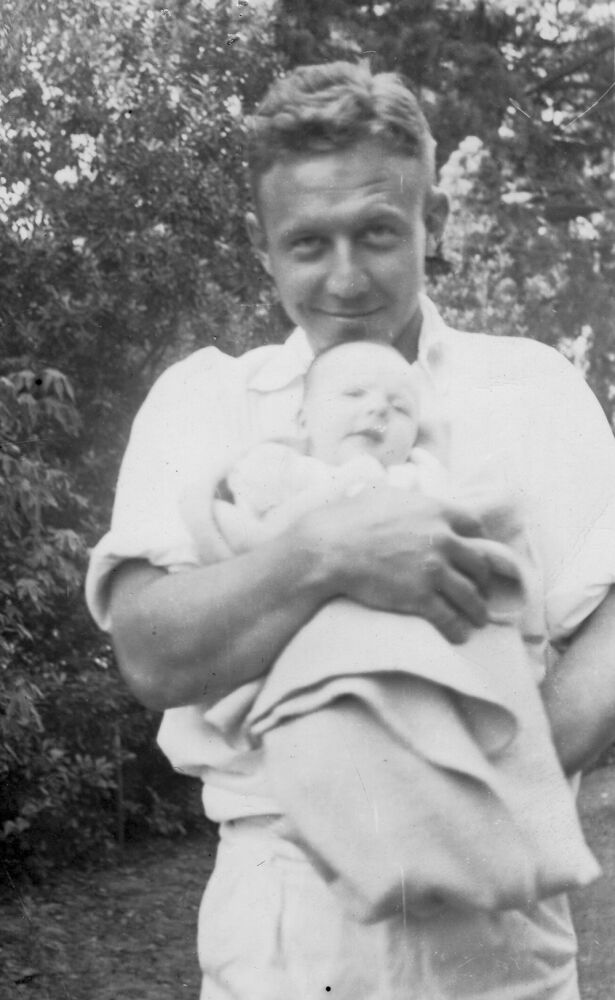 With her father, Bruce Ford, in Geelong, 1942. Courtesy of Helen Garner.
INTERVIEWER
Do you think hewing so closely to the source material made the writing feel more immediate?
GARNER
I suspect it was the only kind of writing I could do in the gaps between being a mother. But it turned out to be one of the things that people especially liked about the novel. It’s quite a close-grained account of the tortures you go through, and the great happiness you experience, when you’re in love—and of the constant recomposing of yourself. A series of collapses of morale and then efforts to pull yourself together and keep going. There’s a lot of living you can do in a relationship that’s not going to last.
Australian writers back then often felt that they had to account for themselves and their place in the world—probably because everybody’s aim was to get published in England or in America. But I never wanted to laboriously create a landscape—to describe what my suburb looked like, or explain what it represented—for some imagined distant audience. I wrote about my environment as I did in my diary, mentioning that I walked up Lygon Street or went to the Fitzroy baths. I was never like Peter Carey, say, or David Malouf—writers who had big things to say about Australia. I just wanted to be able to sort of talk. One of my aims in writing has always been to get as close to human speech as is possible without losing the little starch of formality. And to make people feel things rather than think them—I mean, both would be good.
INTERVIEWER
The chaotic communal lifestyle described in Monkey Grip doesn’t seem entirely compatible with being a writer.
GARNER
There was a lot of noise in those houses—bands practicing, people rushing in and out—which is why I would work in the library, after I rode my daughter to kindergarten on my bike. I lived in several households right through the seventies. There were personality clashes and bursts of envy and rage, but I loved them.
Drugs weren’t the point of them, although they did roll through. Our houses were more innocent, or at least less self-destructive, than others I knew of. They were matriarchies set up by women who had children on their own or whose marriages had broken down, and who lived on the Supporting Mother’s Benefit, a government grant for single mothers. The needs of the kids were paramount. We had meetings. Everyone had to shop and clean and cook. We ran a trim ship. The adults who didn’t have their own kids yet became very attached to ours.
A friend of mine once talked about the “radiant idleness” of the time that Monkey Grip came out of. The grown-ups would spend hours with the kids at the kitchen table. We had colored pencils—what was known as “the full set of Derwents”—and we’d draw cartoons, and update the “Disease Book,” which was a gruesomely illustrated report of whatever illnesses anyone had had. Somebody saved that book and I saw it again recently—it’s a work of art. The kids would be out in the yard or down at the baths for hours and I could lie on the bed and read Proust or Tolstoy. Being able to be a mother without feeling that I was a prisoner … There is a freedom you get from that kind of arrangement, a freedom that we single mothers wouldn’t have had if we’d lived alone in some awful flat. You don’t have that freedom in marriage, either—at least in marriage as I had seen it played out by my parents.
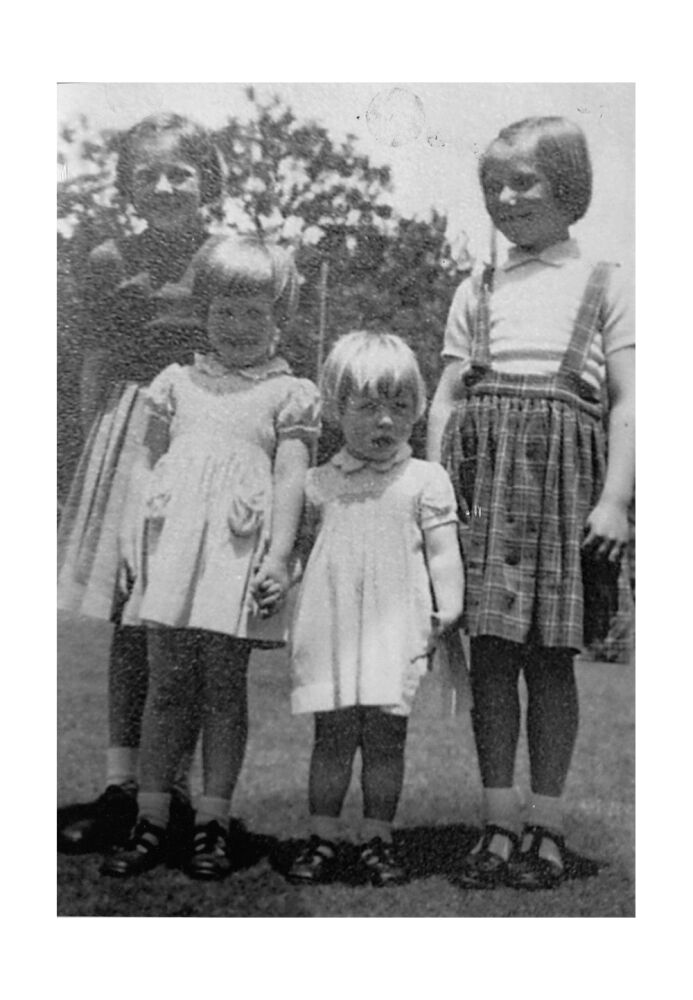 At left, Garner with her sisters Linda, Sally, and Marie in Ocean Grove, 1953. Courtesy of Helen Garner.
INTERVIEWER
Had you intentionally chosen a different kind of life from theirs?
GARNER
I’d always wanted to be around clever people, to be playful with other clever people. My first husband had been involved with a radical theater group that was quite important in Melbourne, and I’d been involved in the feminist arm of it, although I was always a bit of a tourist in that world. But then he was out at night a lot, and I was home holding down the fort with my daughter, and I started to get lonely and sad.
My mother’s life, the life of a married woman with children, had never really appealed to me. It had dawned on me when I was quite young that my mother could never go out for more than about three hours at a time. She always had to be there at lunchtime, at dinnertime. I’d grown up as the eldest child in a family of five girls and one boy, and everybody was always squabbling and looking at the others to see if they were getting more—counting the strawberries in one another’s bowls. I remember it hitting me when I was about fourteen that our mother was in a sort of cage.
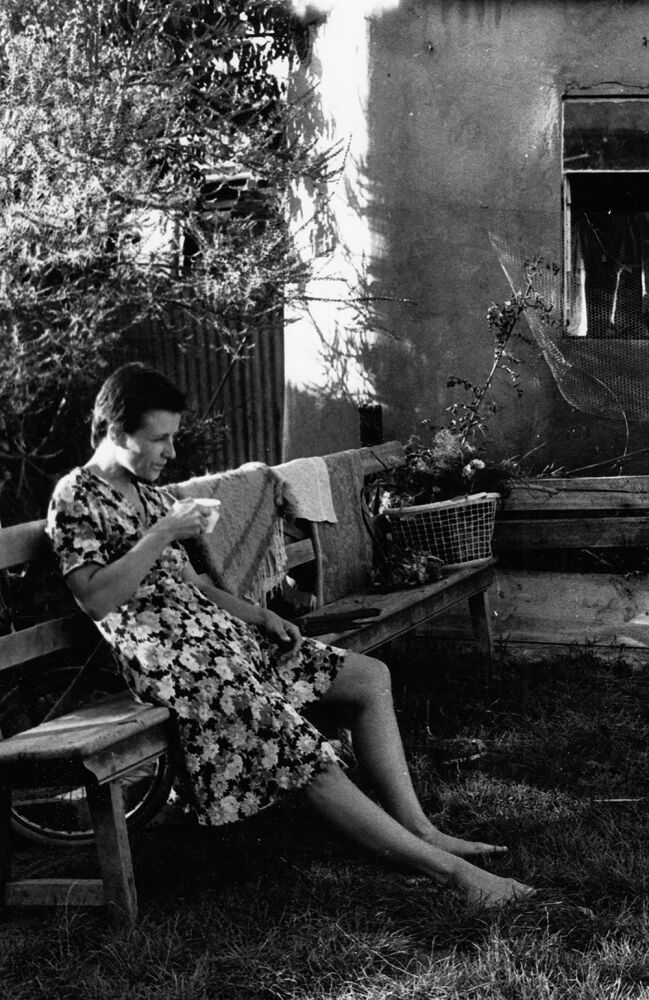 In the backyard of her communal house in North Fitzroy, 1974. Courtesy of Helen Garner.
INTERVIEWER
What was your parents’ relationship like?
GARNER
My father’s mother died when he was two, and he and his sister were raised by their stepmother—who was also their aunt—and a stern father. As the only boy, he was spoiled. My mother told me that when he took her to meet his parents, his stepmother served him a poached egg and before he ate it, my father jiggled the plate to make sure the yolk was cooked to his liking. He steamrolled our mother. He was funny and smart, but he was also a selfish, jealous person. When they married and moved to Geelong he basically cut her off from her family in Melbourne. Until a similar thing happened to me in my third marriage—when my husband was hostile to my family and my daughter—I had never appreciated that loss of my mother’s.
One of her younger brothers was killed in the Second World War, shot down in a plane, when I was a toddler and my sister was a tiny baby. My mother was poleaxed by grief. Dad must have had to pick up the slack for her. I think that’s how I developed such an intense relationship with him early on—he’d have had to comfort me, and he must have taken comfort from me, too. He was aggressively rude to every bloke I ever got involved with. We became completely estranged the first time I got married. His behavior was irrational and destructive and hurtful. I struggled to understand it. When he heard that I was getting married to Bill, he went to the minister, making all sorts of wild claims about why he wasn’t to marry us. The minister said to me, “Your father is the most stubborn man I have ever met in my life.”
INTERVIEWER
What was your role, as the eldest child?
GARNER
There’s a high degree of emotional turmoil, what you could almost call hysteria, in a family that’s composed mostly of women. I loved my sisters and my brother but they used to drive me crazy. I think I’ve repressed a lot. Until the fifth one was born—my brother, when I was ten—I have no memory of there ever being a baby in the house.
One of my cousins said to me recently, “I remember that when we were at the beach together in Ocean Grove, you were always off to one side, lying on a towel, reading a book. You never joined in.” In a big family you’ve got to find a way of getting away from everybody to a place where you can quietly exist, and that’s what reading was for me. It was my way of being absent. I used to kneel by the side of my bed so I could keep reading even while I was pulling my clothes on. My parents were always saying to me, “Put that book away and go outside.”
INTERVIEWER
Were you a good student?
GARNER
I was good at English and French, but I really didn’t cut the mustard when it came to biology or history or math. At university, I did okay for a while, but my fortunes went downhill over the four years, and I crawled out with a third-class honors degree, very deflated. The university modeled itself on Oxford and Cambridge, not that I would have known, and my college, a women’s residential one, was more like a boarding school—in 1961, my first year, all the freshers slept in one big dormitory—two long rows of saggy single beds. It was a pretty frumpy scene. We wore these little twin sets with pleated tartan skirts that came halfway down our shins, and walked with our arms folded—I don’t know what that was about. The others seemed to be living a civilized life, but I wasn’t.
I guess I was what you would call wild. My behavior frightened my mother and made my father angry. Looking back, I don’t blame them. I was off the rails there for a while in my early twenties.
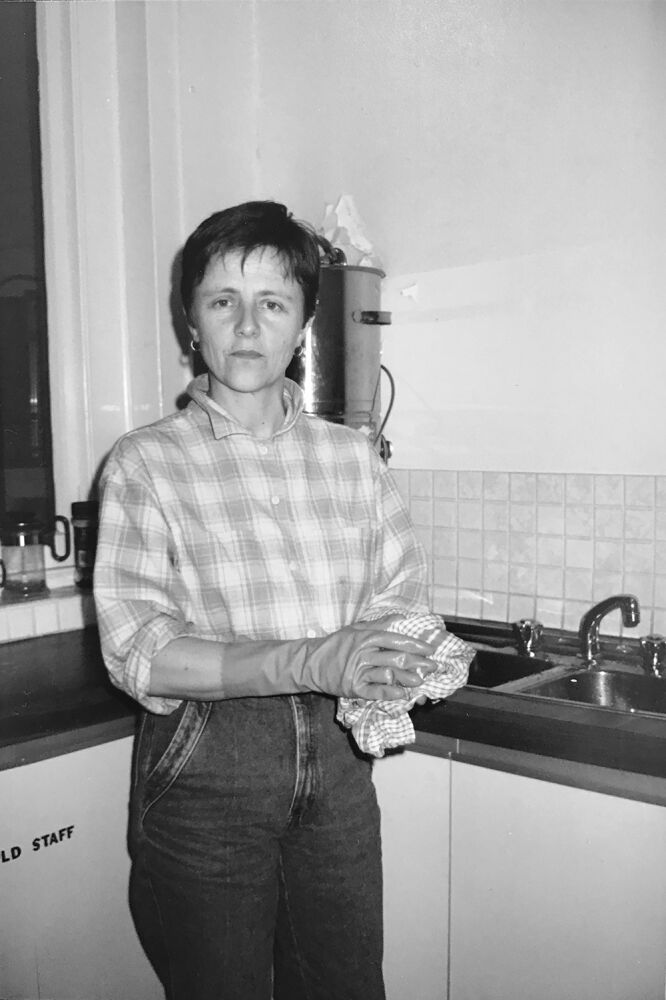 In Sydney, 1983. Courtesy of Helen Garner.
INTERVIEWER
Why was that, do you think?
GARNER
I’d got away from my family. I discovered sex. And drinking. I had two abortions when I was a student. It wasn’t until I was in psychoanalytic psychotherapy, in the mid-nineties, that memories of those abortions resurfaced—in dreams and while I was lying there on the couch—from where I’d stowed them thirty years before. It shocked me that they came back, and that they brought so much grief and sorrow. Not guilt. I didn’t have regrets, and I don’t now. I agree with Germaine Greer—it’s a woman’s sad duty not to have a baby when she knows she won’t be able to mother it.
I’m really glad that I had a child when I did, when I was twenty-seven. It’s quite possible that I might have done something really idiotic and had my tubes tied earlier. As it was, I did that after I had my daughter, when I was involved with the guy who was badly into drugs. I thought, What I don’t want and do not need is another child.
INTERVIEWER
Do you think you would have become a writer had you stayed in your first marriage and had more children?
GARNER
I suppose I could have gone on being a teacher. I started teaching after I graduated, and I worked at three high schools in Victoria in the sixties. I loved it, and I kept going for a couple of years after my daughter was born, until 1972, when I was teaching twelve- and thirteen-year-olds at an inner-suburban high school. I’ve written about this—how I got the sack. One day, we opened our textbooks and found that they had been defaced with drawings of ejaculating penises. The kids were falling about. With incredible naïveté, I said something like “Look, the reason we’re laughing is that sex is interesting, and most kids don’t know nearly as much about it as they should, so if you ever need to know anything about this sex stuff, you can ask me.” And the room went still, and then one kid put her hand up and said, “Do you mean now? Can we write the questions down?” They were writing madly and running up to put the papers on my desk. The conversation I had with them went on for maybe two hours that day, and then the next day we worked our way through another pile of questions. What I remember was the earnestness of the children, their amazement that someone was going to tell them what it was all about. One of my friends suggested I write about it, and the piece came out in a countercultural newspaper that existed at the time called The Digger. To cut a long story short, that was the end of my teaching life, and the beginning of my freelance career. I did the training to be a taxi driver, but then a friend, a lefty union guy, told me about the Supporting Mother’s Benefit.
I do think that if I hadn’t crashed out of my marriage and found a freer kind of life, I might have stayed more obedient to the rules of writing that I had been taught at university. When critics, almost always men, said that Monkey Grip wasn’t a novel and that I’d just published a diary, I defended myself in a way that now seems to me huffy and ridiculous. Back in the seventies people used to dismiss women like me as “small-canvas writers,” saying, Oh, everything she writes is too domestic. After my first novel came out, I lived in Paris for a while, which is where I met my second husband, a Frenchman. When I got back, around 1980, and my second book was published, people were surprised and cross that it was set in Melbourne and wasn’t about Paris.
INTERVIEWER
Was it The Children’s Bach that you were working on in Paris?
GARNER
No, there was another book in between, Honour and Other People’s Children (1980). It’s not the most noted item on my backlist. The first draft was sort of like the poor man’s Monkey Grip. I’d thought you could do the same thing twice, and I found that you can’t. My publishers said it was shit, and they were absolutely right, so I threw away all the really crappy bits and broke it into two stories. There’s nothing more instructive than writing a bad book. But by the time I published The Children’s Bach, four years later, I had somehow learned to write. Every time I look at it, I think, Gosh, did I actually write this? I like that it’s short and it’s skillful. It’s the best fiction I’ve written, in a technical sense—the way it leaps from one character’s point of view to another’s. I don’t know how I figured that out or whose example I was following. It seems to be written by somebody happier and calmer than I’ve ever felt myself to be. I used to think I must have been in some kind of blessed state when I wrote it, but one day years later when I was torturing myself trying to write The First Stone I found a notebook that I’d been keeping while I was writing The Children’s Bach, and it was full of groaning—I can’t do this, this is terrible, why the hell did I start, I’ve got these characters and I don’t know what to do with them … That sort of moaning on every page. I was very relieved to find that notebook, to realize that no book was ever going to flow out of me harmoniously. That was just some ridiculous romantic fantasy of inspiration.
INTERVIEWER
In one of those diary entries, you write, “I cobbled together that scene out of elements so disparate that only a compulsive note-taker like me could’ve had the raw material at her disposal.” What does it look like to cobble together a scene if you’re Helen Garner?
GARNER
That was the scene in The Children’s Bach where Philip and Elizabeth and Poppy go to the Foxes’ place for the first time. The Foxes are the sort of people who like having visitors—they’ve got a wood fire in the kitchen and nice food and everyone cracks jokes. I wanted their warm, old-fashioned world and the cool, spiky world of these visitors—three lost souls—to scrape against each other.
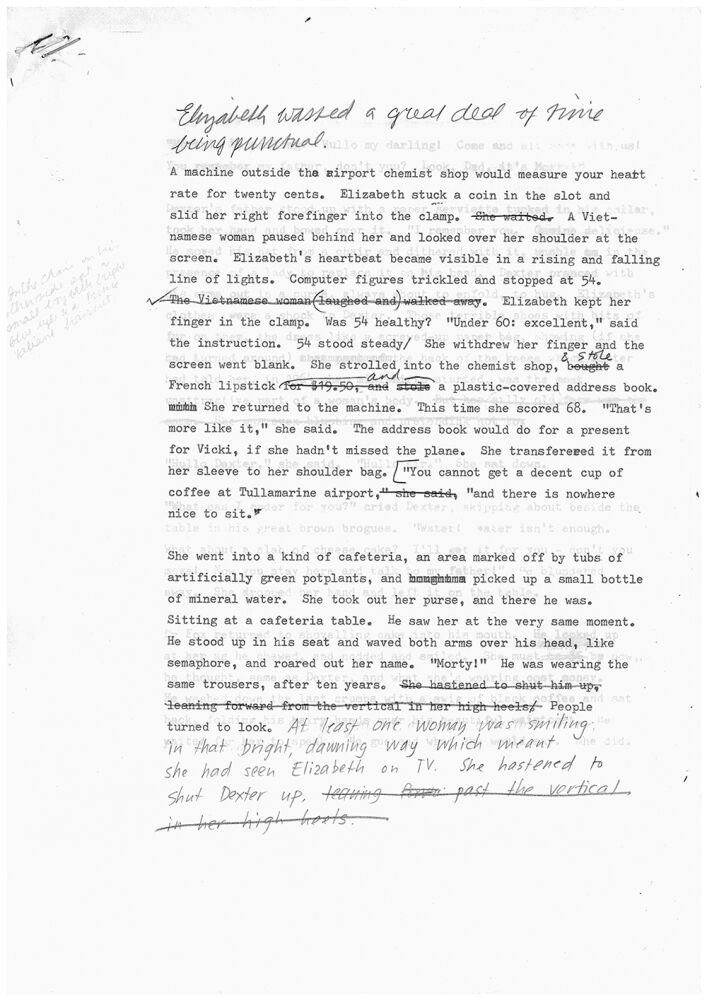
I’m always collecting bits of dialogue—remarks people make or things I overhear in public places. That way I’ve got a bottomless container of voice. When I started to write The Children’s Bach I bought one of those student exercise books that are divided into labeled sections. Once I’d established who the characters were, I gave them each a section. Every time something occurred to me that I imagined might belong to a certain character’s way of thinking, I would write it down in their section. That part of the process was fun—like messing around with a box of building blocks. You know, Oh, there’s a red one, I can put it with the other red ones.
When the time came to write that dinner table scene, I dug up all these random chunks of talk, and whittled them down until I had a dozen crazy little non sequiturs bouncing and flashing off one another.
INTERVIEWER
The ending of the novel—that list of paragraphs all beginning with “And … ”—is strikingly beautiful.
GARNER
I suppose it’s the book thinking about itself—about what is going to happen in the world after it stops being a book. I didn’t want the book to fade out. I wanted it to feel like the way Glenn Gould plays Bach’s Two-and Three-Part Inventions—the way he flings the final notes away with force.
INTERVIEWER
To me, the novel creates an atmosphere of infatuation with that particular kind of family life the Foxes have. Where did that come from, do you think?
GARNER
Some very dear friends of mine had a three-year-old son who was profoundly autistic. They didn’t know what was wrong with him, and there was no name for it back then. He couldn’t really speak, and he didn’t know any words, but songs would reach him where other things wouldn’t, and he had a pure little voice when he sang. It interested me to see how his parents lived around this huge duty that had been imposed upon them—to see how an act of fate like that would scour you of all your triviality. You’d have to find something in yourself that was much deeper than what most people would need to find.
I see now that what I do in that novel is introduce this cozy unit—which actually has a lot of suffering underneath its surface because of the little boy—and then blow it wide open by throwing in Philip, a hip, worldly person who’s left his wife and whose life is a mess. I didn’t set out to do that—I just went from sentence to sentence and page to page, and that’s where it led me.
Jessica Anderson, an Australian writer of the generation before me, read The Children’s Bach and told me she’d noticed that once a woman writer has a teenage daughter she’ll often write a conservative book. I think she was referring not to the form of my novel but to the fact that, at the end, the family recomposes itself. I was a bit thrown by that comment, although it strikes me as possibly true.
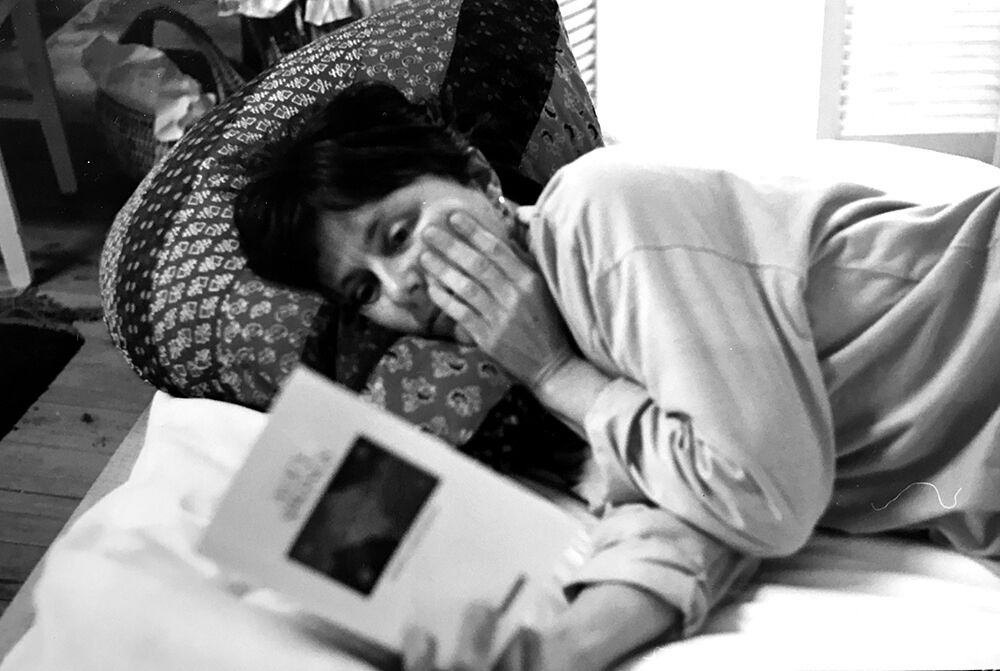 At her Primrose Gully property in Victoria, ca. 1986. Courtesy of Helen Garner.
INTERVIEWER
Is it a conservative novel?
GARNER
I suppose so, if it’s conservative for a woman who feels the frustration of her position as a wife and mother to break out and then make the choice to come back. But you can only say that if you think marriage is an absolutely hopelessly imprisoning and destructive container for a woman, and although I’ve been no good at marriage myself, I don’t think that.
I’ve been involved with a lot of men. These relationships have often ended sadly, and I have puzzled over the years to understand what is it about me that makes me unable to do that thing—whatever it is that makes a long intimate relationship possible. My next two sisters got married and their marriages went steadily onward—they were the ones who had the big family Christmas party at their place. I didn’t know how to do it, and I didn’t know how to find out how to do it. Perhaps it’s some wish for that kind of conventional family life that explains why I got married and divorced three times.
Wait—can I just say one thing?
INTERVIEWER
Of course.
GARNER
In “Recording Angel,” in Cosmo Cosmolino, somebody plays a record of that Schubert quintet, the one with two cellos. That’s how I’ve always felt when I’m with a family that has a cozy life—I’m the second cello. I once heard Rostropovich play that piece, and it was marvelous—his droning, ferocious roving around the quartet. I hear that extra cello as a lost soul that’s prowling and roaming out there in the cold, and I recognize it. It’s me.
After my third marriage ended, my daughter and her husband came to live with me for a bit, and then they asked me to live next door to them and their kids, which I did, and still do. That was the nicest thing anyone’s ever done for me. I think I’m a good grandmother. I love to be near a family, but I can’t be a wife. I like knowing I can go home when I want to. I don’t want there to be a leg rope on me.
INTERVIEWER
Where did the angels in Cosmo Cosmolino come from?
GARNER
At the end of my second marriage, which was a time of great emotional distress and strain, a strange presence would sometimes manifest itself behind me—I would feel something in the room, hovering behind my back. I suppose some people would think it was a crack-up that I was going through. I used to call it—to myself—the Mighty Force, because I felt that it was tremendously powerful but also benign. I knew that if I turned around and looked at it, if I acknowledged it, I’d have to go down on my knees and bow to it, and I was too scared to do that, and too proud. After a while it stopped coming. You know that poem by D. H. Lawrence about the snake at the water-trough? The speaker sees its beauty but he’s frightened of it, so he throws a lump of wood at it and it makes an undignified retreat into its hole. At the end of the poem he writes, “I missed my chance with one of the lords / Of life.”
That was a time that now feels very distant and strange. My daughter was in high school, and after my husband left, I got two more people into the house to help me pay the rent. One of them was a guy in the hot stage of becoming a born-again Christian. Everything he thought and did came through that evangelical filter. We argued, we yelled at each other. I look back now and see what a fruitful time it was—but he drove me insane with his big black Bible on the table.
I wasn’t, in a sense, myself when I came to write Cosmo Cosmolino, a few years later. It’s a blip in terms of how I’ve developed as a writer. It was fun to mess around with more ornate sentences and grotesque imagery and people becoming angels and flying away, but I’ve since learned that my natural way of writing is not that baroque.
INTERVIEWER
What was it that led you to turn to writing nonfiction?
GARNER
I’d been making a living from freelance journalism for years. When I read in the paper in 1992 that the master of a famous college was up on an assault charge for having made a pass at two young women—or rather I should say “inappropriately touching” two of his students—I was amazed that they had gone to the police. A lot of women my age thought the students’ response was an overreaction, and I wanted to write a newspaper article about that—but it soon blew up into something much bigger. And I wound up writing a book. I got into a lot of trouble over The First Stone. But it sold way more than anything else I’d written, and it occurred to me that maybe I could swing over the skills that I’d been developing in my so-called small-canvas fiction, skills that felt natural to me, and apply them to the kind of nonfiction that involves an understanding of large, complex things, like courts and the law, that I’d previously been completely ignorant of.
INTERVIEWER
Did you develop any particular techniques for that kind of reporting?
GARNER
The thing about The First Stone is that it’s not just a simple account of that case—it also consists of conversations I had with scores and scores of women. A lot of the thinking that was being done in universities those days was being expressed in dull, theoretical language and it didn’t appeal to people who weren’t feminists or intellectuals looking for a justification for their rage. I wanted mine to be a book anyone could read. It was a great pleasure to talk to women about their experiences, some of which I found deeply shocking—I wanted to let the reader sink down from what I then thought of as a trivial offense into the texture of what women have to go through just to get through life. I loved the process of chopping those stories into the main narrative.
It was while I worked on The First Stone that I first devoted a journal to the reporting process, and I’ve done that for all my big projects ever since. At the end of each day, when I get home from court or from interviewing people, I write an account of it in a diary-like form. I write down who I met, where we sat, what they were wearing, how they behaved toward me—whether I had to charm my way into the interview, if they were hostile or scared or bullshitting me, all those sorts of details. I’m working fast, but the writing is reasonably coherent. If I’ve got a friend I’m emailing with, especially if I’m in another town and I’m lonely and homesick, I’ll print out the emails and paste them into the journal. It becomes a record of my engagement with the material. For Joe Cinque’s Consolation, particularly, those notebooks turned out to be the spine of the book.
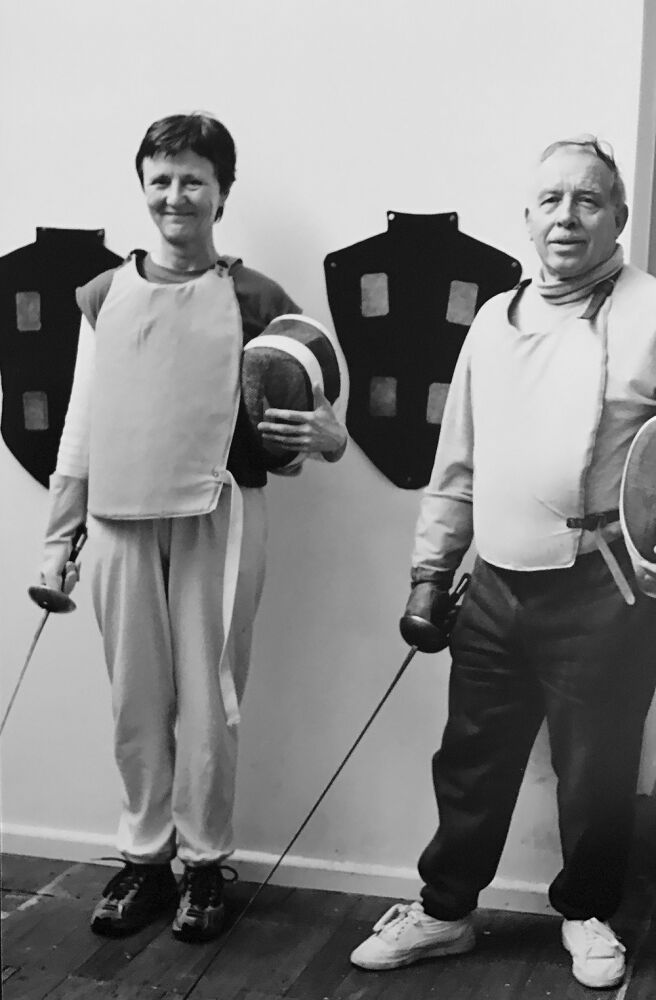 With her fencing teacher in Brunswick, 2000. Courtesy of Helen Garner.
INTERVIEWER
How did you decide to make yourself a character in your nonfiction?
GARNER
I wouldn’t even know how to write a detached God’s-eye view of a process as complicated as a trial. For This House of Grief, I followed the case of Robert Farquharson, who was charged with having murdered his three children. Those trials went on for years, and when you spend that long immersed in proceedings like that, your attitude changes constantly. Courts are imagined as places of reason, but they’re actually awash with feeling. You go through enormous shifts of sympathy and withdrawal of sympathy and then rage and unhappiness and pity. It seems to me that these emotional fluctuations are worth talking about, and that they illuminate the matter at hand. As a first-person narrator, you can pull in feelings or memories from your own past that come to you while you’re watching the trial. Or you can throw in something you overheard someone saying on the street or a question somebody asked you that revved your mind up in a new way. I think that’s what Janet Malcolm meant when she was reviewing The First Stone in The New Yorker and used the term “unreliable narrator.” She’s the biggest influence on me in this area of my work.
INTERVIEWER
How so?
GARNER
Her books, her psychoanalytic approach to life, her intense curiosity about people, her cool eye, and her very strong sense of imagery blasted a path for me. I realized, when I first read her in the nineties, how constrained I’d always been as a writer. I would be full of thoughts about something I’d witnessed and wanted to describe, but those thoughts would seem to me illegitimate, as if I didn’t have the right to admit them into what I was writing. When I read Malcolm’s study of Sylvia Plath’s biographers, The Silent Woman, I saw an incredible freedom in the way she observed people’s behaviors and interpreted what they were unconsciously revealing.
I remember interviewing a retired member of the Ormond College Council for The First Stone, who was very much against the complainants and what they’d done. I visited him one morning at his big old house in the eastern suburbs, and battled to get facts out of him. Like all lawyers, he knew how to talk for hours without saying anything. At eleven a cuckoo popped out of a clock, and he went to the kitchen for coffee and a jar of shortbread biscuits. He took the lid off it and put it on the table in the middle of the room. He poured our coffee, and asked me if I would like a biscuit. I ate one, then another. They were delicious. I think his wife had made them. I took a third one, and that’s when he got up and walked right across the room and screwed the lid back on the jar. On his way back to his seat he said, “Oh, I didn’t do that to keep you out of there.” We both laughed, but I thought, Yes, you did. I’m wasting my time. You’re not going to tell me anything. That was a double-decker Janet Malcolm moment.
INTERVIEWER
What did it feel like to be at the center of the controversy surrounding The First Stone?
GARNER
Thank God I didn’t write it in this age. I would have been massacred on social media. I was massacred as it was, but what they could pull in those days was less total. There was a berserk feeling around that book. Previously I’d only ever done publicity for novels—rambling on about characters is easy. Now I was having to defend myself.
The first public event I did was to a crowd of furious young university feminists, rows and rows of them scowling at me. One of them jumped up and shouted, “What is your speaking position?” I know now that she meant I was straight, middle class, white, educated, a member of the elite, and so on, but back then I had no idea what she was talking about. I said, naively, “What’s a speaking position?” And she rolled her eyes and clicked her tongue and sneered.
I tried to play it with the straightest bat I could muster, but I was in shock. In media interviews they’d tear strips off me. Once I even cried on national radio—well, my voice trembled. I’d be sitting in a café and I’d look up and there’d be some young woman standing outside the window with her hands on her hips giving me a death stare through the glass. Booksellers told me about arguments that had taken place at the cash register in their shops, how people were almost coming to blows about the book. Now I think, How fantastic—and it was walking out of the shops. But back then, I was staggered by the onslaught. Being hated was painful, like being beaten up is painful. And yet, as it all started to die down, I began to think, When I get over this, I will have no fear. I did feel free after it was over. Free of the obligation to write as a feminist. I had experienced feminism as a straitjacket, to put it crudely, and I no longer wanted to speak as part of a group that would call me a heretic if I said what I really thought.
At that time I was married to the man I refer to in my diaries as V. He was respected—a writer’s writer—and he had a severe belief in the hierarchy of forms. For him the absolute top of the mountain was fiction, the novel. Nonfiction didn’t cut it. It was a lesser form. But after The First Stone had been on the best seller list for weeks, a friend of ours said to me, “This must be very difficult for him.” I could sense that our marriage was going to hit trouble because of this success, even though I’d moved off the turf of our rivalry. I hadn’t done it on purpose—it was a semiconscious vacating of the field. And anyone who’s read How to End a Story will see how well that worked.
INTERVIEWER
Do you think being a writer and marriage are generally compatible?
GARNER
They probably are, but it probably takes a lot of generosity and flexibility. If you’re burdened by a classic idea of the artist as a figure to whom everything is owed and whose prerogatives are enormous and can never be challenged, forget it. That sort of person can have only a servant for a partner.
I know now that I’m not cut out for marriage. I never found a way of dealing with it. Anyway, it’s hard to love and be loved. Sometimes accepting love is harder than giving it, especially if you’re the sort of person who thinks they’re a very small piece of shit.
INTERVIEWER
The third volume of your diaries spans the years 1995 to 1998, after the publication of The First Stone, as your marriage to V broke down. Did you edit those diaries very much?
GARNER
The third diary is such a wretched story. I pulled it into shape during the COVID lockdowns. I decided I would not take out the bits that made me look bad. The fact that something embarrassed me was not a good enough reason to cut it. The process was awful, in that I could see my foolishness and fearfulness and stupidity, the mistake after mistake after mistake that I had made, twenty-five years ago. There’s so much unhappiness and anger and pain in that third volume that editing it almost overwhelmed me.
I needed a light to slog toward, something hopeful that had happened beyond the point where the diary ends. And what saved me was thinking about Maria Cinque. She was the mother of Joe Cinque, the murder victim in a trial I went to in 1999, a few months after I’d split up with V and I was all over the map. I used to see her and her husband in the Supreme Court every day, sitting quietly in the front row. They were archetypal figures. Just looking at them made me feel small and ignorant and insignificant.
One day, during a break, I went to the toilet, and Mrs. Cinque was at the washbasin putting on her lipstick. She smiled at me and said, “I see you in court. Are you a journalist?” I thought, Oh God, what do I say? I couldn’t tell the truth, which was, Actually I’m probably perving on your suffering. So I said, “Sort of—I’m a freelance writer.” She nodded, and I blurted out, “If I write something about this, will you speak to me?” She looked me up and down, very slowly, in a measuring way. I didn’t know what sort of a test it was, but I must have passed it, because she said she would. I didn’t know it at the time, but she had just opened a door into the next phase of my life. And that’s how I got to write Joe Cinque’s Consolation. Because Maria said yes.
Since my third marriage ended and I came back to Melbourne in 2000, I’ve spent a lot of time in courts, writing about trials. Finding my way to the law has been one of my greatest joys. It was a homecoming to some part of myself that I hadn’t known was there. When I was sitting in a court, when my intellect and my emotions were working in concert with each other, I used to think, God, I’m so lucky—I was born to do this.
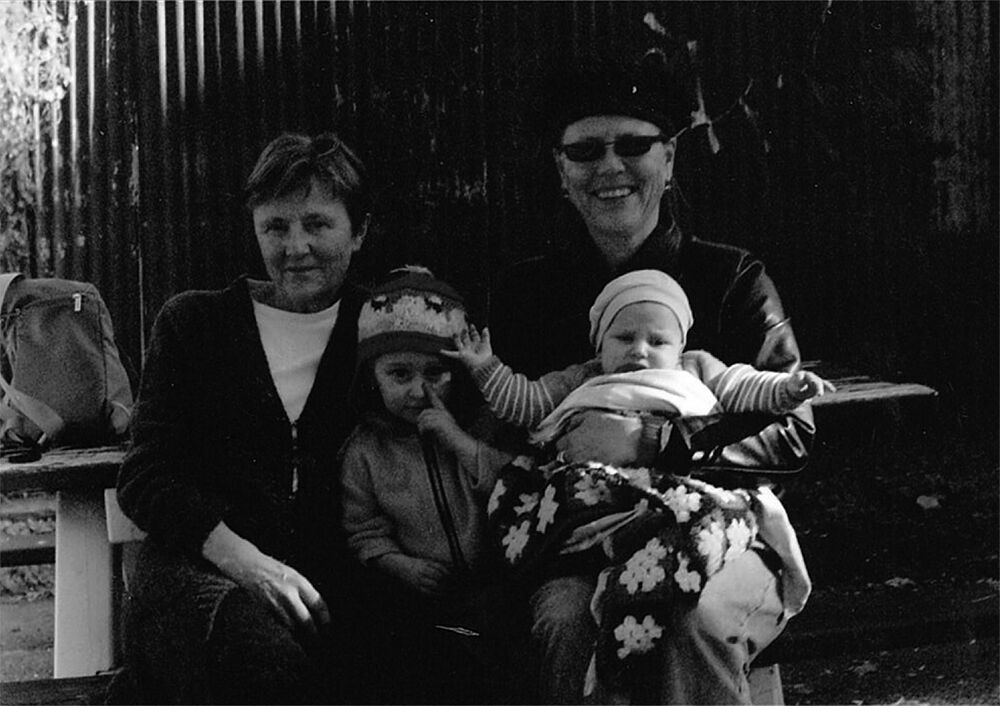 Garner with her grandsons and her sister Sally in Melbourne, 2007. Courtesy of Helen Garner.
INTERVIEWER
Can it also be difficult to spend so many years following a single case?
GARNER
It’s grueling. The Farquharson trials were spread out over seven years. When he ran out of appeals, when it was finally over and I could start to write the book, I was a mess. I was traumatized by the whole experience, and I felt ashamed of myself for that, as though it meant I was a wimp and an amateur. Later, I was relieved to learn that other journalists who’d covered his trials had been devastated as well, that it wasn’t just me and my quivering bourgeois sensibilities. The mother of the three little drowned boys died recently, on Mother’s Day. She’d married again and had two more kids with her second husband. I’d become fond of her parents during the trials, so I wrote them a letter, of sorrow, as one would. Then the other day, I got a phone call from her father, whom I’d always liked, and he … Hang on.
INTERVIEWER
Yes?
GARNER
I’m suddenly thinking that this is an extension of me being that person we were talking about before—the outsider, the extra cello. I’m shocked. I’m stunned by this thought. I circled round the Cinque family, too, didn’t I? I loved going to their house.
INTERVIEWER
Across all your work, fiction and nonfiction, you’ve been drawn to these ruptured families.
GARNER
The thing is, despite being told that my concerns were too domestic, I’ve always known that the family is where everything is played out. The most crucial things happen within families—those patterns of behavior are huge forces. As soon as you get into psychoanalytic thinking, this becomes blindingly clear.
INTERVIEWER
Why did you return to fiction after sixteen years, with The Spare Room?
GARNER
That book was a way of unloading the freight of grief I was hauling, for what my friend—&let’s call her Nicola—had gone through, and horror that she underwent such terrible things on my watch. She told me she was coming down to Melbourne for cancer treatment at this weird clinic, a treatment that turned out to be brutal and mad and damaging and excruciating, and she asked if she could stay with me while she did it. I’d had a completely absurd fantasy of myself as a Florence Nightingale figure. I was going to make my spare room lovely for her, and the sheets would be fresh, and I would serve her, and wait on her, and have all sorts of little treats in the house that she would like to eat—it was a kind of vanity. The minute I saw her get off the plane hobbling and shuffling like an old woman, I realized that she was a hundred times sicker than I’d expected. Those were really the worst three weeks of my life, and probably the most interesting. One thing I learned is that there can be a power struggle between sick people and the people who look after them. It’s not a beautiful, gracious giving and taking, with all the giving being done by the healthy, upright person and all the taking by the horizontal one who’s weakened and is going to die. She fought me. She fought me, and all the strength of her character was packed into her fight against my fight against the treatment that she was having. I was appalled by it all, not least because it overturned my idea of myself as this endlessly patient, kind person with overflowing goodwill. I found out that you can come to the end of what you’ve got to give.
That was the fastest book I’ve ever written—it took only a few months—because it was written under the pressure of these awful feelings. I started off calling the narrator by an invented name, but a friend suggested that I call her Helen. One reason I did this was because I wanted to confess that I’d had these terrible feelings and this anger, and that my self-imposed mission to help ease her out of here had failed. I wrote it six months after she died, using my diary to remember bits of detail. I’d cried when she died and I’d grieved for her and I missed her, but it was when I had to make her die in the book that I lay on the floor and howled.
INTERVIEWER
Why did you call that book a novel?
GARNER
Perhaps the publisher had told me that they were calling it a novel and I didn’t quite register it, but I was shocked when I saw the word novel on the cover. I wish you could just say, This is a book—not have to call it anything.
Underlying the famously big gap between fiction and nonfiction there’s a rather naive belief that fiction is invented—that it’s pulled out of thin air. All those comments I’ve had to cop about my novels not being novels—they rest on that idea that the novel is mightier than every other form. Men tend to care more about those hierarchies than most women writers do. There’s a certain blokey nobility to the concept—How dare she think that she’s scaled the heights of Mount Olympus just by saying what happened to her? If I say that my book is a novel, what I mean is that some of it’s made up, that I have taken certain artistic liberties. So, gentlemen, put that in your pipe and smoke it.