Issue 56, Spring 1973
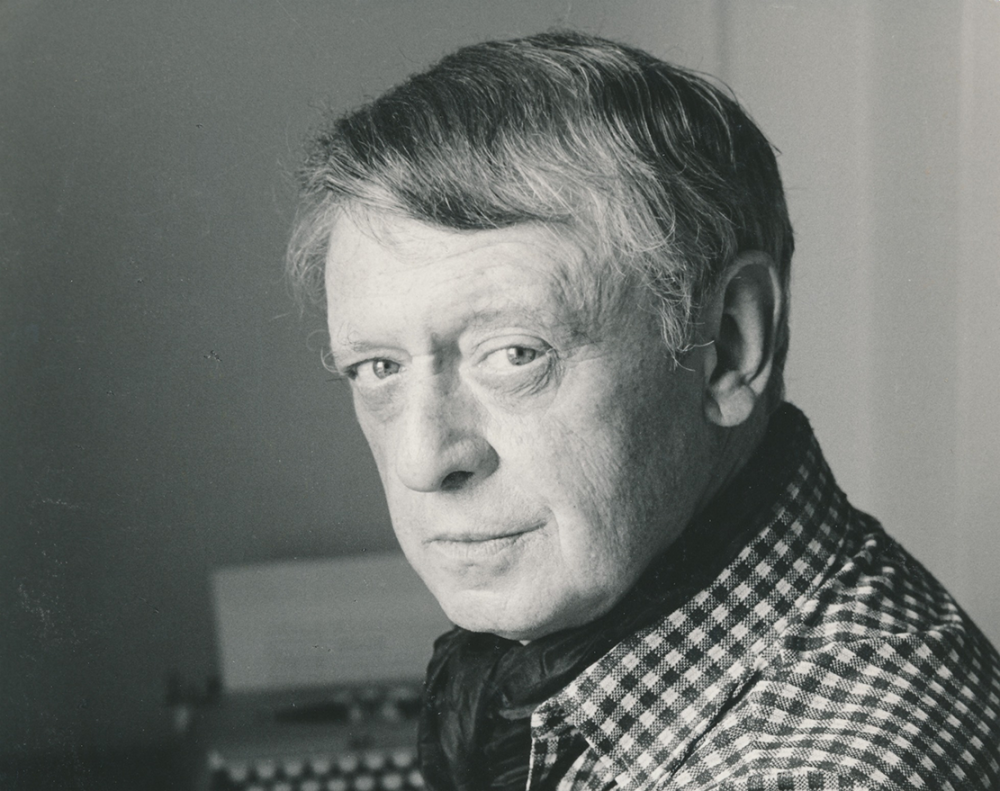
John Anthony Burgess Wilson was born in Manchester, England, on February 25, 1917. Raised a Roman Catholic, he attended local parochial schools and graduated with honors in English Literature from manchester University in 1940. He served in the Army Education Corps from 1940-46; for three years he was stationed on Gibraltar, where his first novel, A Vision of Battlements (1965), is set.
After the war Burgess held several teaching posts, including that of Colonial Education Officer in Malaya and Borneo from 1954-59. During this period he wrote his Malayan trilogy, The Long Day Wanes (1956-59); when illness forced his repatriation in 1959, he became a professional writer. His other novels include The Right to an Answer (1960), The Worm and the Ring (1961), Devil of a State (1961), A Clockwork Orange(1962), The Wanting Seed (1962), Honey for the Bears (1963), Nothing Like the Sun (1964), The Eve of Saint Venus (1964), Tremor of Intent (1966), Enderby (1968), and MF (1971). One Hand Clapping (1961) was published under the pen name Joseph Kell. Burgess has also written Re: Joyce (1965), a crirical study, and Shakespeare (1970), a biography, besides editing A Shorter Finnegans Wake (1966). The Novel Now, a critical survey, appeared in 1967, followed by Urgent Copy (1968), a collection of literary essays and reviews.
In his spare moments Burgess returns to composing, his first love; he takes music very seriously, has had a symphony performed, and wrote the incidental music for the production of his own new translation of Cyrano de Bergerac (1971) at the Tyrone Guthrie Theater in Minneapolis. The same company has recently performed Burgess's translation of Oedipus the King (1972). He now lives with his wife and son in Rome
Much of the interview was conducted through an exchange of letters from June 1971 until the summer of 1972. On December 2, 1972, a portion of the interview was taped at the Center for Twentieth Century Studies of the University of Wisconsin. Burgess’s schedule during his two-day visit had been backbreaking; there was scarcely a break in the round of class visits, Joyce readings, and interviews. Tired as he appeared after that routine, Burgess showed no tendency to curb the flow of his responses; and his spoken portions, when spliced with the previous exchanges, seem as polished as a written draft.
Currently visiting in the United States as Distinguished Professor at City College of New York, he has been able, while teaching full time and working in the theater, to complete two new books: Joysprick, a study of Joyce's language, and The Clockwork Condition, an autobiographical essay.
INTERVIEWER
Are you at all bothered by the charges that you are too prolific or that your novels are too allusive?
ANTHONY BURGESS
It has been a sin to be prolific only since the Bloomsbury group—particularly Forster—made it a point of good manners to produce, as it were, costively. I’ve been annoyed less by sneers at my alleged overproduction than by the imputation that to write much means to write badly. I’ve always written with great care and even some slowness. I’ve just put in rather more hours a day at the task than some writers seem able to. As for allusiveness—meaning, I suppose, literary allusiveness—that’s surely in the tradition. Any book has behind it all the other books that have been written. The author’s aware of them; the reader ought to be aware, too.
INTERVIEWER
At what time of day do you usually work?
BURGESS
I don’t think it matters much; I work in the morning, but I think the afternoon is a good time to work. Most people sleep in the afternoon. I’ve always found it a good time, especially if one doesn’t have much lunch. It’s a quiet time. It’s a time when one’s body is not at its sharpest, not at its most receptive—the body is quiescent, somnolent; but the brain can be quite sharp. I think, also, at the same time that the unconscious mind has a habit of asserting itself in the afternoon. The morning is the conscious time, but the afternoon is a time in which we should deal much more with the hinterland of the consciousness.
INTERVIEWER
That’s very interesting. Thomas Mann, on the other hand, wrote religiously virtually every day from nine to one, as though he were punching a time clock.
BURGESS
Yes. One can work from nine to one, I think it’s ideal; but I find that the afternoon must be used. The afternoon has always been a good time for me. I think it began in Malaya when I was writing. I was working all morning. Most of us slept in the afternoon; it was very quiet. Even the servants were sleeping, even the dogs were asleep. One could work quietly away under the sun until dusk fell, and one was ready for the events of the evening. I do most of my work in the afternoon.
INTERVIEWER
Do you imagine an ideal reader for your books?
BURGESS
The ideal reader of my novels is a lapsed Catholic and failed musician, short-sighted, color-blind, auditorily biased, who has read the books that I have read. He should also be about my age.
INTERVIEWER
A very special reader indeed. Are you writing, then, for a limited, highly educated audience?
BURGESS
Where would Shakespeare have got if he had thought only of a specialized audience? What he did was to attempt to appeal on all levels, with something for the most rarefied intellectuals (who had read Montaigne) and very much more for those who could appreciate only sex and blood. I like to devise a plot that can have a moderately wide appeal. But take Eliot’s The Waste Land, very erudite, which, probably through its more popular elements and its basic rhetorical appeal, appealed to those who did not at first understand it but made themselves understand it. The poem, a terminus of Eliot’s polymathic travels, became a starting point for other people’s erudition. I think every author wants to make his audience. But it’s in his own image, and his primary audience is a mirror.
INTERVIEWER
Do you care about what the critics think?
BURGESS
I get angry at the stupidity of critics who willfully refuse to see what my books are really about. I’m aware of malevolence, especially in England. A bad review by a man I admire hurts terribly.
INTERVIEWER
Would you ever change the drift of a book—or any literary project—because of a critic’s comments?
BURGESS
I don’t think—with the exception of the excision of that whole final chapter of A Clockwork Orange—I’ve ever been asked to make any changes in what I’ve written. I do feel that the author has to know best about what he’s writing—from the viewpoint of structure, intention, and so on. The critic has the job of explaining deep-level elements which the author couldn’t know about. As for saying where—technically, in matters of taste and so on—a writer is going wrong, the critic rarely says what the author doesn’t know already.
INTERVIEWER
You’ve mentioned the possibility of working with Stanley Kubrick on a film version of Napoleon’s life. Can you remain completely independent in devising the novel you’re currently writing about Napoleon?
BURGESS
The Napoleon project, which began with Kubrick, has now got beyond Kubrick. I found myself interested in the subject in a way that didn’t suggest a film adaptation and am now working on something Kubrick couldn’t use. It’s a pity about the money and so on, but otherwise I’m glad to feel free, nobody looking over my shoulder.
INTERVIEWER
Has working as a professional reviewer either helped or hindered the writing of your novels?
BURGESS
It did no harm. It didn’t stop me writing novels. It gave facility. It forced me into areas that I wouldn’t have voluntarily entered. It paid the bills, which novels rarely do.
INTERVIEWER
Did it bring you involuntarily to any new subjects or books that have become important to you?
BURGESS
It’s good for a writer to review books he is not supposed to know anything about or be interested in. Doing reviewing for magazines like Country Life (which smells more of horses than of calfskin bindings) means doing a fine heterogeneous batch, which often does open up areas of some value in one’s creative work. For instance, I had to review books on stable management, embroidery, car engines—very useful solid stuff, the very stuff of novels. Reviewing Lévi-Strauss’s little lecture on anthropology (which nobody else wanted to review) was the beginning of the process which led me to write the novel MF.
INTERVIEWER
You’ve stressed the importance of punctuality to a good reviewer. Do you find that a creative writer need stick to a strict work schedule, too?
BURGESS
The practice of being on time with commissioned work is an aspect of politeness. I don’t like being late for appointments; I don’t like craving indulgence from editors in the matter of missed deadlines. Good journalistic manners tend to lead to a kind of self-discipline in creative work. It’s important that a novel be approached with some urgency. Spend too long on it, or have great gaps between writing sessions, and the unity of the work tends to be lost. This is one of the troubles with Ulysses. The ending is different from the beginning. Technique changes halfway through. Joyce spent too long on the book.
INTERVIEWER
Are you suggesting that Molly Bloom’s soliloquy is an inappropriate ending because it’s technically different from the opening three chapters devoted to Stephen Dedalus?
BURGESS
I don’t mean the very end of Ulysses. I mean that from the Cyclops episode on, Joyce decides to lengthen his chapters to make the reading time correspond with the imagined time of enactment. In that sense the book is technically not so much a unity as people like to think. Compare the Aeolus episode with the Oxen of the Sun and you’ll see what I mean.
INTERVIEWER
Considering the length of time that Proust spent on his novel and that Mann devoted to Joseph and His Brothers, is seven years really so long for a work as great as Ulysses? What, then, about the seventeen years Joyce frittered away on Finnegans Wake?
BURGESS
Time spent on a book is perhaps no concern of the reader’s, really. (Madame Bovary, a comparatively short book, took longer to write, surely, than the Joseph sequence.) The whole question is whether the writer can be the same person, with the same aims and approach to technique, over a long stretch of time. Ulysses, being innovative, had to go on being more and more innovative as it was written, and this makes it a sort of disunity. Finnegans Wake, though it took much longer, got its essential technique established pretty early.
INTERVIEWER
Your new book, Joysprick, is coming out soon, I understand. How does it differ in emphasis from Re: Joyce?
BURGESS
It covers a little of the same ground but not very much. It’s an attempt to examine the nature of Joyce’s language, not from a strictly linguistic point of view but from a point of view which may be said to be exactly halfway between literary criticism and linguistics; it doesn’t use many technical terms. It makes a phonetic analysis of Joyce’s language; there aren’t many linguists who can do this nowadays. Phonetics is rather old hat. But it does examine the dialects of Ulysses, the importance of establishing a pronunciation in Finnegans Wake, an analysis of the way Joyce constructs a sentence. It is not a profound book; it is meant to be a beginner’s guide to the language of Joyce, and the real work of probing into Joyce’s linguistic method must be left to a more scholarly person than myself.
INTERVIEWER
You say that you are taking what you call an old-fashioned phonetic approach to Joyce’s language; and yet in MF you make use of Lévi-Strauss’s structuralism. Are you at all interested in considering Joyce from the point of view of structural linguistics?
BURGESS
I don’t think that’s my line; I think this has to be left to a scholar. I think somebody has to be in a university, has to be not engaged as I am in the production of books and teaching and lecturing and living a pretty varied “show-biz” life; this is a job for a cool scholar. I don’t think I qualify to do it. I’m interested in what sounds Joyce is hearing when he is writing down the speech of Molly Bloom and Leopold Bloom and the minor characters. It’s a matter of great literary import, I would suggest, because the final monologue of Molly Bloom inclines a particular way of speech which is not consonant with her declared background. Here in Joyce there is something very implausible about the fact that Molly Bloom is the daughter of a major, brought up in the Gibraltar garrison, coming to Dublin speaking and thinking like any low Dublin fishwife. This seems to be totally inconsistent, and the point has not even been made before. I know Gibraltar better than Joyce did and better than most Joyce scholars. I’m trying to examine this.
INTERVIEWER
If Molly’s monologue is too elegant, isn’t it one of Joyce’s points to have the poetic emerge from the demotic?
BURGESS
It’s not elegant enough. I mean the fact that she uses Irish locutions like “Pshaw.” She would not use any such term, she would not.
INTERVIEWER
There’s a geographical thing.
BURGESS
There’s a pattern implied. There’s a social thing. In a very small garrison town like Gibraltar with this man, Major Tweedy, whose previous wife is Spanish, his half-Spanish daughter would speak either Spanish as a first language (and not with the usual grammar) or English as a first language—but certainly both languages, in the first instance in an Andalusian way, and in the second instance in a totally class-conscious, pseudo-patrician way. She would not come back to Dublin and suddenly start speaking like a Dublin fishwife.
INTERVIEWER
So Molly’s language is probably closer in terms of social background to that of Nora Barnacle.
BURGESS
It is indeed; this final image is an image of Nora Barnacle and not of Molly at all. And as we know from Nora’s letters, Joyce must have studied the letters and learned from them how to set down this warm womanly pattern of speech. Nora wrote the letters totally without punctuation, and sometimes it is hard to distinguish between a chunk of one of Nora’s letters and a chunk of Molly’s final monologue.
INTERVIEWER
I’m looking forward to this book. Have you thought of writing a long, expansive novel?
BURGESS
I have in mind two long novels—one on a theatrical family from the Middle Ages till today, the other on a great British composer. The projects are so big that I’m scared of starting on them.
INTERVIEWER
Could you begin with a few excerpts in the form of short stories?
BURGESS
I can’t write short stories, not easily, anyway, and I’d rather keep my novel dark until it’s ready for the light. I made the mistake once of publishing a chapter of an emergent novel in the Transatlantic Review and the sight of the extract in cold print turned me against the project. This is my one unfinished novel.
INTERVIEWER
Do you still hope to write a novel about Theseus’ encounter with the Minotaur, or has Rawcliffe’s scenario in Enderby disposed of that project?
BURGESS
As for the Minotaur idea, I have thought of publishing a volume of all Enderby’s poems, and they would include The Pet Beast (which has become, incidentally, the title of the Italian version of Enderby—La Dolce Bestia). I can see the sense of pretending that someone else has written your book for you, especially your book of poems. It frees you of responsibility—”Look, I know this is bad, but I didn’t write it—one of my characters wrote it.” Don Quixote, Lolita, Ada—it’s an old and still lively tradition. I don’t get writing blocks except from the stationer, but I do feel so sickened by what I write that I don’t want to go on.
INTERVIEWER
Do you write the big scenes first, as Joyce Cary did?
BURGESS
I start at the beginning, go on to the end, then stop.
INTERVIEWER
Is each book charted completely in advance?
BURGESS
I chart a little first—list of names, rough synopsis of chapters, and so on. But one daren’t overplan; so many things are generated by the sheer act of writing.
INTERVIEWER
Do you write nonfiction any differently?
BURGESS
The process is the same.
INTERVIEWER
Is the finished product much influenced by the fact that you do the first draft on the typewriter?
BURGESS
I don’t write drafts. I do page one many, many times and move on to page two. I pile up sheet after sheet, each in its final state, and at length I have a novel that doesn’t—in my view—need any revision.
INTERVIEWER
Then you don’t revise at all?
BURGESS
Revising, as I said, is done with each page, not with each chapter or the whole book. Rewriting a whole book would bore me.
INTERVIEWER
Why did you decide to continue Inside Mr. Enderby, the first half of Enderby, after several years?
BURGESS
I planned the work as the long book that came out in America, but—since I was approaching the end of the one year that the doctors had given me to live—I was not able to do more than the first half in 1959-60. Unwillingness of the publishers to publish Inside Mr. Enderby—as Part I was called in England—made me delay the writing of Part II. But I had it all in my mind right at the start.
INTERVIEWER
After the doctors had diagnosed a brain tumor following your collapse in a Brunei classroom, why did you choose to write during that “terminal year” rather than travel, say? Were you confined in semi-invalid status?
BURGESS
I was no semi-invalid. I was very fit and active. (This made me doubt the truth of the diagnosis.) But to travel the world one needs money, and this I didn’t have. It’s only in fiction that “terminal year” men have something tucked away. The fact is that my wife and I needed to eat and so on, and the only job I could do (who would employ me?) was writing. I wrote much because I was paid little. I had no great desire to leave a literary name behind me.