Issue 80, Summer 1981
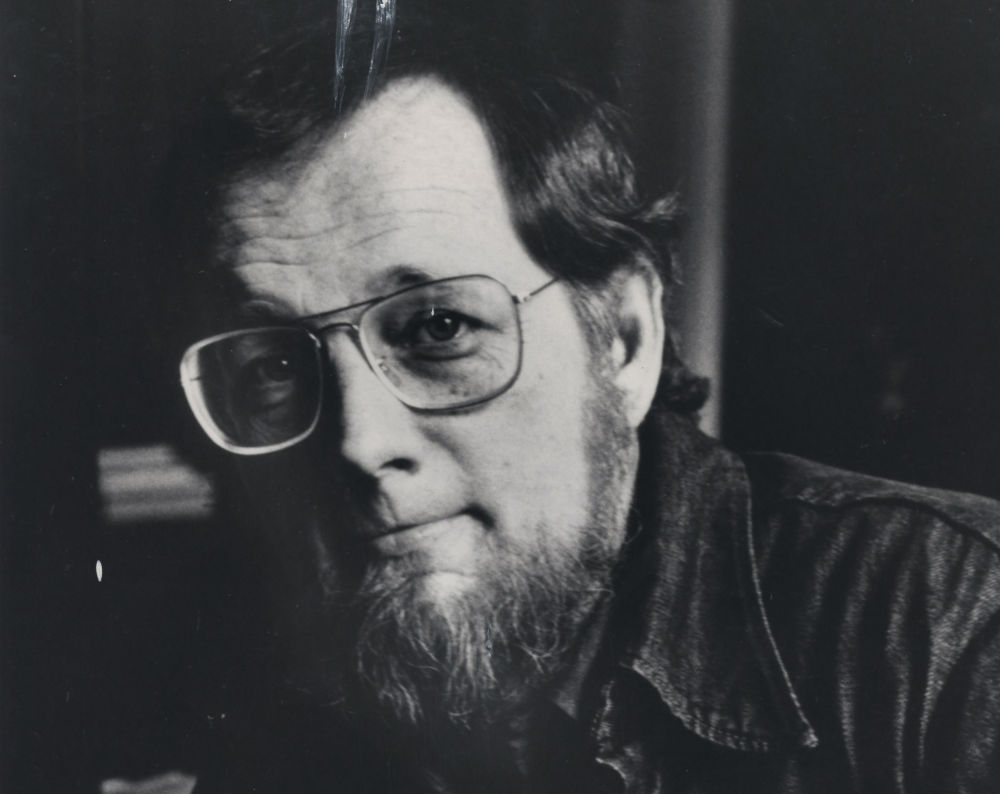 Donald Barthelme, Courtesy of Special Collections, University of Houston Library
Asked for his biography, Donald Barthelme said, “I don’t think it would sustain a person’s attention for a moment.” He was born, in Philadelphia, deep in the deep Depression (1931) and raised from it in Houston, Texas. There he endured a normal childhood, attended the University of Houston, studied philosophy under Maurice Natanson, and worked on a local newspaper. Then he was drafted, served in Korea, and returned to Houston, which he later left for New York City. There he did editorial work, especially for Location, and his odd short fictions made themselves known. Soon he became the most startling of the staid New Yorker’s regular contributors, and he still is.
He lives in New York City—“I move around quite happily. Alertly, but happily”—in a second-floor apartment in the West Village, cannily located between St. Vincent’s Hospital and a self-confessedly famous pizza parlor. The typical Barthelme interview is terse if not abrupt, but to this one he devoted large chunks of a weekend. He began at a dinner with fellow writer Ann Beattie and others, continued for two days in his spacious living room, and ended symmetrically at an elegant dinner prepared by his wife, Marion.
The talk was continuous and preferably about someone other than himself. He praised many favorite writers, including Kierkegaard, Dostoyevsky, Kleist, Kafka, Hemingway, S. J. Perelman, Frank O’Hara, John Ashbery, and Beckett. (“Beckett, I suppose, made it possible for me to write…”) He spoke enthusiastically of philosophers and psychologists, and of many contemporary writers. He refused the role of esoteric writer addressing a coterie audience. (“I assume that they’re kind of worn-down people like you and me… plain walking-around citizens.”) And like all sensible artists he fudged the conceptualization of his story writing. (“All the magic comes from the unconscious. If there is any magic.”)
The transcribed interview, with traffic noises, the clinking of glasses, and Marion Barthelme’s cheery voice still echoing in the background, was sent dutifully to the author. Many moons later and after much brooding and revision, the following dialogue emerged, cleansed of mere actuality and posing its figures in no landscape. The Platonic idea of an interview. But one may still intuit the old knobkerrie meditatively rubbed on the sleeve of the rumpled tweed jacket, the smoky setter asleep before the faithful fire… and now the writer’s ascetic features, framed in a square Danish Calvinist’s beard, soften benignly as the interviewer ventures his first academic question:
INTERVIEWER
You’re often linked with Barth, Pynchon, Vonnegut, and others of that ilk. Does this seem to you inhuman bondage or is there reason in it?
BARTHELME
They’re all people I admire. I wouldn’t say we were alike as parking tickets. Some years ago the Times was fond of dividing writers into teams; there was an implication that the Times wanted to see gladiatorial combat, or at least a soccer game. I was always pleased with the team I was assigned to.
INTERVIEWER
Who are the people with whom you have close personal links?
BARTHELME
Well, Grace Paley, who lives across the street, and Kirk and Faith Sale, who live in this building—we have a little block association. Roger Angell, who’s my editor at the New Yorker, Harrison Starr, who’s a film producer, and my family. In the last few years several close friends have died.
INTERVIEWER
How do you feel about literary biography? Do you think your own biography would clarify the stories and novels?
BARTHELME
Not a great deal. There’s not a strong autobiographical strain in my fiction. A few bits of fact here and there. The passage in the story “See the Moon?” where the narrator compares the advent of a new baby to somebody giving him a battleship to wash and care for was written the night before my daughter was born, a biographical fact that illuminates not very much. My grandmother and grandfather make an appearance in a piece I did not long ago. He was a lumber dealer in Galveston and also had a ranch on the Guadalupe River not too far from San Antonio, a wonderful place to ride and hunt, talk to the catfish and try to make the windmill run backward. There are a few minnows from the Guadalupe in that story, which mostly accompanies the title character through a rather depressing New York day. But when it appeared I immediately began getting calls from friends, some of whom I hadn’t heard from in some time and all of whom were offering Tylenol and bandages. The assumption was that identification of the author with the character was not only permissible but invited. This astonished me. One uses one’s depressions as one uses everything else, but what I was doing was writing a story. Merrily merrily merrily merrily.
Overall, very little autobiography, I think.
INTERVIEWER
Was your childhood shaped in any particular way?
BARTHELME
I think it was colored to some extent by the fact that my father was an architect of a particular kind—we were enveloped in modernism. The house we lived in, which he’d designed, was modern and the furniture was modern and the pictures were modern and the books were modern. He gave me, when I was fourteen or fifteen, a copy of Marcel Raymond’s From Baudelaire to Surrealism, I think he’d come across it in the Wittenborn catalogue. The introduction is by Harold Rosenberg, whom I met and worked with sixteen or seventeen years later, when we did the magazine Location here in New York.
My mother studied English and drama at the University of Pennsylvania, where my father studied architecture. She was a great influence in all sorts of ways, a wicked wit.
INTERVIEWER
Music is one of the few areas of human activity that escapes distortion in your writing. An odd comparison: music is for you what animals were for Céline.
BARTHELME
There were a lot of classical records in the house. Outside, what the radio yielded when I was growing up was mostly Bob Wills and his Texas Playboys; I heard him so much that I failed to appreciate him, failed to appreciate country music in general. Now I’m very fond of it. I was interested in jazz and we used to go to black clubs to hear people like Erskine Hawkins who were touring—us poor little pale little white boys were offered a generous sufferance, tucked away in a small space behind the bandstand with an enormous black cop posted at the door. In other places you could hear people like the pianist Peck Kelley, a truly legendary figure, or Lionel Hampton or once in a great while Louis Armstrong or Woody Herman. I was sort of drenched in all this. After a time a sort of crazed scholarship overtakes you and you can recite band rosters for 1935 as others can list baseball teams for the same year.
INTERVIEWER
What did you learn from this, if anything?
BARTHELME
Maybe something about making a statement, about placing emphases within a statement or introducing variations. You’d hear some of these guys take a tired old tune like “Who’s Sorry Now?” and do the most incredible things with it, make it beautiful, literally make it new. The interest and the drama were in the formal manipulation of the rather slight material. And they were heroic figures, you know, very romantic. Hokie Mokie in “The King of Jazz” comes out of all that.
INTERVIEWER
Are there writers to whose work you look forward?
BARTHELME
Many. Gass, Hawkes, Barth, Ashbery, Calvino, Ann Beattie—too many to remember. I liked Walker Percy’s new book The Second Coming enormously. The weight of knowledge is extraordinary, ranging from things like how the shocks on a Mercedes are constituted to how a nineteenth-century wood-burning stove is put together. When the hero’s doctors diagnosed wahnsinnige sehnsucht or “inappropriate longings” as what was wrong with him I nearly fell off my chair. That’s too beautiful to be real but with Percy it might be. Let’s see… Handke, Thomas Bernhard, Max Frisch, Márquez.
INTERVIEWER
Even Autumn of the Patriarch?
BARTHELME
After One Hundred Years of Solitude it was hard to imagine that he could do another book on that scale, but he did it. There were technical maneuvers in Autumn of the Patriarch—the business of the point of view changing within a given sentence, for instance—that I thought very effective, almost one hundred percent effective. It was his genius to stress the sorrows of the dictator, the angst of the monster. The challenge was his own previous book and I think he met it admirably.
It’s amazing the way previous work can animate new work, amazing and reassuring. Tom Hess used to say that the only adequate criticism of a work of art is another work of art. It may also be the case that any genuine work of art generates new work. I suspect that Márquez’s starting point was The Tin Drum, somehow, that Günter Grass gave him a point of departure… that the starting point for the essential Beckett was Bouvard and Pecuchet and that Bellow’s Henderson the Rain King is a fantasia on the theme of Hemingway in Africa. This is not the anxiety but the pleasure of influence.
INTERVIEWER
You don’t, then, believe in entropy?
BARTHELME
Entropy belongs to Pynchon. I read recently that somebody had come forward with evidence that the process is not irreversible. There is abroad a distinct feeling that everything’s getting worse; Christopher Lasch speaks of it, and so do many other people. I don’t think we have the sociological index that would allow us to measure this in any meaningful way, but the feeling is there as a cultural fact. I feel entropy—Kraus on backache is a favorite text around here.
INTERVIEWER
Do you see anything getting better—art, for instance?
BARTHELME
I don’t think you can talk about progress in art—movement, but not progress. You can speak of a point on a line for the purpose of locating things, but it’s a horizontal line, not a vertical one. Similarly the notion of an avant-garde is a bit off. The function of the advance guard in military terms is exactly that of the rear guard, to protect the main body, which translates as the status quo.
You can speak of political progress, social progress, of course—you may not see much of it, but it can be talked about.
INTERVIEWER
Well, you’ve established yourself as an old fogey.
BARTHELME
So be it.
INTERVIEWER
Your own influences—whom would you like to cite as your spiritual ancestors?
BARTHELME
They come in assorted pairs. Perelman and Hemingway. Kierkegaard and Sabatini. Kafka and Kleist. Kleist was clearly one of Kafka’s fathers. Rabelais and Zane Grey. The Dostoyevsky of Notes from Underground. A dozen Englishmen. The surrealists, both painters and poets. A great many film people, Buñuel in particular. It’s always a stew, isn’t it? Errol Flynn ought to be in there somewhere, and so should Big Sid Catlett, the drummer.
INTERVIEWER
Why Errol Flynn?
BARTHELME
Because he’s part of my memory of Sabatini, Sabatini fleshed out. He was in the film version of Captain Blood, and The Sea Hawk. He should have done Scaramouche but Stewart Granger did it instead, as I recall.
INTERVIEWER
You have a story called “Captain Blood.”
BARTHELME
A pastiche of Sabatini, not particularly of that book but all of Sabatini. You are reminded, I hope, of the pleasure Sabatini gives you or has given you. The piece is in no sense a parody, rather it’s very much an hommage. An attempt to present, or recall, the essence of Sabatini. Also it hopes to be an itself.
INTERVIEWER
What about the more awkward question of writers standing in your way?
BARTHELME
I think deep admirations force you away from the work admired, as well as having the generating influence we’ve mentioned. Joyce may have done this for Beckett, Márquez may do this for young Latin American writers—force them to do something that is not Márquez.
INTERVIEWER
But hasn’t everything been done?
BARTHELME
One can’t believe that because it’s not profitable. The situation of painting is instructive. Painters, especially American painters since the Second World War, have been much more troubled, beset by formal perplexity, than American writers. They’ve been a laboratory for everybody. Some new attitudes have emerged. What seems clear is that if you exacerbate a problem, make it worse, new solutions are generated. Ad Reinhardt is an example. Barnett Newman, proceeding by subtraction, or Frank Stella rushing in the other direction.
INTERVIEWER
Why this constant invocation of the word new?
BARTHELME
It equates with being able to feel something rather than with novelty per se, it’s a kind of shorthand for discovery. Probably a bad choice of words. Rosenberg’s The Tradition of the New deals precisely with the anomalies involved.
INTERVIEWER
Has this anything to do with your continuing attempt to reexamine or complicate your style or procedures?
BARTHELME
You isolate aspects of the process, look at them separately, worry about this and then worry about that. It’s like a sculptor suddenly deciding to use rust. Rust was not appreciated at its full value until rather recently. Roger Angell once asked me why I’d single-spaced a story I’d offered him and I told him that I was trying to keep myself interested.