Issue 199, Winter 2011
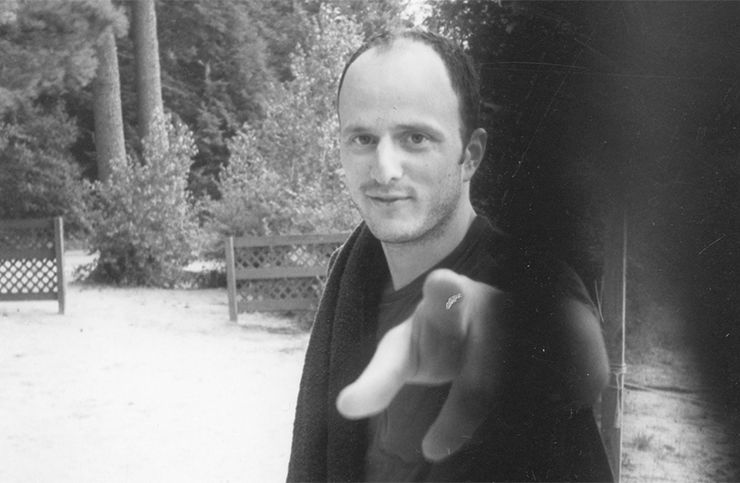 At the MacDowell Colony in 1994.
Born in Detroit in 1960, Jeffrey Eugenides lived through the city’s last glory years as the heart of the American auto industry. His first two novels, The Virgin Suicides (1993) and Middlesex (2002), are rooted in Detroit and the adjacent suburb of Grosse Pointe, where he spent much of his youth. These two settings—the once-proud, dying city and its affluent suburb, separate yet inextricably linked—are rendered as vividly as the characters in these two books. The Virgin Suicides takes place in Grosse Pointe (“our waterlocked spit of land French explorers had named the ‘Fat Tip’”). The story of five sisters and their gruesome deaths is told in the collective voice of their would-be suitors, now older but still haunted by the girls’ suicides.
Eugenides’s use of the first-person-plural voice in The Virgin Suicides was an audacious gambit; no less risky was his choice of an intersex person to narrate Middlesex. Raised a girl, Callie Stephanides decides, after a tumultuous puberty and several visits to a creepy specialist in Manhattan, to cross the divide of gender and live as a man. To understand who he is—socially, biologically, and genetically—the grown-up, male Cal not only revisits his childhood memories of the sixties and seventies but also reconstructs, as best he can (and at times fancifully), a family history that moves from the early twentieth century in a Turkish mountain village to Detroit during the boom years of the automotive age.
Middlesex received the Pulitzer Prize. In 2007, Oprah Winfrey chose it for her book club, making Eugenides a household name. By that time, he was deep into The Marriage Plot, a novel that looks back at his college years at Brown in the eighties, dramatizing the collision of radical French theory and the orthodoxies of New Criticism. The story of three bright, restless characters on the cusp of adulthood, The Marriage Plot is in some sense a novel of ideas, but ideas that matter only as they bear on the messy business of living.
Our interview was conducted over two sessions last August in Eugenides’s home in Princeton, New Jersey, where he lives with his wife and daughter. As we reviewed the transcripts, Eugenides began an extended book tour of the United States, Canada, and Europe. Questions were revisited by phone, and many answers were clarified, or rewritten, by hand on hotel stationery—evidently during moments of turbulence—as Eugenides flew between Los Angeles, San Francisco, Portland, Seattle, Chicago, and Toronto.
—James Gibbons
INTERVIEWER
This is a beautiful room. Do you write here?
EUGENIDES
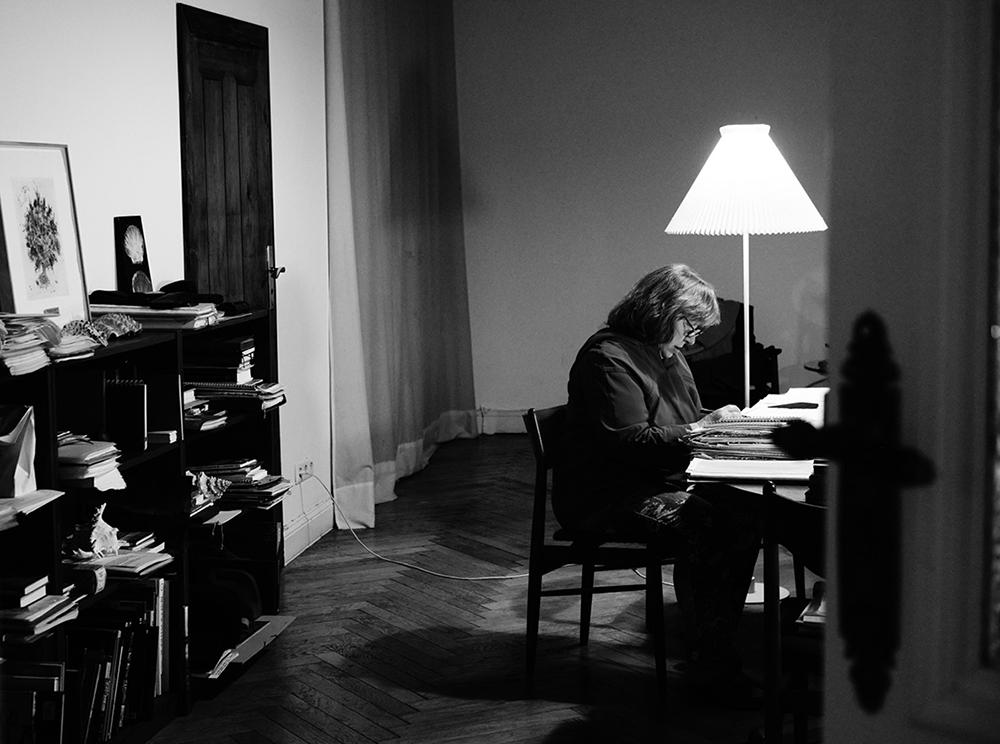
This is my summer office. It’s mostly glass and looks onto the garden. I thought it would be my dream studio, but actually the glass is distracting, so I end up using a dismal bedroom upstairs. Leonardo said that small rooms concentrate the mind. I find that I like working in small, cramped rooms with not much in them, as compared to a pretty studio. But I feel guilty about not using this room, so I come down here in the summer and try to do something useful. Thank you for giving me the opportunity to use my nice studio. Actual composition I don’t want to do in a pleasant space. I’m even thinking of moving up into the attic because it’s the most austere and removed place in the house.
INTERVIEWER
In the other places you’ve lived, have you done your work in similarly small rooms?
EUGENIDES
In college and in the apartments I lived in after college, I had just one room that was mine—my bedroom. So I’m used to working at a desk that’s not that far from the bed. I worked in the living room for part of Middlesex. Finally, when we moved to Berlin, we got a bigger apartment, and I worked in one of the extra bedrooms. Mainly I’ve written my books in bedrooms of apartments. This is the first house we’ve ever owned, so now I have an actual studio. I was almost fifty by the time I had one.
INTERVIEWER
Do you keep to a strict writing schedule?
EUGENIDES
I do. I try to write every day. I start around ten in the morning and write until dinnertime, most days. Sometimes it’s not productive, and there’s a lot of downtime. Sometimes I fall asleep in my chair, but I feel that if I’m in the room all day, something’s going to get done. I treat it like a desk job.
With The Marriage Plot, the last year or so, I started doing double sessions where I would work all day, have dinner, and then go back and work at night. I didn’t want to put myself through that, but I had so much to do and a lot of things were coming together, so I had to work long hours. I’d go to bed at midnight and wake up at seven or eight and start again.
INTERVIEWER
Do you have any special rituals, or is writing something you just have to hunker down and do?
EUGENIDES
Nothing out of the ordinary. The usual stimulants—coffee or tea. And at the end of a book, when I’m extremely exhausted, mentally fatigued, I sometimes sneak off into the yard and smoke a cigar, maybe six or seven times per book. That’s a bad habit I picked up when I lived in Berlin.
INTERVIEWER
Cal in Middlesex smokes cigars.
EUGENIDES
That’s why that got in there. Occasionally, instead of having a Red Bull, as a twenty-year-old might, I resort to the Thomas Mann method, the Maria Mancinis, but not very often. Cigars are the perfect literary drug. I understand why Mann, Freud, and so many durable people smoked cigars. It really focuses the mind. But I didn’t do it much with The Marriage Plot. I was in healthy, nonsmoking America and stayed mainly clean.
INTERVIEWER
Do you always write on the computer?
EUGENIDES
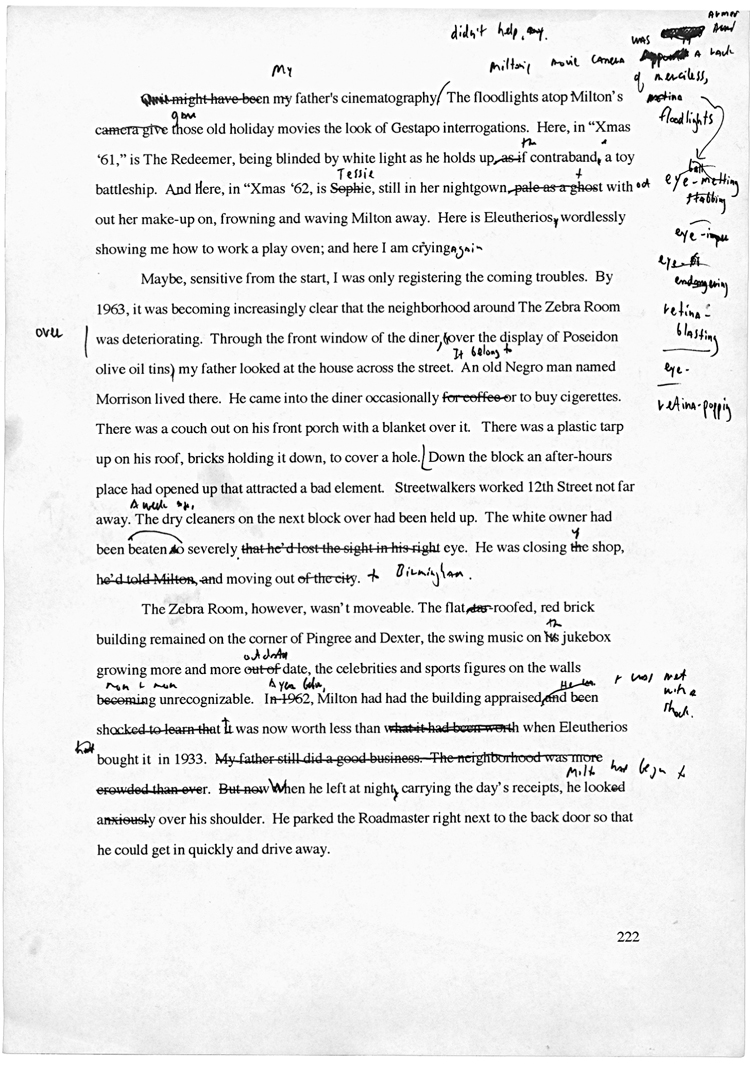
I compose on the computer. Now and then, I print out what I’m working on and make handwritten corrections. There’s usually a period where I make corrections by hand, turn the page over, and write new paragraphs on the back of the sheet. I used to do that almost every day. It seems I do that less and less often. Now I can go as long as a month before printing something out. But there are always handwritten corrections at some point.
INTERVIEWER
Do you rewrite your sentences over and over again or do they come out fairly finished in a first draft?
EUGENIDES
The Virgin Suicides was written in a slow, methodical fashion, sentence by sentence. Parts of my other books were written that way as well. There were small transitions in Middlesex, even though they were only three or four sentences long, where I had to spend a long time to get them to move. There are so many time shifts in the book, and it was difficult to give the right signposts so that the reader knew what was happening. I rewrite a lot. That’s why I don’t publish books very often. The fact that I’m working every day and publish so seldom shows that I’m reworking and rewriting a lot on the sentence level, and on the paragraph and structural levels, too.