Issue 182, Fall 2007
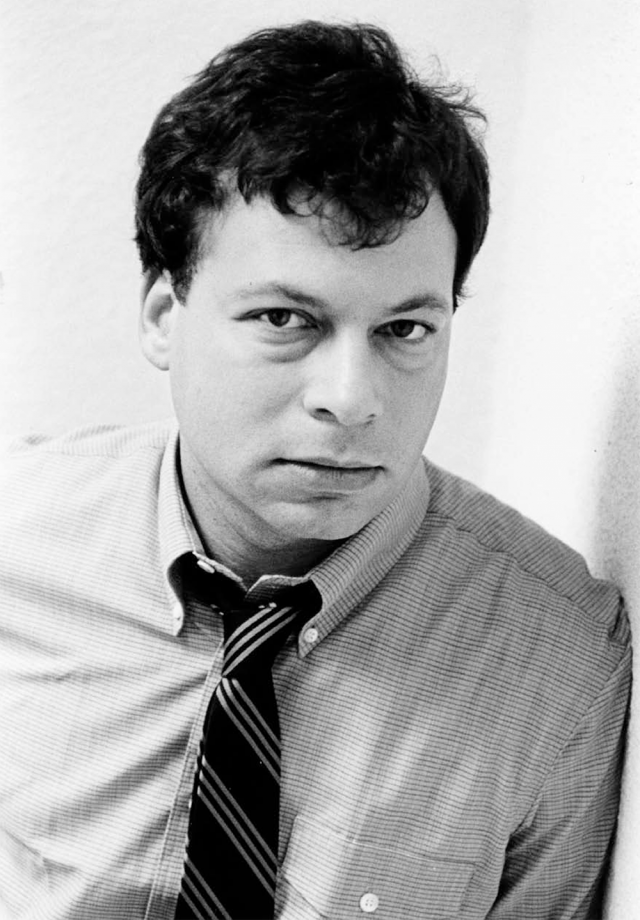 Kleinzahler in 1982.
August Kleinzahler found the title of his most recent poetry collection, The Strange Hours Travelers Keep (2003), in the opening lines of William Carlos Williams’s “January Morning”: “I have discovered that most of / the beauties of travel are due to / the strange hours we keep to see them.” Like Williams, Kleinzahler is a New Jersey native. He was born in Jersey City in 1949 and raised in Fort Lee, not far up the Palisades from Weehawken—where Williams saw “the domes of the Church / of the Paulist Fathers” on that January morning as he traveled by ferry to Manhattan for his hospital rounds. On a cold January morning this year I took the ferry in the other direction, landing in Weehawken, where Kleinzahler picked me up in his mother’s car for the drive to Fort Lee.
Although Kleinzahler has lived in San Francisco since 1981, he has maintained a strong connection to his home turf. As we drove, he described the recent shifts in ethnic geography, how Italians have been replaced by Asians and which neighborhoods have been gentrified. In his essay “East/West Variations,” Kleinzahler describes the character of north Jersey as “straightforward, plainspoken to the point of bluntness, though not at all unfriendly. The humor is deadpan, ironical, playfully deprecating. It’s a beer-and-a-bump kind of place. Affectation is quickly and viscerally registered.” The same could be said of Kleinzahler—a welterweight in his youth and now a middleweight—and he is proud of it. In 2005 he was named Fort Lee’s first poet laureate.
Two years ago The New York Times ran a profile of Kleinzahler under the headline “In Addition to His Pugnacity and Charm, He Can Write Poetry,” in which the newspaper named him a “poetry star.” This is not hyperbole. His sixth book, Earthquake Weather (1989), was a finalist for the National Book Critics Circle Award, and since then he has been awarded a Guggenheim Fellowship, an Academy Award in Literature from the American Academy of Arts and Letters, and the Griffin Poetry Prize. His recent books, including Red Sauce, Whiskey and Snow (1995), Green Sees Things in Waves (1998), and the essay collection Cutty, One Rock (2004), have earned him a large audience, drawn by his ability to modulate between high and low diction, often in the same poem, and by his wide-ranging fascinations, which include bebop, microbiology, Gustav Mahler, Ava Gardner, neurophysiology, and the Tartar hordes. Next year, Kleinzahler will publish his twelfth book of poetry, Sleeping It Off in Rapid City.
Kleinzahler’s ninety-year-old mother still lives in his childhood home, looked after by a woman who spends mornings with her. The rooms of the house are small and modestly furnished, though Indian, Chinese, and Southeast Asian sculpture—mostly bronze bodhisattvas—take up every available surface. These and the prints and paintings that cover the walls are what is left of a collection amassed by Kleinzahler’s father, a businessman who worked in commercial real estate who died a few years ago.
We sat beside each other on the living room couch, a digital recorder on the table in front of us. In answering my questions Kleinzahler “ahhed” and “uhummed,” his motor turning over before it caught, and then his answers came in bursts. The “playful deprecation” he identifies in the north Jersey character could be heard in his sly chuckle when he considered the follies of his youth.
We talked for more than two hours and then he walked me down the road to see the former home of the gangster Albert Anastasia of Murder Incorporated. From there we walked to the edge of the Palisades and looked across the Hudson to Manhattan. In his driveway he pointed out where he’d shot baskets as a boy, and behind the garage I saw the ghost of a strike zone used in stickball games. We ended our tour at Hiram’s, a locally famed hot-dog stand, where a photograph of Kleinzahler hangs on the wall.
INTERVIEWER
Do you think of yourself as unusual, not just for a poet but for an American, in that you can go home again?
AUGUST KLEINZAHLER
Yes—the older I get the more I’m aware of that. I considered this normal for many years, but I don’t feel as connected as I did twenty years ago when I came back with some frequency and house-sat for the folks during the eighties. This area is home to me—visually, and in the olfactory sense as well—in a way that San Francisco is not. It has always been stimulating for me to come back for extended periods of time even when being here wasn’t always terribly comfortable. There’s a sort of residual force field here that stretches me this way and that, like an astronaut going through the g-force. A number of people have pointed out to me that the poems I write on this side of the country are different in nature than the ones I write on the West Coast. They find them more intense, I think.
INTERVIEWER
The poems written here seem denser in detail: “Full of timber, Ford chassis, rock salt.” All the goods and material that move on interstates, rivers, by air, into and out of cities whose “markets never rest.”
KLEINZAHLER
Sounds like a digestive allusion. When I’m in Texas or Iowa I’m aware of the railroads and superhighways, and here there’s the city and the George Washington Bridge filled with its perpetual stream, the planes coming overhead, the cars moving along, the tremendous energy of the place, and its concentration of people. Nothing is still here. It’s very dynamic. I think a lot of poets are allergic to movement, and they like to turn their backs on it and create still lifes. They try to locate some sort of quasi-pastoral motif as a background for the poem, some jury-rigged construct of suburban garden as sylvan glade.
Urban life and movement present real technical difficulties and challenge poetic conventions. Urban life is dense and fast and requires flexible structures that can incorporate speed and information. It’s tough to come up with a coherent, interesting structure. Most simply avoid the problem or take refuge in some rote “avant-garde” gesture like fridge-magnet indeterminism, i.e. spilling the language all over the floor and stomping on it like a three-year-old child.
INTERVIEWER
When you were a child, did you pick up a lot from your family? Were you a “little pitcher with big ears”?
KLEINZAHLER
I was a tremendous Little League pitcher and very self-conscious about my ears, which I worried stuck out. I once struck out fourteen batters in a five-inning game for Hoffman Piano. That’s not what you meant, though, is it? At times I’m a good mimic. I remember sitting around the corner here on the stairs when my folks had parties and all their friends had drinks. I’d listen and run upstairs if anyone came around the corner. I still like watching and listening to people and picking up scraps.
INTERVIEWER
Is your bedroom here the same as it was back then?
KLEINZAHLER
Well, it’s still there. The bedroom furniture is much the same. The wallpaper is less narrative. On the wall now there’s a picture of the poet Basil Bunting taken when he was visiting San Francisco in the seventies and a poster from a Coach House reading I gave in the late seventies called “Revenge of Big Sonnet,” with all sorts of poets, including Ed Dorn. Those weren’t there when I was eight. The desk I got for my thirteenth birthday.
INTERVIEWER
Who was the teacher to whom you dedicated Cutty, One Rock? “For Mr. Wooster, who, with the help of his right shoe, taught me to diagram a sentence in 1962.”
KLEINZAHLER
Mr. Wooster was my seventh-grade English teacher. He kicked us in the shins mercilessly. He wore spongy shoes mostly, but we all checked to see what shoes he was wearing on any given day. Two aspects of that kind of old-fashioned education were important for me in becoming a writer. One was diagramming sentences, and the other was Latin class, though I was awful at it. These have been enormously useful to me. Having that solid background in grammar, sentence structure, and syntax made it easier later on for me to stretch out, play with the organization of language a bit, and still land on my feet. Or, at the very least, try.
INTERVIEWER
You dedicated Storm over Hackensack to your brother Harris, and in the title essay of Cutty, One Rock we learn that he took his own life. He seems to have had an enormous impact on you.
KLEINZAHLER
After his death in 1971, three days before my own twenty-second birthday, I became more determined to go my own way, with the poetry and in life, and to hell with the risks or anyone’s expectations. It made me a bit braver, I suspect, than I might ordinarily have been. In writing “Cutty, One Rock” I completely came unglued at several points. I’m glad no one was around to see it. It was pretty pitiful. He remains a sort of lodestar for me, encouraging my better, braver self. That last year for him was very intense, to use that unfortunately belabored word. I wouldn’t know how else to describe it.
INTERVIEWER
Intense in what way?
KLEINZAHLER
The last year of his life my brother’s world came apart. His gambling debts had gotten perilously steep, mob collectors were pressuring him, and he was in trouble with the law for a white-collar caper he’d gotten involved in. At the time I was very much a part of it and saw his lifestyle beating him down and taking its toll, physically and psychologically. Finally it was all too much for him and he bailed out, so to speak. I was devastated. My brother was very dear to me. I loved him utterly, in the way only a baby brother can. Everybody loved him: he was beautiful and reckless and fun and kind, full of mischief and a lovely poetic soul to go with it. Writing “Cutty,” I think I came to terms somewhat with just how much I adored him and missed him.