Issue 6, Summer 1954
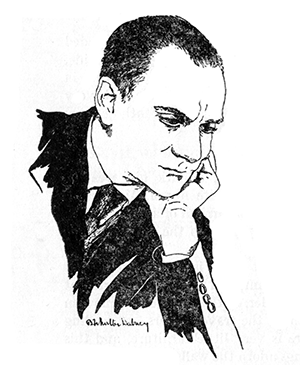 Alberto Moravia, 1954.
Via dell’Oca lies just off the Piazza del Popolo. A curiously shaped street, it opens out midway to form a largo, tapering at either end, in its brief, cobbled passage from the Lungotevere to a side of Santa Maria dei Miracoli. Its name, Street of the Goose, derives, like those of many streets in Rome, from the signboard of an eating house long forgotten.
On one side, extending unbroken from the Tiberside to Via Ripetta, sprawl the houses of working-class people: a line of narrow doorways with dark, dank little stairs, cramped windows, a string of tiny shops; the smells of candied fruit, repair shops, wines of the Castelli, engine exhaust; the cry of street urchins, the test-roar of a Guzzi, a caterwaul from a court.
On the opposite side the buildings are taller, vaguely out of place, informed with the serene imperiousness of unchipped cornices and balconies overspilling with potted vines, tended creepers: homes of the well-to-do. It is here, on this side, that Alberto Moravia lives, in the only modern structure in the neighborhood, the building jutting like a jade and ivory dike into the surrounding red-gold.
The door is opened by the maid, a dark girl wearing the conventional black dress and white apron. Moravia is behind her in the entry, checking the arrival of a case of wine. He turns. The interviewer may go into the parlor. He’ll be in directly.
Moravia’s living room, at first sight, is disappointing. It has the elegant, formal anonymity of a Parioli apartment rented by a film actor, but smaller; or that of a reception room at the Swiss Legation, without the travel folders—or reading matter of any sort. There is very little furniture, and this is eighteenth century. Four paintings adorn the walls: two Guttusos, a Martinelli, and, over a wide blue sofa, a Toti Scialoja. At either end of the sofa, an armchair; bracketed between the chairs and sofa, a long low Venetian coffee table inlaid with antique designs of the constellations and signs of the zodiac. The powder blue and old rose of the table are repeated in the colors of the Persian rug beneath. A record cabinet stands against the opposite wall; it contains Bach, Scarlatti, Beethoven’s Ninth and some early quartets, Stravinsky, Prokofiev, Monteverdi’s Orfeo. The impersonality of the room seems almost calculated. Only the view from the windows recalls the approaching spring; flowers blossom on roof-terraces, the city is warm, red in the westering sun. Suddenly Moravia enters. He is tall, elegant, severe; the geometry of his face, its reflections, are cold, almost metallic; his voice is low, also metallic—one thinks, in each case, of gunmetal. One detects a trace of unease, shyness perhaps, in his manner, but he is at home in his parlor; he settles comfortably on the sofa and crosses his legs.
INTERVIEWER
May we start at the beginning?
ALBERTO MORAVIA
At the beginning?
INTERVIEWER
You were born . . .
MORAVIA
Oh. I was born here. I was born in Rome on the twenty-eighth of November, 1907.
INTERVIEWER
And your education?
MORAVIA
My education, my formal education that is, is practically nil. I have a grammar-school diploma, no more. Just nine years of schooling. I had to drop out because of tuberculosis of the bone. I spent, altogether, five years in bed with it, between the ages of nine and seventeen—till 1924.
INTERVIEWER
Then “Inverno di malato” must refer to those years. One understands how—
MORAVIA
You aren’t suggesting that I’m Girolamo, are you?
INTERVIEWER
Well, yes . . . .
MORAVIA
I’m not. Let me say—
INTERVIEWER
It’s the same disease.
MORAVIA
Let me say here and now that I do not appear in any of my works.
INTERVIEWER
Maybe we can return to this a little later.
MORAVIA
Yes. But I want it quite clearly understood: my works are not autobiographical in the usual meaning of the word. Perhaps I can put it this way: whatever is autobiographical is so in only a very indirect manner, in a very general way. I am related to Girolamo, but I am not Girolamo. I do not take, and have never taken, either action or characters directly from life. Events may suggest events to be used in a work later; similarly, persons may suggest future characters; but suggest is the word to remember. One writes about what one knows. For instance, I can’t say I know America, though I’ve visited there. I couldn’t write about it. Yes, one uses what one knows, but autobiography means something else. I should never be able to write a real autobiography; I always end by falsifying and fictionalizing—I’m a liar, in fact. That means I’m a novelist, after all. I write about what I know.