Issue 65, Spring 1976
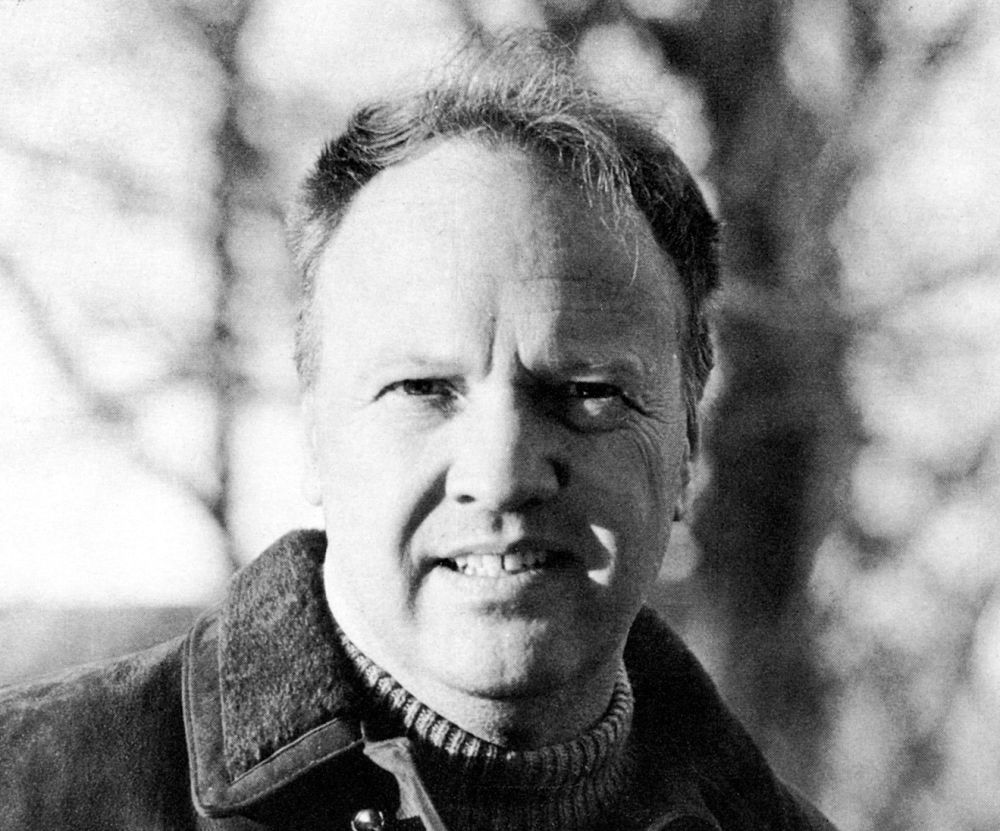 Photograph by Christopher Dicky
In 1960, when he was thirty-seven—an age at which most men have abandoned pretenses at having creative gifts—James Dickey published his first book of poetry, Into the Stone, a Scribner’s Poets of Today volume that he shared with two other unknown poets, Paris Leary and Jon Swan. In the years since, Dickey has become one of the most powerful voices in American poetry. His many books include Drowning with Others (1962), Helmets (1964), Buckdancer’s Choice (1965), for which he won the National Book Award, Poems 1957-67 (1967), The Eye-Beater’s (1970), and Sorties (1971). In 1966 he served as Poetry Consultant for the Library of Congress.
But, ironically, it was fiction, not poetry, that made Dickey’s name a household word. After toying with Deliverance for nearly ten years, he finished it in a great thrust of energy in 1969. By the middle of 1970, Deliverance was on top of the nation’s best-seller lists. He later wrote the screenplay for the popular motion picture.
Those who knew Dickey closely, however, were aware that Deliverance, while a publishing phenomenon, was not the center of his creative objective. He once remarked to a student, “‘The Eye-Beaters’ is worth a hundred Deliverances.”
This interview took place in Dickey’s Lake Katherine home in Columbia, South Carolina, where he is serving as Poet-in-Residence for the University of South Carolina. It was recorded in three sessions (two in May 1972 and one in May 1974) in his huge den with an inch-thick gray carpet and an appropriate wall of books. Dickey, a large, bearish man, has a voice to match. Throughout the tapings he poised on his chair’s edge, sucking air through his teeth in anger at incompetent poets, and often shaking with laughter at good one-liners. On the first day he wore a pink shirt with French cuffs; the next sessions found him garbed in jackets and pants of leather or suede. After each day’s taping, Dickey played the guitar, took his interviewer canoeing, or demonstrated his skill with the bow and arrow. He is adroit with all three, perhaps excelling on the six-string. He has contributed numerous guitar tapes to the Library of Congress in addition to providing some of the music for Deliverance.
This fall, his long poem, The Zodiac, will be published, followed by his second novel, Alnilam.
INTERVIEWER
You have said you got where you are today, an established poet and novelist, “the hardest way possible, unsolicited manuscripts.” Can you tell us about it?
DICKEY
It was very difficult to do; I didn’t have any precedent; I didn’t know any writers, editors, publishers, or agents. They might have been in the outer part of the solar system as far as I was concerned. I just knew that I liked to write and I had some ideas that I thought might work out as poems. So I wrote them, then sent them around. As they say, I could have papered my bedroom wall with the rejections.
I began to send stuff out when I was at Vanderbilt, and the only way that I knew where to send anything was to go into the stacks of the library and get a magazine out that I admired, like the Sewanee Review, and get the address off the masthead and send the poem to the guy who was the editor at that address. I sent poems in and I kept getting back these form rejections. In 1948 or 1949 I remember with what wonder I saw true human handwriting on the rejection slip. It said, “Not bad.”
INTERVIEWER
What made you decide to commit yourself to writing?
DICKEY
Like most American writers I kind of backed into it. I liked poetry; I liked to read it. I’m the kind of person who can’t be interested in a thing without wanting to see if I can’t get out there and do a little of it myself. If I see somebody shooting arrows, I want to get a bow and see if I can shoot some myself.
INTERVIEWER
Did the legendary Vanderbilt crowd have much effect on you?
DICKEY
There is no sense in which it could be said that I was a latter-day Fugitive or Agrarian. But Donald Davidson was my teacher, and he’s the single best teacher that I’ve ever had with the possible exception of Monroe Spears. He made poetry and intellectual life important; all you had to do was walk into his classroom and you knew you were in the presence of some important spirit. I got interested in anthropology, astronomy, the kind of thing that Donald Davidson stood for. But the whole Vanderbilt ethos and Agrarianism and cultural pluralism were just academic subjects to me. I’m much more interested in them now than when I was in the milieu that produced them.
INTERVIEWER
What did you do when you graduated?
DICKEY
I took an M.A. in 1950 and became an instructor in technical English and report writing at what was then called Rice Institute in Houston, Texas, but almost immediately after my appointment I went off to the Korean War.
INTERVIEWER
When did you get into the advertising business?
DICKEY
A few years after the war—1956, and I stayed in it until 1961. I worked with three different agencies—first I was with McCann-Erickson, on the Coca-Cola account, where I was known not as Jungle Jim, but as Jingle Jim. I then moved to Atlanta and worked with an agency called Liller Neal and Battle, where I worked on fertilizer accounts, mainly. Also banks and Pimento products. I then took a position as creative director and vice president of an Atlanta agency called Burke Dowling Adams, where I engineered the advertising campaign dealing with the awarding of the transcontinental run by Delta to the West Coast. Now, in connection with my film work, I fly that airline all the time.
INTERVIEWER
How important was your work to you? Do you regret leaving it?
DICKEY
No. I’m glad I left it. But if I had four or five different lives, or the proverbial nine lives, I would like to spend one of them in business. It’s a fascinating and exciting way to live. It’s very frustrating; it’s got its hang-ups; it’s a man-killing pace; and it’s tremendously difficult. But I love business people and I met some really terrific people whom otherwise I wouldn’t have known. I wouldn’t have had any relationship to them unless that were the relationship: making deals, working with them on their problems, and selling their products. I enjoyed it. There’s something about the nine-to-five existence and the five-thirty cocktails after work on Friday afternoons and talking over the problems of the week with your buddies who are working on the same problems that’s really kind of nice. I remember it with affection and with a certain amount of gratitude. Nevertheless, I don’t have that many lives. I have only one, so when it was time for me to leave, I left.
INTERVIEWER
What were you writing during your business period?
DICKEY
I wrote my whole first book, Into the Stone, on company time. I had a typewriter and I had a bunch of ads stacked up in those famous brown envelopes with work orders on them. When I had a minute or two, I’d throw a poem into the typewriter and try to work out a line or get a transition from one stanza to the next. But the business world gives you almost no time to do anything but business. You are selling your soul to the devil all day and trying to buy it back at night. This can work out fine for a while, but after that the tensions and the difficulties begin to mount up and you see that you are going to have to make a choice. This took place with me after about five-and-a-half or six years.
INTERVIEWER
What made you decide to make your final commitment to writing, to say, “This is it, I am leaving”?
DICKEY
Age. I knew I couldn’t have it both ways much longer, and as they say in the pro football games or basketball games on Sunday afternoons, “The clock is running.” I didn’t have that much time. I needed a lot more time to do my work and not their work. And there is also the feeling of spending your substance, your vital substance, on something that is really not that important—of giving the best of yourself, every day, to selling soda pop. You just don’t want to let yourself go that easily. You can’t. Or I couldn’t, anyway.
INTERVIEWER
Do you think in some ways it is a commitment to a kind of artificial moral order?
DICKEY
Well, if you work for the Coca-Cola Company, the first thing you’re told is how many people’s jobs and lives depend on the drink and how old and venerable and honorable the company is, that the pension plans are good, the medical plans are good, and so on. But after all, it’s only soda pop, and you’re quite sure in the end that you don’t want to spend your vital substance on something that’s not any more important than a soft drink. If you go with the Coca-Cola Company, Pepsi-Cola, R.C., or any of them, you enlist yourself in a war that was going on before you were born, and will go on after you die. It’s a little bit—I hate to drag this in—like Vietnam. You fight limited engagements in limited areas and nobody ever wins.
INTERVIEWER
After Into the Stone, came out, did you think that you were going to succeed as a poet?
DICKEY
I didn’t know then, and I still don’t know. The Guggenheim people wrote to me and asked me if I would like to stand for a fellowship and to send in whatever I had to offer. I was in one of those Scribner three-decker-large-economy-size-packages of young poets with Paris Leary and Jon Swan, and I sent them that, and presto, lo and behold, they gave me some money—several thousand dollars. I said to Maxine, “This is our escape hatch. Let’s sell the house and go and live in Italy. Why the hell not? When are we ever going to get another chance?” I swore I was going to go back to Europe before I was forty. I made it at the age of thirty-nine.
INTERVIEWER
What sort of effect did Europe have on you and your writing?
DICKEY
Italy was especially good. First of all, there was what Davidson used to talk about all the time, cultural pluralism: different wines, different dishes, different paintings, different life-styles, all kinds of different things which gives such richness and variety to life. What we’ll end up with if the world gets increasingly Americanized is life in a gigantic Rexall’s. Of course, you can go into Rexall’s and get a lot of things you need. You can also get a lot of things you don’t need, but might be interested in having. There are a lot of diversified products in Rexall’s. But Rexall’s is Rexall’s. It’s not the same as going to a bull fight or going to a folk dance in Sicily or going into the Uffizi Museum in Florence.
When an American goes to Europe, he doesn’t go there to get just another version of America. He wants difference. You see fields of tulips in Holland. You never saw anything like that in your life. You see cliffs down on the Amalfi Drive, you see people in an Italian village. The guys having a drink together: Why, by God, they fall into each other’s arms—and they just saw each other last night; they were probably drunk together last night. You don’t see Americans do that. Americans are pushing each other away all the time, even the men and women.
INTERVIEWER
Would you advise a young writer to go abroad for a while?
DICKEY
Yes. I believe that a broad scan of experience can be nothing but beneficial to a young writer. It may be confusing at the beginning, but the increment of his personal memory-bank can be only for the best. To cite but one example, look at Hemingway’s experience of Paris. Take others: Henry James’ experience of London, J.B. Priestley’s sojourn in Arizona, and Stephen Crane’s in Cuba. You name it.
INTERVIEWER
What other advice would you give?
DICKEY
I don’t know. The talent game is a tough game. Luck plays an enormous part in it. It’s not like business, though luck has a very strong place in business too. You can write one good poem by luck or hazard that’s going to make people want your work. Whether or not you can produce anything good later on is not the important thing. It’s that you struck it right then. It’s the same with a novel—I wrote Deliverance. The movies bought it; it was serialized, written into a dozen languages; it’s the best novel I can write, but there’s also an enormous element of luck in it. I wrote the right book at the right time. People were caught up in a savage fable of decent men fighting for their lives and killing and getting away with it. My next novel could be a failure.
INTERVIEWER
How can a young poet know if his work is really worthwhile?
DICKEY
You never know that. I don’t know it; Robert Lowell doesn’t know it; John Berryman didn’t know it, and Shakespeare probably didn’t know it. There’s never any final certainty about what you do. Your opinion of your own work fluctuates wildly. Under the right circumstances you can pick up something that you’ve written and approve of it; you’ll think it’s good and that nobody could have done exactly the same thing. Under different circumstances, you’ll look at exactly the same poem and say, “My Lord, isn’t that boring.” The most important thing is to be excited about what you are doing and to be working on something that you think will be the greatest thing that ever was. One of the difficulties in writing poetry is to maintain your sense of excitement and discovery about what you write. American literature is full of people who started off excited about poetry and their own contribution to it and their own relationship to poetry and have had, say, a modicum of success and have just gone on writing poetry as a kind of tic, a sort of reflex, when they’ve lost all their original excitement and enthusiasm for what they do. They do it because they have learned to do it, and that’s what they do. You have to find private strategems to keep up your original enthusiasm, no matter what it takes. As you get older, that’s tougher and tougher to do. You want to try to avoid, if you possibly can, the feeling of doing it simply because you can do it.
INTERVIEWER
What are some of these private strategems?
DICKEY
A very great deal of exercise, to keep the body moving, because when the body moves the mind is inclined to move with it. At times, a certain amount of alcohol helps. The point is to get to a certain level at which the creative flow can best take place. Any means to effect this end is to the good.
INTERVIEWER
How do ideas for poems come to you?
DICKEY
Well, I can give you one example, of course there are many. But, I remember when I was in Okinawa and the war was over and we went out to one of the invasion beaches near Buckner Bay, me and my co-fliers, and we went swimming and there was an old amtrack there in ten feet of water that the Japanese had stove in—big holes in the sides of it—and I swam down and sat in the driver’s seat. That image stayed with me and years later, twenty or twenty-five years later, I wrote “The Driver.”
INTERVIEWER
You also write about things that an ordinary person would pass by, like the jump of a fish, or the movement of trees, or light.
DICKEY
That could almost be cited as the definition of a poet: Someone who notices and is enormously taken by things that somebody else would walk by. The major thing for a writer to do is develop some means of selecting the best of his memories and ideas and images and to build on them and reluctantly let the others go.
INTERVIEWER
Can you describe the genesis and working out of a poem based on an image that most people would pass by? “Dust” for example?
DICKEY
“Dust” was a collusion between or among two or three different kinds of elements. I wanted to try to utilize a stanza form with a short first line, evolving into longer lines, and at the end coming back to a short line. This is purely a technical problem. The second element was literary: I wanted to work with the Biblical statement, “But dust thou art, to dust returneth.” The third element that was important was the sense of lying about half drunk in a California afternoon and looking up through the sunlight shining through the window and really noticing—as one will do when one is about half drunk—these strange little things in the air. They are always spiral-shaped and it seemed to me that this might have something to do with venereal disease, with the spirochete and so on. So that was the fourth element. I tried to get all of them together in one poem.
INTERVIEWER
You speak of technical elements. How do you feel about free verse?
DICKEY
I go back and forth. Sometimes I like to write in very strictly measured forms. I think there are tremendous advantages accruing to that. But then I also want to try to open out the poem and make what I have recently been calling the “balanced poem,” and make gaps within the lines and write in bursts of words. You shouldn’t restrict yourself… what Ivor Winters did, and say that it’s got to be this way or it’s no good at all. You should experiment. You should wander around a bit; you should risk being wrong. Actually, free verse is not a term that I myself care much for. I would call it unrhymed, irregular verse, because I remember what Mr. Eliot said, "No verse is free for the poet that wants to do a good job," and it really isn’t free. What you are talking about is that you are not writing a rhyming or a regular verse, but more of an open, organic form.
INTERVIEWER
Does form ever control your subject matter?
DICKEY
I used to be much interested in inventing forms, for example, the form in “The Hill Below the Lighthouse” dictated the subject matter. What I did was to work out a refrain scheme—I call it a returning rhyme—so that each stanza had an end line which was italicized. And the end stanza of the poem—the sixth or seventh, I forget which—was made up of the refrained lines themselves.
INTERVIEWER
Do you show your poems in a working stage to anyone else?
DICKEY
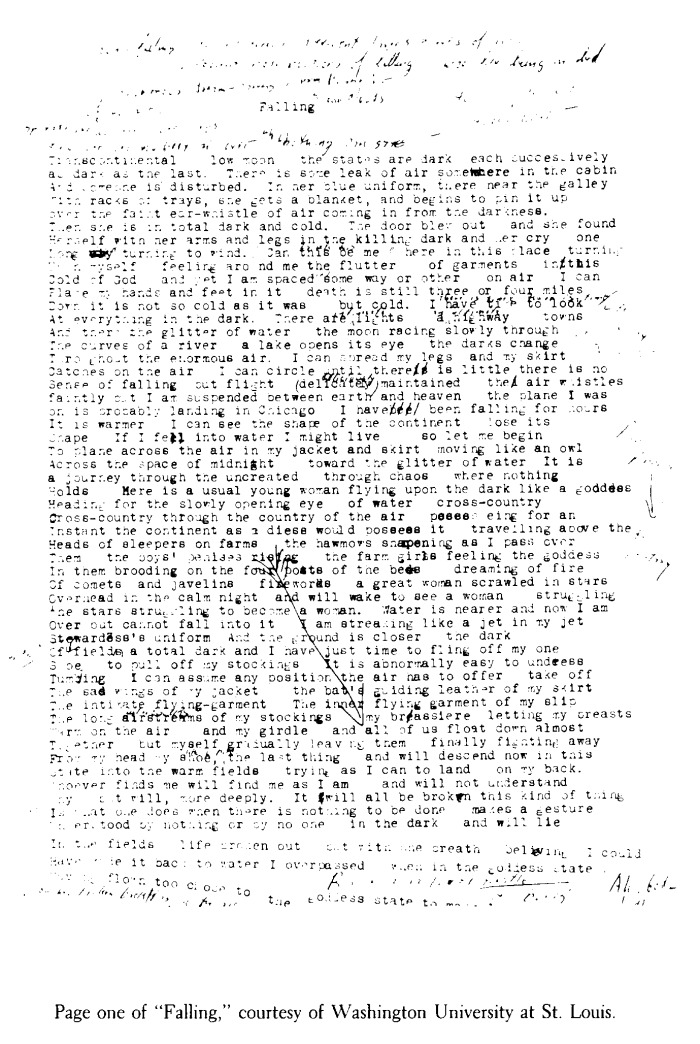
It depends. There are some things that I show to certain selected people if I think the words have reached the stage where their future development might prove good. But generally I keep the successive drafts of a poem to myself, because I conceive the poetic process as quite a private matter between the poet, his hand, and the blazing white island of paper which he is trying to populate or eliminate.