Issue 102, Spring 1987
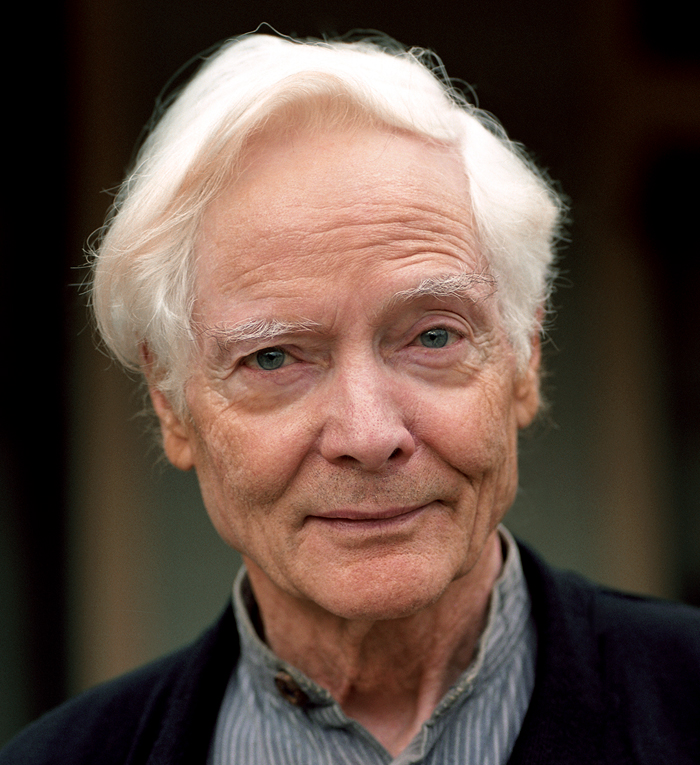
Photo by Matt Valentine
I went to visit W. S. Merwin at his home in Ha’iku, Hawaii, on the northeast coast of Maui, in mid-June, 1986. The Merwins (William, his wife Paula, and their chow puppy Maoli) live towards the end of a winding, rocky dirt road that deadends at a cliff overhanging the Pacific. They have three acres of land that Merwin has planted—in red volcanic clay ruined by fly-by-night pineapple farming fifty years ago. He and Paula tend it now like concerned parents whose growing children were once sickly—healthy at present but needing constant attention. Because of his efforts, the grounds are richly alive with native vegetation: huge mango, banana, and papaya trees, looming palms whose leaves have been splayed by the hard winds, flowering pink, yellow, and red hibiscus, white gardenia plants, giant red heliconias that look as if carved from wax, white birds-of-paradise, ferns of all kinds. There is a large vegetable garden and a small enclave of native plants—some of them endangered Hawaiian species—which Merwin keeps in plastic pots protected by a roof of palm fronds and chicken wire.
The house, which Merwin designed himself, is sided in Eucalyptus robusta. It has high ceilings, dark eucalyptus floors, sliding glass windows and doors. It is surrounded by deeply recessed lanais, which are filled with potted plants and bird feeders. Always one is aware of the vista of the Pacific in the distance.
The furniture in the house is mostly country French (an old armoire, a heavy wooden dining-room table), a reminder of Merwin’s many years in rural France. There are wooden bookcases crammed with books in almost every room. The books themselves are varied and wide-ranging, though they also demonstrate Merwin’s concentrated interests in Zen Buddhism, in ecology (I counted six copies of America the Poisoned—five “to give away”), botany, gardening, agriculture, history—in the life of Native American and other tribal societies, and in Hawaii itself. All in all, the house and its surrounding property create the feeling of a wholly encompassing and engrossing world.
William Stanley Merwin was born in New York City in 1927 and grew up in Union City, New Jersey, and in Scranton, Pennsylvania. He has published twelve books of poetry to date: A Mask for Janus (1952), The Dancing Bears (1954), Green with Beasts (1956), The Drunk in the Furnace (1960), The Moving Target (1963), The Lice (1967), The Carrier of Ladders (1970), for which he was awarded the Pulitzer Prize, Writings to an Unfinished Accompaniment (1973), The Compass Flower (1977), Finding the Islands (1982), Opening the Hand (1983), and The Rain in The Trees (1987). He is well known for his work as a translator and has published at least fifteen books of poetry in translation, including Selected Translations, 1948–1968 (1969), for which he won a PEN Translation Prize, and Selected Translations, 1968–1978 (1979). He has also published four books of prose: The Miner’s Pale Children (1970), Houses and Travellers (1977), Unframed Originals (1982), and Regions of Memory: Uncollected Prose, 1949–1982 (1986). He is currently finishing three new manuscripts: a new book of poems which Atheneum will publish, a volume of translations from the Argentine poet Roberto Juarroz, and another, done in collaboration with Soiku Shigematsu, of translations from the medieval Japanese Zen master and garden designer Muso Soseki, both of which North Point Press plans to publish. And for the past few years he has been working on several long essays on Hawaiian history and its bearing on the present. Merwin has lived in many places over the years—Spain, England, France, and Mexico as well as in New York City—but he has now settled, it seems permanently, in Hawaii.
Our interview took place on consecutive June days in Merwin’s study. Both times we met in the late afternoon at an hour he usually reserves for working in the garden. The light on both afternoons was radiantly bright—the ocean sparkled in the background. On both days Merwin was barefoot (in Hawaiian houses it is polite to leave your shoes at the door) and wore khaki shorts and a T-shirt—his usual dress at home. Moderately tall, he has curly graying hair, intensely clear eyes, and at fifty-nine he still looks remarkably boyish and handsome—the poet incarnate.
INTERVIEWER
In the past thirty-four years, you have published twelve books of poetry, three books of prose, and at least fifteen books in translation. Yet you said recently that “writing is something I know little about.” How is that possible?
W.S. MERWIN
The kind of writing that matters most to me is something you don’t learn about. It’s constantly coming out of what I don’t know rather than what I do know. I find it as I go. In a sense, much that is learned is bound to be bad habits. You’re always beginning again.
INTERVIEWER
Do you write every day? Ezra Pound once advised you to write seventy-five lines a day. Have you followed his advice?
MERWIN
I haven’t written seventy-five lines a day, but for years I’ve tried to stare at a piece of paper for a while every day. It tends to turn one into a kind of monster.
INTERVIEWER
How’s that?
MERWIN
You have to be rather relentless about pushing other things out of the way. This activity of writing, which has no promises attached to it, comes to be given a kind of arbitrary but persistent importance.
INTERVIEWER
Would you say something about the hymns you used to write for your father? Were those your first poems?
MERWIN
I suppose they were. I was about five years old when I wrote them. I wrote them on my own, and I was very disappointed that they weren’t used in church.
INTERVIEWER
You have a highly developed ecological and environmental consciousness. When did it start?
MERWIN
I’ve tried repeatedly to figure out just when and how it began. It’s probably impossible to say. Such dispositions come long before most decisions, I think. But there are two things I remember. First, I had a rather repressed childhood. I was brought up never to say no to anybody, never to say I didn’t like something, never to talk back. But one day—I must have been around the age of three—two men came and started cutting the limbs off the one tree in the backyard, and I simply lost my temper and ran out and started beating them. Everybody was so impressed with this outburst of real rage that my father never even punished me. And the second thing: I was so fascinated by these watercolors in a book about Indians that I began teaching myself to read the captions. The Indians seemed to be living in a place and in a way that was of immense importance to me. So I associate learning to read—English, oddly enough—with wanting to know about Indians. I’m still growing into it. I’ve never outgrown that. The Indians represented to me a wider and more cohesive world than the one I saw around me that everyone took for granted. I grew up within sight of New York City, and whenever I was asked what I really wanted to do, I would say I wanted to go to the country. I’d been taken out and had seen the country when I was very small and that was what I always wanted to go back to. I’m not sure of the exact origin, but I do know that it goes back a very long way. Feeling that way about “the country” has made me ask questions that I suppose are strange to many of my contemporaries, but they seem to get less and less eccentric as our plight as a species grows more and more desperate, and we behave accordingly. As a child, I used to have a secret dread—and a recurring nightmare—of the whole world becoming city, being covered with cement and buildings and streets. No more country. No more woods. It doesn’t seem so remote, though I don’t believe such a world could survive, and I certainly would not want to live in it.
INTERVIEWER
Your father was a Presbyterian minister. Do you think you inherited from him a Presbyterian urge to improve the world?
MERWIN
I don’t think it was an urge to improve the world. It was an urge to love and revere something in the world that seemed to me more beautiful and rare and magnificent than I could say, and at the time in danger of being ignored and destroyed. I think I felt that as a very small child. Though how much of it I owe to my father or his family, I can’t say. The world around me did not seem to me to be satisfactory. There was something incomplete about the world of streets and sidewalks and cement—and I did have a very strong sense of growing plants and trees and so forth, and still do. I remember walking in the streets of New York and New Jersey and telling myself, as a kind of reassurance, that the ground was really under there. I’ve talked and tried to write about that, but I feel that I haven’t even begun to say it. But that hunger, that tropism, is something that I don’t believe we can live without, even if we aren’t aware of what we’re missing and by now many of us aren’t aware of it. We’re missing it just the same. We’re deprived of something essential.
INTERVIEWER
Is it some profound connection to the natural world?
MERWIN
The connection is there—our blood is connected with the sea. It’s the recognition of that connection. It’s the sense that we are absolutely, intimately connected with every living thing. We don’t have to be sentimental and pious about it, but we can’t turn our backs on that fact and survive. When we destroy the so-called natural world around us we’re simply destroying ourselves. And I think it’s irreversible.
INTERVIEWER
Do you see a connection between poetry and prayer?
MERWIN
I guess the simple answer is yes, if only because I think of poetry as an attempt to use language as completely as possible. And if you want to do that, obviously you’re not concerned with language as decoration, or language as amusement, although you certainly want language to be pleasurable. Pleasure is part of the completeness. I think of poetry as having to do with the completeness of life, and the completeness of relation with one’s experience, completing one’s experience, articulating it, making sense of it.
INTERVIEWER
How about the influence of Zen in your work?
MERWIN
When you talk about prayer in Judeo-Christian terms, prayer is usually construed as a kind of dualistic act. You’re praying to somebody else for something. Prayer in the Western sense is usually construed as making a connection. I don’t think that connection has to be made; it’s already there. Poetry probably has to do with the recognizing of that connection, rather than trying to create something that isn’t there.